Starch in scrambled eggs sounds unusual until you see what it is doing. Dispersed in cold water before it reaches the pan, a small amount of starch thickens as the eggs cook and helps manage free moisture. That gives the cook a slightly wider margin between tender curds and dry, rubbery eggs.
It does not make eggs impossible to overcook, and it cannot promise perfect results in 15 seconds. The pan, batch size, burner, and movement of the spatula still matter. This guide offers a restrained base ratio, explains the starch choices, and uses visual cues that travel better from one kitchen to another than a stopwatch.
🥚 The method at a glance
- Starting ratio: for every two eggs, use about 3 grams of starch, 10 milliliters of cold water, and 7 grams of butter.
- Mix the slurry first: dry starch tends to form stubborn lumps when added directly to beaten eggs.
- Potato starch is the easiest starting point: it thickens quickly and works well in a small amount.
- Watch the eggs, not only the clock: a thin skillet and a heavy skillet can produce different times on the same burner setting.
- Starch changes texture, not food-safety rules: finished scrambled eggs should not contain separate raw liquid.
Where the starch-slurry technique came from
In 2015, Lady & Pups author Mandy Lee published a fast scrambled-egg recipe built around milk, potato starch, and a generous amount of butter. J. Kenji López-Alt later adapted the approach for NYT Cooking, helping it reach a much wider English-language audience.
It is therefore more accurate to describe this as Mandy Lee's technique, later popularized by other food writers, than as one publication's unique trick. The formula below is a more restrained home version, with less butter, moderate heat, and practical doneness cues for an ordinary stove.
What starch changes in scrambled eggs
As eggs heat, their proteins unfold and form a network. Excessive temperature or prolonged cooking tightens that network and can push moisture out. That is why overcooked scrambled eggs feel firm or rubbery and may leave water on the plate.
When heated, the dispersed starch thickens part of the liquid phase and changes the way the finished eggs feel. It can produce softer curds and reduce visible weeping. “Can” is the important word: there is no controlled culinary trial of these exact home proportions, and too much starch creates a pasty texture rather than a creamy one.
🔬 What the technique can—and cannot—do
- It can help: thicken some free liquid, reduce watery eggs, and widen the brief window for a tender texture.
- It cannot fix: browned butter, an overheated pan, or eggs left over the burner for too long.
- It does not guarantee: identical results from potato, tapioca, and cornstarch.
- It does not replace: sufficient cooking and clean utensils.
Which starch should you use?
Potato starch
This is a practical default. It thickens quickly and does not require much. Begin with the stated amount rather than adding an extra spoon “for insurance”; too much can make the eggs sticky.
Tapioca starch
Tapioca works in a similar way but can add noticeable elasticity when overused. It makes sense if you already keep it for gluten-free baking, but there is no need to buy a separate bag for one breakfast.
Cornstarch
Cornstarch is widely available and works better in a moderate-heat method than in an ultra-fast scramble. Mandy Lee eventually removed it from the fastest version of her recipe because she found that very brief cooking could leave a powdery mouthfeel. Do not chase the 15-second claim here; give the mixture enough time to heat through.
🧮 Serving calculator
One serving uses two eggs. Choose a number and the ingredient quantities will update automatically. Check off ingredients as you prepare them.
How to make creamy scrambled eggs with starch
- Set out the plates. Eggs continue cooking in a hot pan, so the finished scramble needs somewhere to go immediately.
- Make the slurry. In a small bowl, whisk the starch with the cold water or milk until completely smooth. Cold liquid matters: warm liquid can start uneven thickening before the starch is dispersed.
- Add the eggs. Crack them into the slurry, add salt, and whisk just until uniform. A large head of foam is unnecessary.
- Heat the pan. Place a nonstick skillet over medium heat. Add the butter and let it melt and foam lightly without browning.
- Form the curds. Pour in the egg mixture. When a thin opaque rim appears, draw a silicone spatula from the edges toward the center, tilting the pan so uncooked egg runs onto the open surface.
- Control the heat. If the bottom sets faster than you can fold it, lift the pan off the burner for a few seconds. This is more effective than trying to rescue overcooked eggs with extra milk.
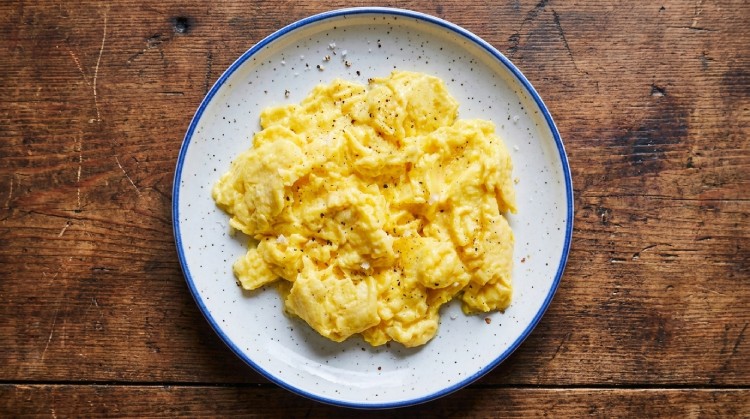
- Stop at the right point. Transfer the eggs when curds have formed and still look glossy, but no separate raw liquid remains. Add pepper and delicate herbs on the plate.
🌡️ Creamy should not mean raw
Starch can leave the surface glossy, so appearance alone may be misleading. The FDA advises that scrambled eggs should not be runny and lists 160°F, or 71°C, for egg dishes. Children, pregnant people, older adults, and anyone with a weakened immune system should avoid undercooked eggs. If you want a softer style for someone in a higher-risk group, use pasteurized shell eggs or a pasteurized liquid egg product and follow its package directions.
Choose the texture you prefer
🍳 Match the method to the result
How to use this guide: select a row or its arrow to expand the recommendation.
Small, creamy curds
Use medium-low heat and make frequent, short strokes with the spatula. Lift the pan off the burner whenever a thin layer on the bottom begins setting faster than you can move it.
Large, soft folds
Use broader, slower sweeps from the edge to the center. Avoid chopping through folds that have already formed, and do not use such a large pan that the eggs spread into a paper-thin layer.
Firmer eggs without dry edges
Keep the starch amount but reduce the added water by roughly one-quarter. Cook a little longer over moderate heat instead of increasing the burner temperature.
Scrambled eggs without starch
Omit the slurry, lower the heat, and pay closer attention to the pan. Starch adds a margin for error; it is not a requirement for creamy scrambled eggs.
Why the eggs did not turn out
- There are pale lumps: the starch was not fully dispersed in cold liquid before the eggs were added.
- The texture is pasty: there was too much starch or it did not heat sufficiently. Reduce the starch by about one-quarter next time.
- Water collects on the plate: the mixture may contain too much added liquid, or the proteins tightened after prolonged cooking and expelled moisture.
- The eggs are dry despite the starch: they remained in the hot pan too long. Move them to a plate instead of merely turning off the burner.
- They taste powdery: cornstarch is the usual culprit when the cooking stage is extremely brief.
- They stick: check the nonstick surface, let the butter coat the whole base, and do not pour the eggs into cold fat.
How to scale the recipe
Ingredient quantities multiply neatly, but pan area and heating speed do not. A small skillet suits two eggs, while four need a wider cooking surface. For six or eight eggs, make two batches. Smaller batches heat more evenly and are easier to move off the pan at the right moment.
Do not transfer a cooking time from a small batch to a large one. Watch for the opaque edge, the rate at which folds form, and the disappearance of separate raw liquid. Those cues are more useful across different stoves.
What to add after cooking
- sliced chives, dill, or parsley;
- freshly ground black pepper or a pinch of smoked paprika;
- finely grated hard cheese folded in near the end;
- toast, tomatoes, or salad greens for contrasting texture;
- a few drops of chile oil on the plated eggs.
Cook watery vegetables separately. Raw tomatoes, mushrooms, and spinach can release enough liquid to make doneness harder to judge.
Sources and further reading
- Lady & Pups: Mandy Lee's original publication and later starch updates.
- NYT Cooking: J. Kenji López-Alt's version of the technique.
- Journal of Food Science: heating, protein-gel structure, and water holding.
- FDA: cooking and serving eggs safely.
Conclusion
A starch slurry does not replace attention at the stove, but it can make a fast scramble more forgiving. Disperse a small amount of starch in cold liquid, cook a manageable batch over moderate heat, and move the eggs out of the hot pan as soon as they are done. If you prefer classic scrambled eggs without an added thickener, the same temperature control and timely finish still apply.