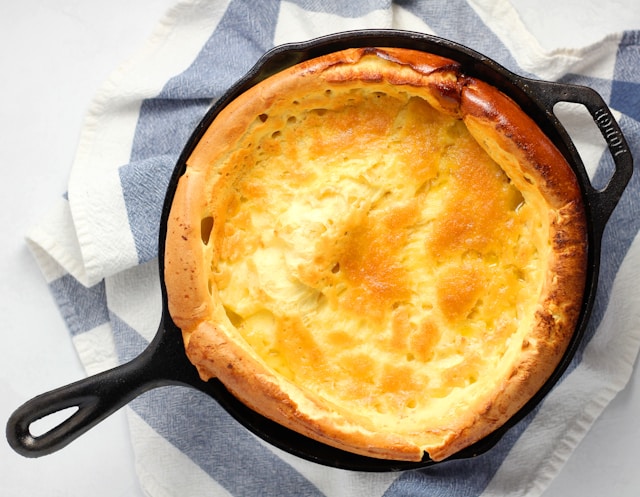
A Dutch baby looks like a kitchen trick: a thin batter with no baking soda or baking powder turns into one enormous pancake with tall, golden edges. The effect is dramatic, but the method is straightforward. It depends on a hot metal pan, enough egg for structure, and moisture that becomes steam in the oven.
The dish is also called a German pancake, although the modern Dutch baby is primarily an American creation. It is related to, but not the same as, the thinner Pfannkuchen commonly cooked on the stovetop in Germany. This guide gives a base recipe for a 10-inch skillet, proportional amounts for other pans, and practical reasons a Dutch baby may stay flat.
🥞 Recipe at a glance
- Pan: a 10-inch cast-iron or other oven-safe metal skillet.
- Yield: 2 to 3 servings.
- Active time: about 10 minutes.
- Baking time: roughly 15 to 20 minutes.
- Oven: 425°F conventional or 400°F convection.
- Key rule: do not open the oven during the first 12 minutes.
Are Dutch babies and German pancakes the same?
In current American recipe writing, Dutch baby and German pancake usually refer to the same oven-puffed pancake. The name is associated with Manca’s Cafe in Seattle, where Victor Manca created and popularized small baked pancakes. The Manca family still has a Dutch Babies trademark certificate dated 1956.
One familiar story says that Dutch was a child's version of the German word Deutsch. The documentary trail for that detail is thin, so it is more accurate to call it a popular origin story than a settled fact.
Traditional German Pfannkuchen or Eierkuchen are generally cooked as thinner individual pancakes on the stovetop. German public broadcaster NDR describes the puffy, oven-baked Dutch baby as an American style. The label “German pancake” is useful because that is how many North American families know the dish, but it should not be mistaken for one standard pancake served throughout modern Germany.
Why a Dutch baby rises without baking powder
As the batter bakes, water from the milk and eggs heats rapidly. Some of that moisture becomes steam, which stretches the batter upward along the hot sides of the pan. Egg proteins and gluten from the flour set around the expanding pockets and temporarily hold the shape.
That is why a fully heated oven and a hot metal pan matter more than prolonged blending. Air incorporated by a blender may help at the beginning, but steam is the main driver. Once the pancake leaves the oven, steam escapes and the pressure drops, so the center sinks. Deflation is normal, not proof that the recipe failed.
⚖️ A ratio worth remembering
For every large egg, use approximately 30 grams of all-purpose flour and 60 milliliters of milk. The batter scales easily, but the cooking surface must grow with it. Doubling the batter in the same skillet produces a thick, wet center instead of a broad ring of crisp edges.
Ingredients for a 10-inch skillet
🛒 What you need
Check off the ingredients as you prepare them.
Weight is more reliable than a packed measuring cup. If you need another conversion, use The LINES’ baking weight chart.
How to adapt the recipe to your pan
📐 Choose a pan size
How to use this guide: select a row or its arrow to expand the recommendation.
8-inch skillet — 1 to 2 servings
Use 2 eggs, 60 grams flour, 120 milliliters milk, 8 grams sugar, a pinch of salt, and 1 tablespoon or 15 grams butter. Bake for approximately 12 to 16 minutes.
10-inch skillet — 2 to 3 servings
Use the base recipe: 3 eggs, 90 grams flour, 180 milliliters milk, 12 grams sugar, 1/4 teaspoon salt, and 2 tablespoons or 28 grams butter. Bake for about 15 to 20 minutes.
12-inch skillet — 3 to 4 servings
Use 4 eggs, 120 grams flour, 240 milliliters milk, 16 grams sugar, 1/4 teaspoon salt, and 2 1/2 tablespoons or 35 grams butter. Bake for approximately 17 to 22 minutes.
9-by-13-inch metal pan — 4 to 5 servings
Use 5 eggs, 150 grams flour, 300 milliliters milk, 20 grams sugar, 1/2 teaspoon salt, and 3 tablespoons or 42 grams butter. Bake for approximately 18 to 23 minutes. Do not put this larger batch into a small round skillet.
Measure a round skillet across the inside of its base, not across the flared rim. Cast iron produces a particularly crisp edge, but a heavy steel skillet or metal baking pan also works. Make sure the handle and any nonstick coating are rated for the oven temperature.
Glass and ceramic heat differently. A metal pan is the safer default for this preheating method. Do not preheat empty glass bakeware unless the manufacturer of that specific dish explicitly permits it, and always follow its thermal-shock precautions.
How to make a puffed Dutch baby
- Preheat the oven. Set a rack just below the middle position. Heat the oven to 425°F conventional or 400°F convection. Once the oven reaches temperature, heat the empty metal skillet inside it for 8 to 10 minutes.
- Combine the liquid ingredients. Whisk the eggs and milk until uniform, then mix in the sugar, salt, and vanilla.
- Add the flour. In a blender, 10 to 15 seconds is enough. By hand, add the flour gradually and whisk until no large lumps remain; tiny lumps are harmless. Let the batter stand for 5 to 10 minutes while the skillet heats.
- Prepare the hot skillet. Remove it with dry oven mitts and remember that the handle is also hot. Add the butter and carefully tilt the pan to coat the base and lower sides. If the butter turns black immediately, let the pan cool briefly and replace the burned butter before continuing.
- Pour in the batter. Give it one quick stir, pour it into the center, and return the skillet to the oven immediately. Do not set a hot skillet on a cold or wet surface.
- Keep the door closed. The first 12 minutes allow steam to expand and the edges to set. An early drop in oven temperature can interrupt the rise.
- Check for doneness. The rim should be tall and golden brown. The center should look set and springy, with no visibly liquid batter. If the middle still looks raw, continue baking in 2-minute increments.
- Serve immediately. Transfer or slice the pancake as soon as it leaves the oven. It will begin sinking within minutes, but the flavor and contrast of textures remain.
🌡️ Custardy does not mean raw
A Dutch baby may have a soft, custard-like center, but it should not contain liquid batter. U.S. food-safety guidance lists 160°F, or 71°C, as the safe internal temperature for egg dishes. When serving a young child, a pregnant person, an older adult, or someone with a weakened immune system, check the thickest part with a food thermometer rather than relying only on color.
Why the pancake did not rise
- The skillet was not hot enough. In a merely warm pan, steam develops slowly and the edges miss the strong initial push.
- The pan was too large. The batter spreads into a thin layer and dries before it can build dramatic walls. Match the batch to the size guide.
- The pan was too small. An overly deep layer remains wet in the center while the edges become too dark.
- The oven door opened early. Even a short temperature drop can reduce the rise before the structure has set.
- The batter was refrigerator-cold. Cold eggs and milk pull heat from the skillet. Cool room temperature is enough; there is no reason to leave eggs on the counter for an extended period.
- There was too much flour. A cup scooped directly from the bag may hold considerably more flour than intended. Thick batter is harder for steam to stretch.
- It rose and then collapsed. That is expected. The center sinks as steam escapes, while properly browned edges retain some height.
Useful substitutions
- Milk: whole or 2% milk gives predictable browning. Lactose-free dairy milk can be used in the same quantity. An unsweetened plant beverage is possible, but browning and the tenderness of the center may change.
- Vanilla: omit it for a neutral pancake or replace it with vanilla sugar while reducing the granulated sugar by the same weight.
- Butter: clarified butter works well in the hot pan. A neutral refined oil tolerates heat but loses the characteristic buttery flavor.
- Savory version: omit the sugar and vanilla. Add grated cheese, herbs, cooked mushrooms, or vegetables after baking or near the end so they do not weigh down the raw batter or release excess water.
- Gluten-free flour: use a blend formulated as a cup-for-cup baking replacement. Starch-heavy blends absorb liquid differently, so an identical rise cannot be assumed.
What to serve with it
The classic finish is fresh lemon juice and a light dusting of confectioners’ sugar. Berries, tart cherry jam, maple syrup, sautéed apples, and plain Greek yogurt all work without masking the eggy, buttery center. Add sugar just before serving because it quickly dissolves on the hot, moist surface.
For a savory brunch, top the pancake with herbs, a salty cheese, and mushrooms or greens cooked separately. Add moist toppings at the table to keep the edges crisp.
Can you save the leftovers?
The pancake is best during its first few minutes out of the oven. Cool leftovers promptly, cover them, and refrigerate within two hours. For the best texture, eat them within 1 to 2 days and reheat at 350°F for 5 to 7 minutes. A microwave warms the pancake but softens its edges. USDA guidance allows 3 to 4 refrigerated days for cooked egg dishes, but quality declines sooner.
Sources and further reading
- HeraldNet: Dutch baby history, Manca’s Cafe, and the 1956 trademark.
- NDR: traditional German Pfannkuchen and the American Dutch baby style.
- King Arthur Baking: the role of eggs, a hot oven, and the pan in Dutch baby rise.
- FoodSafety.gov: safe minimum temperatures for egg dishes.
- FDA: safe preparation and refrigerated storage of cooked egg dishes.
Conclusion
A tall Dutch baby does not depend on a secret ingredient. It comes from matching the amount of batter to the pan, heating the metal thoroughly, and keeping the oven temperature steady during the first minutes. Weigh the flour, choose the correct batch for your skillet, and expect the center to settle after baking. The real appeal is not permanent height but the contrast between crisp edges and a tender, fully cooked middle.