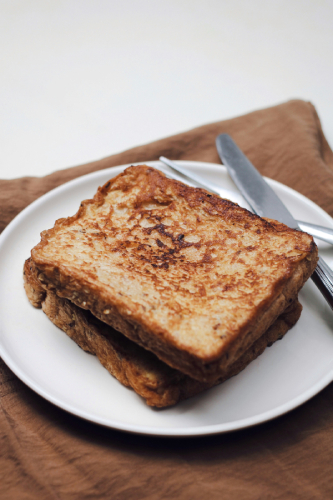
Good French toast has a browned surface and a soft center that is fully cooked rather than wet. The result depends less on using an extravagant amount of cream and more on choosing sturdy bread that can absorb custard without falling apart.
Brioche and challah make a rich slice, but they are not mandatory. A day-old sandwich loaf, milk bread, or another close-crumbed enriched bread works well when cut about 5/8–3/4 inch / 1.5–2 cm thick.
Recipe at a glance
- Yield: 6–8 thick slices
- Active time: 20–25 minutes
- Skillet: about 4 minutes per batch
- Oven: 5–7 minutes to hold the batch and finish thick slices
- Oven temperature: 400°F / 200°C
Choose the bread by the result you want
Brioche, challah, or milk bread: a rich, tender center; reduce the custard sugar if the loaf is already sweet.
Sandwich bread or French bread: easy to find; dry fresh slices for 8–10 minutes in a 300°F / 150°C oven.
Whole-grain bread: a firmer, more pronounced texture; soak a little longer while making sure the slice still holds together.
Very soft fresh bread: the most likely to tear and become mushy, so dry it first.
Ingredients
- 6–8 slices day-old bread, 5/8–3/4 inch / 1.5–2 cm thick
- 3 large eggs
- 3/4 cup (170 g) heavy cream, half-and-half, or whole milk
- 2 tbsp granulated sugar; use 1 tbsp for sweet brioche
- 1 tsp vanilla extract
- 1/4 tsp ground nutmeg or cinnamon
- pinch of fine salt
- 2 tbsp rum or brandy, optional
- 1 tbsp unsalted butter
- 1 tbsp neutral vegetable oil
Allergens: wheat, eggs, and milk, depending on the bread and dairy choice.
Prepare the custard and workspace
Heat the oven to 400°F / 200°C and line a sheet pan with parchment. The oven is particularly useful when cooking more than two slices: the first pieces stay hot and thick centers finish warming evenly.
Whisk the eggs, cream or milk, sugar, vanilla, spice, salt, and optional alcohol in a wide shallow dish. Mix until completely uniform but not highly foamy; a cap of bubbles coats the bread unevenly.
Match the soak to the slice
- 1/2-inch / 1–1.5 cm slice: 10–15 seconds per side.
- 5/8–3/4-inch / 1.5–2 cm slice: about 25–30 seconds per side.
- Dense whole-grain bread: up to 40 seconds per side if it still holds together.
Lift a soaked slice with a wide spatula and let excess custard drip away for a few seconds. The bread should feel heavier without sagging or splitting.
Brown in the skillet and finish in the oven
- Heat the skillet over medium. Add some butter and oil. Let the foaming settle, but do not wait for the milk solids to turn black.
- Work in small batches. Add one or two slices without crowding. Cook for about 2 minutes on the first side and 1 1/2–2 minutes on the second, until evenly golden.
- Control the heat. If the surface darkens in under a minute, lower the burner and wipe away burnt butter solids before the next batch.
- Transfer to the sheet pan. Hold the toast in the oven for 5–7 minutes. For a very thick slice, this is more than warming: the center should be hot and no longer look liquid.
Cook the egg custard through
No cool, liquid custard should remain in the center. For a precise check on an extra-thick slice, insert a thin thermometer from the side; 160°F / 71°C is the safety target for egg dishes. Wash hands, utensils, and surfaces after contact with raw egg.
No-oven method
After browning the first side, lower the heat to medium-low and cover the skillet for 1–2 minutes. Flip and repeat. Do not stack finished slices; trapped steam softens the crust. Hold them on a rack or serve in batches.
Ways to serve it
For a sweet plate, add berries, sliced apple, yogurt, a small amount of honey, jam, or maple syrup. For less sweetness, cut the custard sugar to 1 teaspoon and serve with cottage cheese or plain yogurt and fruit.
Rum or brandy contributes aroma but is not structurally necessary. Omit it without changing the other ingredient amounts.
French toast troubleshooting
How to use this guide: select a row or its arrow to expand the recommendation.
The outside is dark but the center is cool and raw
The skillet was too hot or the slices were unusually thick. Lower the heat, brown gently, and finish for 5–7 minutes in the oven. For a precise safety check, bring the center to 160°F / 71°C.
The bread fell apart while flipping
It was too fresh, too thin, or soaked too long. Dry the slices and shorten the soak. Move them with a wide spatula rather than your fingers.
The surface is pale and soft
The pan was not fully heated or excess custard was carried into it. Let the slice drip briefly and wait until the butter foams before adding the first piece.
The toast tastes strongly of egg
The custard may have been unevenly mixed or there was too much for the amount of bread. Whisk it thoroughly and use 6–8 thick slices. Vanilla, spice, and salt balance the flavor but should not mask an undercooked center.
The crust softened before serving
Do not cover or stack the finished toast. Keep it in a single layer on a rack or sheet pan in the hot oven.
Sources and editorial note
The base proportions come from King Arthur Baking. This The LINES update adds a bread-selection guide, thickness-based soaking times, heat control, a no-oven method, a safe egg-custard target, and original troubleshooting.