Where does the journey to real artisan sourdough bread begin? Right in your own kitchen. All you need is flour, water, and a little patience to cultivate your very own colony of wild yeast.
Recipe Overview:
- Active Time: 50 minutes (total over all days)
- Total Time: 5–7 days
- Yield: A strong, active homemade starter
Ingredients for a Homemade Sourdough Starter
- Flour: 50g (about 1/2 cup) of all-purpose flour for each step.
- Water: 50g (slightly less than 1/4 cup) of clean, non-chlorinated water.
Note: For best results, weigh your ingredients on a digital kitchen scale. Precision is the key to baking success.
How to Make a Sourdough Starter from Scratch: Day-by-Day Schedule
Day 1: The Birth (Mixing Flour and Water)
In a non-reactive container (glass, ceramic, stainless steel), combine 50g of flour and 50g of water. The container should hold at least 1-quart (1 liter) so the starter has room to grow. Stir thoroughly, cover loosely, and let it sit for 24 hours at around 70°F (21°C).
Day 2: First Signs of Fermentation
You may see no activity at all, and that’s perfectly normal. Transfer 50g of your starter to a clean jar (or the same one), and discard the rest. Add 50g of flour and 50g of water. Mix well, cover loosely, and let it rest for another 24 hours.
Day 3: Active Life and Feeding Begins
You should start seeing some bubbles and noticing a fruity, tangy aroma. Now it’s time to transition to two feedings a day (morning and evening). Each time, keep 50g of the starter, and add 50g of flour and 50g of water.
Day 4: Stabilizing the Wild Yeast
Repeat the twice-a-day feeding process (spaced about 12 hours apart) as described in Day 3. The starter is getting stronger and more predictable.
Day 5: Ready for Baking Sourdough Bread
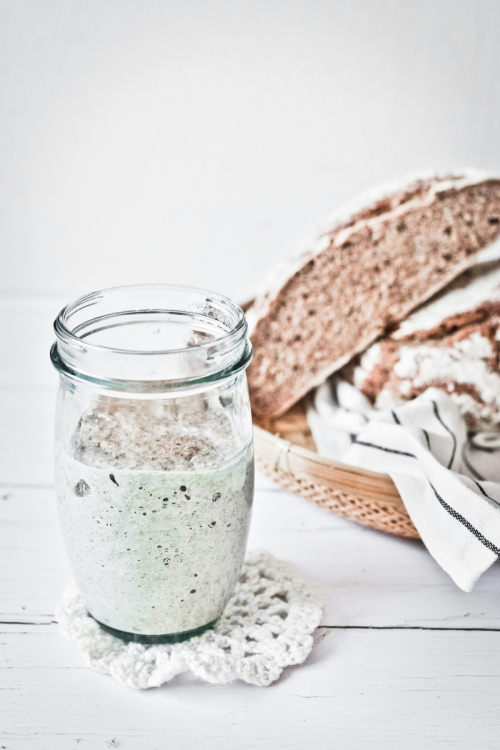
By the end of Day 5, the starter should double in volume within 6 to 8 hours of feeding. It should look webby and porous, with a pleasant, tangy aroma. If it still seems weak, continue the twice-daily feeding rhythm for Days 6 and 7.
💡 How to Properly Measure Flour Without a Scale?
If you don't have a kitchen scale, use the "Spoon & Level" method to avoid adding too much flour to your starter:
- Fluff: Lightly fluff the flour in its container with a spoon.
- Spoon: Spoon the flour into your measuring cup until it mounds over the top. Do not scoop directly with the measuring cup!
- Level: Sweep off the excess flour with the flat edge of a knife.
Read more about sourdough starter maintenance at King Arthur Baking.