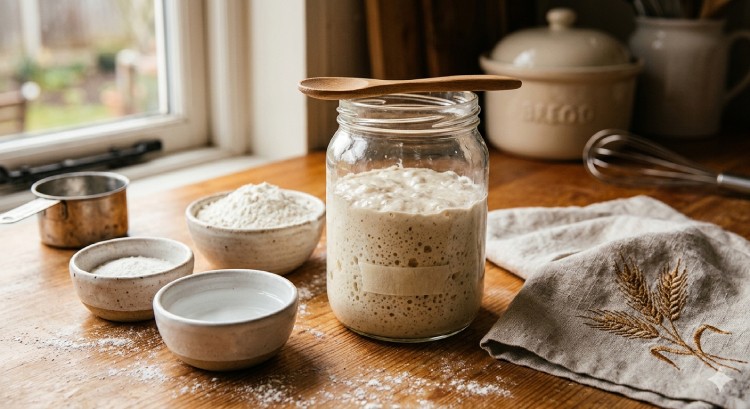
Once you've successfully created your own sourdough starter, it needs regular care. Think of it as a pet—the health of your starter depends on proper and timely feeding.
🥖 Don't have a starter yet? Learn how to make one from scratch in our guide: Homemade Sourdough Starter from Scratch: A Step-by-Step Guide
Ingredients and Ratios for Feeding Sourdough Starter
- Starter: 50g (about 1/4 cup).
- Flour: 50g (about 1/2 cup) of all-purpose flour.
- Water: 50g (slightly less than 1/4 cup) of warm water.
How to Store a Sourdough Starter: Room Temperature vs. Fridge
🏠 Option 1: Room Temperature Maintenance
Best if you bake bread every day or every other day.
- Leave 50g of starter in your jar; discard or use the rest.
- Add 50g of flour and 50g of water. Mix thoroughly.
- Cover and let it sit for 24 hours. Repeat this cycle daily.
*Remember: the warmer your kitchen, the faster the starter "eats" its meal and requires a new feeding.
❄️ Option 2: Storing Sourdough Starter in the Fridge
Ideal for those who bake once a week.
- Take out the starter (if there is liquid on top—called hooch—pour it off or stir it in).
- Keep 50g of starter, and add 50g of flour and 50g of water.
- Let the mixture sit at room temperature for 1-2 hours to allow the yeast to wake up.
- Return it to the fridge. Repeat this once a week.
How to Prep Cold Sourdough Starter for Baking Bread
If your starter has been living in the fridge, it needs to regain its energy before mixing the dough:
- Take it out of the fridge 12–24 hours before you plan to bake.
- Feed it (50g starter + 50g flour + 50g water).
- Repeat feeding every 12 hours until the starter doubles in volume within 6 to 8 hours. That’s the sign it’s ready to work!
💡 Hack: The "Spoon & Level" Method
If you don't have a kitchen scale on hand, remember the correct cup measuring technique:
- Fluff the flour in its container with a spoon.
- Spoon it into a measuring cup until it mounds over the top (do not scoop directly with the cup!).
- Level the surface with the flat edge of a knife.
This will prevent you from adding too much flour, which often makes the starter too thick.
For the original recipe and maintenance tips, visit King Arthur Baking.