Small daily actions will not keep a home “perfectly clean with no effort.” They have a more modest and useful purpose: preventing crumbs, dishes, damp towels, and misplaced objects from becoming a large cleanup at the end of the week.
This is not another cleaning schedule, and it does not require cleaning for a fixed number of minutes every day. Instead, it uses existing household triggers: finishing a meal, changing clothes, washing your face, or running laundry. Each trigger receives one short action that closes the loop.
What small habits can—and cannot—do
- They can: contain visible mess, prevent fresh spills from drying, and keep work surfaces and walkways usable.
- They cannot: replace floor cleaning, bathroom maintenance, dust removal, appliance care, or seasonal deep cleaning.
- They should not: require a new wall of organizers or aggressive chemicals on every surface.
- It is not failure: when an unusually busy day allows only the safety-critical minimum.
1. Finish the activity instead of leaving it “almost done”
Household mess often consists of unfinished loops. Dinner ended, but ingredients remained on the counter. Getting dressed ended, but clothes landed on a chair. The washer stopped, but damp laundry remained inside.
Define a minimum finish for one repeated activity:
- after eating—return perishable food to the refrigerator, remove food waste, and collect dishes in one place;
- after changing—return clothing to storage or place it in the laundry hamper;
- after showering—hang the towel to dry and wipe water from the floor;
- after working—remove cups and plates from the desk.
Do not adopt every option at once. Start with the loop that creates the most frequent mess.
2. Attach one action to an event that already happens
A reminder to “clean tonight” is easy to ignore because it has no precise starting point. A specific trigger is simpler: after brushing your teeth, wipe water around the basin; after breakfast, load the dishwasher or wash the dishes by hand; before leaving a room, take one object that belongs elsewhere.
The first version should be small enough for a demanding day. If it is repeatedly skipped, change the trigger, location, or scope instead of treating the missed habit as a character flaw.
3. Address fresh mess while respecting the material
Crumbs, water droplets, and many fresh spills are generally easier to remove before they dry. Lift or blot the excess with a clean cloth, then use a method approved for the surface. Wood, natural stone, laminate, painted furniture, and screens do not share the same cleaning requirements.
Do not apply a random “universal” recipe to an expensive or unknown finish. Check the manufacturer’s care instructions and, when appropriate, test a product in an inconspicuous area. Broken glass, an unknown chemical spill, or biological contamination is not an ordinary quick wipe.
4. Control two continuous streams: dishes and laundry
Dishes and laundry recur regardless of how well the home is organized. They need closed routes rather than motivational tricks.
Dishes
Decide where used dishes collect and when they move into washing. With a dishwasher, compatible items can go directly inside instead of filling the sink first. Without one, use one side of the sink or a separate basin while preserving access to water. The cycle ends when dishes are dry and returned, not merely washed.
Laundry
Place the hamper where clothing is normally removed without blocking a walkway or occupying a damp area. Start a load when someone will be available to remove and dry it promptly. The full cycle ends when dry laundry returns to storage rather than living in a basket for another week.
5. Keep a minimal tool near the task—not the entire chemical cabinet
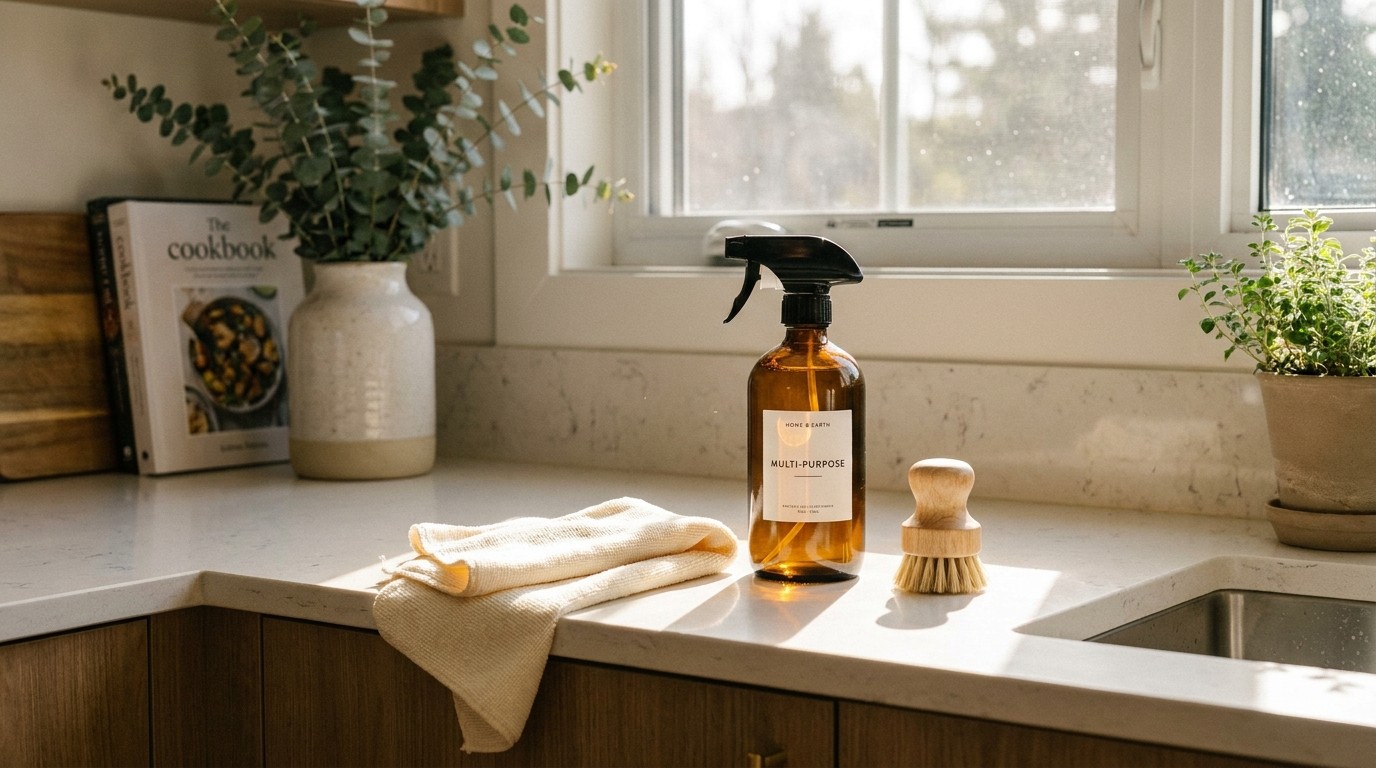
A simple tool at the point of use can remove unnecessary steps: a clean counter cloth, a shower squeegee, a crumb brush, or a sink sponge. This makes a small cleanup easier to complete immediately.
Keep concentrates, bleach, and disinfectants in their original labeled containers, away from food and out of reach of children and pets. Follow the label, ventilate when directed, and never mix cleaning or disinfecting products.
Cleaning and disinfecting are different jobs
For many ordinary household situations, cleaning with an appropriate detergent and water is sufficient. Disinfection is more relevant when there is a specific risk, such as illness in the household or a food-contact surface contaminated by raw meat or its juices. Clean first, then disinfect when needed and according to the product directions.
6. Run a functional closing shift, not a whole-house inspection
Evening does not suit everyone. One household may reset the kitchen after dinner; another may do it after breakfast. The time matters less than leaving essential functions ready for the next user:
- the sink, or part of it, remains usable;
- perishable food is not left at room temperature;
- walkways and floors are free of obvious trip hazards;
- damp towels and cloths are spread out to dry;
- the cooker and used appliances are switched off.
Stop there. Baseboards, the oven, windows, and other larger jobs belong to scheduled maintenance, not a daily closing shift.
An important limit to “clean as you cook”
During a safe pause, you can remove packaging, return an ingredient to the refrigerator, or wipe a clear section of counter while remaining near the cooking process. Do not leave an active hob or grill to clean a bathroom or complete a task in another room. Fire-safety authorities advise staying with cooking and turning off the heat if you need to leave.
When you need a separate plan
Small habits maintain basic function; they do not determine how often to clean floors, scrub a bathroom, change bedding, or maintain appliances. Use our separate realistic cleaning schedule to build those tasks around the size of the home, its occupants, children, and pets.
Start with one habit for one week. Success is not a showroom-perfect home. It is reaching the next cleaning session without dried dishes, damp laundry trapped in the washer, or objects obstructing a walkway.