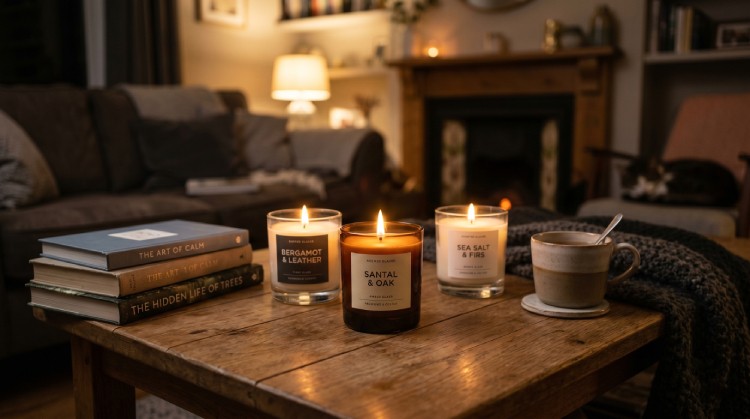
One candle on a coffee table does not turn a living room into a smoking lounge. But a “natural wax” label does not turn a flame into an air purifier, either. A candle burns, and any combustion adds fine particles and gaseous compounds to indoor air.
That is why the answer is not a simple yes or no. It matters how many candles are burning, how long they stay lit, whether the room is ventilated, and whether anyone present has asthma, migraines, or fragrance sensitivity.
The short answer
- Available evidence suggests that occasionally burning one candle in a reasonably large, ventilated room creates a relatively low exposure for most healthy adults.
- That does not mean zero emissions or safe for everyone: candles produce particulate matter, and fragrance can trigger symptoms in sensitive people.
- Several candles, long burn times, a small unventilated room, and a visibly sooting flame all increase indoor pollution.
- The clearest established hazard is not chronic poisoning but fire, burns, and nearby materials catching alight.
What enters the air when a candle burns
Burning candles produce ultrafine particles, soot, and volatile organic compounds. Laboratory studies have detected substances including formaldehyde, benzene, acrolein, and polycyclic aromatic hydrocarbons. Detecting a chemical is not the same as demonstrating a dangerous dose; risk depends on concentration and length of exposure.
Studies published in 2014 and 2021, often cited as reassurance, found that most modeled concentrations remained below relevant air-quality guidance values under typical-use scenarios. The 2021 paper nevertheless discussed exceptions involving nitrogen dioxide, acrolein, and benzo[a]pyrene in some scenarios. Both projects involved candle or fragrance-industry collaborators. That does not invalidate the findings, but “below a guidance value in this model” should not be rewritten as “absolutely harmless to everyone.”
In 2023, researchers exposed 36 young adults with mild asthma to air containing a high concentration of candle particles for five hours. They found weak changes in the small airways and signs of mild inflammation, while many other markers did not change. This was not the same as an evening with one candle, nor does it prove chronic disease, but it is a good reason to take ventilation and individual sensitivity seriously.
Paraffin, soy, or beeswax: there is no simple ranking
Paraffin has a poor reputation because it comes from petroleum, while soy and beeswax are often marketed as “clean” alternatives. Wax composition can affect emissions, but it does not act alone. Wick design, fragrance load, dyes, flame stability, and ventilation matter too.
A soy or beeswax candle can still soot if its wick is too large, the flame is disturbed by a draft, or the wax contains too much fragrance. A well-made paraffin candle with a stable flame is not automatically “toxic” simply because of its wax.
Myth: beeswax cleans the air with negative ions
There is no convincing clinical evidence that a beeswax candle removes dust or allergens from a room or has a calming effect through “negative ions.” Choose beeswax for its appearance, scent, or origin—not as a replacement for ventilation or an air purifier.
“Natural fragrance” does not mean non-irritating
A candle fragrance may contain synthetic aroma chemicals, essential oils, or both. Natural origin does not prevent irritation or an allergic response. The American Lung Association notes that fragranced products can cause headaches, eye or throat irritation, coughing, wheezing, or shortness of breath, particularly in people with asthma, COPD, migraines, allergies, or chemical sensitivities.
A statement that a fragrance mixture complies with IFRA Standards is useful information, but it is not a guarantee that the finished candle emits nothing undesirable. IFRA does not certify individual candles, and a supplier’s certificate of conformity for a fragrance mixture does not replace a safety assessment of the finished product.
If a scent gives you a headache, irritates your throat, or makes you cough, there is little value in searching for a more “natural” version of the same fragrance. Extinguish the candle, air the room, and choose an unscented or flameless option next time.
What about lead in candle wicks?
This concern has a historical basis. Lead cores were once used to help wicks remain upright. The United States banned the manufacture and import of candles with lead-cored wicks in 2003. It is inaccurate, however, to turn that specific U.S. rule into a worldwide claim or to say that every modern wick is made only from cotton, paper, or wood.
Buy from sellers that identify the manufacturer, materials, and instructions. Vintage candles of unknown origin and unlabelled imports are better left unburned indoors.
How to reduce smoke and particle exposure
- Burn fewer candles at once. One candle produces less pollution and heat than a full arrangement.
- Ventilate the room. Maintain gentle air exchange, but keep the flame out of a strong draft because an unstable flame is more likely to soot.
- Watch the flame. If it grows tall, flickers heavily, develops a black “mushroom” on the wick, or leaves soot on the container, extinguish it, let it cool, and check the manufacturer’s instructions.
- Trim the wick as directed. Around 1/4 inch (5–6 mm) is common, but the candle maker’s instructions take priority.
- Do not use fragrance to hide a problem. If a room smells damp, smoky, like gas, or of spoiled food, find and address the source first.
A quick check before you light one
The room is reasonably large, can be ventilated, and no one is bothered by the scent
Burning one candle for a short period is a relatively low-exposure scenario. Keep it in sight and extinguish it if you see smoke or soot.
Someone present has asthma, COPD, migraines, or fragrance sensitivity
An unscented candle—or no combustion at all—is the better choice. If a fragranced product has caused symptoms before, do not repeat the test in a closed room.
It is a bedroom, a small bathroom, an unventilated room, or children and pets are nearby
Flameless lighting is the more sensible option. It adds no combustion products and greatly reduces the fire risk, especially when someone might fall asleep or become distracted.
Fire safety matters more than the type of wax
Keep candles in heat-resistant holders on a stable surface, well away from curtains, paper, clothes, furniture, and anything else that can catch fire. Keep them out of the reach of children and pets. Never leave a burning candle unattended, move it while lit, or keep it burning when you leave the room or go to bed.
Follow the manufacturer’s minimum-wax and burn-time instructions so the container or holder does not overheat. If you want the glow in a bedroom, around decorations, or in a busy household, a rechargeable LED candle is the safer choice.
Should you stop using candles?
For most healthy adults, there is no convincing evidence that occasionally burning one candle in a ventilated room carries the same risk as secondhand smoke. But that does not make a candle beneficial to indoor air, and it does not show that frequently burning several scented candles in a small room is harmless.
The sensible middle ground is straightforward: fewer candles, shorter burn times, fresh air, and no visible smoke. If your body reacts to the fragrance or combustion, take that response seriously and choose an unscented or flameless alternative.
If smoke or fragrance causes significant breathing difficulty, extinguish the candle, move to fresh air, and seek urgent medical help.
Sources
- US EPA: sources of indoor particulate matter and candle combustion.
- Regulatory Toxicology and Pharmacology, 2014: risk assessment of scented-candle emissions.
- Environment International, 2021: gaseous and particulate emissions from candles.
- Particle and Fibre Toxicology, 2023: controlled exposure study in adults with mild asthma.
- American Lung Association: fragranced products and sensitive groups.
- IFRA: what conformity with fragrance standards does and does not mean.
- US CPSC: the U.S. ban on lead-cored candle wicks.
- London Fire Brigade: candle and open-flame safety at home.