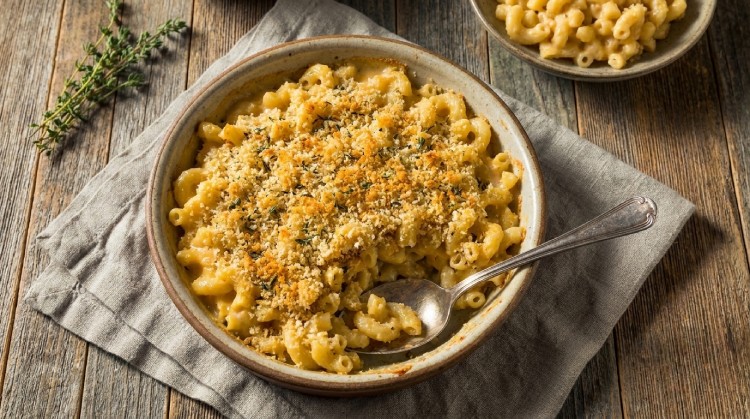
Baked mac and cheese comes with a small contradiction: the oven creates the golden crust we want, but it can also steal the moisture from the sauce. The answer is not more cream or an indiscriminate pile of cheese. Undercook the pasta, keep the sauce looser than the finished dish should be, and bake only until the topping is crisp.
This version skips cheese powder and builds the sauce with everyday ingredients. Sharp cheese supplies the flavor, a younger melting cheese keeps the texture supple, and garlic-herb breadcrumbs add contrast without burying the pasta under an excessively thick crust.
Recipe at a glance
- Yield: 4 main-dish or 6 smaller servings
- Total time: about 45–50 minutes
- Active time: about 25 minutes
- Baking dish: about 2 quarts
- Oven: 375°F / 190°C, or 340°F / 170°C convection
Use texture, not the clock, as your guide: before baking, the sauce should fall slowly from a spoon and look slightly looser than you want on the plate. The pasta and breadcrumbs will absorb moisture in the oven.
What keeps baked mac and cheese creamy
- Pasta cooked 2 minutes short of al dente. It finishes in the sauce instead of turning soft and swollen.
- A butter-and-flour roux. The starch thickens the milk and helps the cheese melt into a more stable sauce.
- Cheese added away from boiling heat. Excess heat can tighten the proteins and leave the sauce grainy or oily.
- A short bake. Every component is already cooked; the oven only needs to heat the casserole and brown the crumbs.
Ingredients
For the pasta and cheese sauce
- 10 1/2 oz (300 g) short pasta, such as elbows, shells, cavatappi, or penne
- 3 tbsp (40 g) unsalted butter
- 1/3 cup (40 g) all-purpose flour
- scant 3 cups (700 ml) whole or 2% milk
- 9 oz (250 g) sharp cheddar
- 3 1/2 oz (100 g) Monterey Jack, young Gouda, or another reliable melting cheese
- 1 tsp Dijon mustard
- 1/4 tsp sweet or smoked paprika, optional
- freshly ground black pepper
- salt
For the garlic herb breadcrumbs
- 1 heaping cup (60 g) panko or dry breadcrumbs
- about 2 tbsp (25 g) unsalted butter
- 1 small garlic clove, finely grated
- 1 tsp dried thyme or Italian seasoning, or 1/2 tsp each dried thyme and rosemary
- 1/4 cup (20 g) finely grated Parmesan, optional
Allergens: milk, wheat, and mustard if used. Check the label on packaged breadcrumbs as well.
A practical cheese formula
Use roughly two parts flavorful cheese to one part easy-melting cheese.
- Classic: sharp cheddar + Monterey Jack.
- Deeper flavor: sharp cheddar + young Gouda or Gruyère.
- Using one cheese: choose medium cheddar or young Gouda rather than a very dry, extra-aged cheese.
Grate the cheese from a block and add it in small handfuls. An extra-aged cheese brings plenty of character, but it can melt less predictably when used on its own.
How to make baked mac and cheese
- Heat the oven and prepare the dish. Preheat the oven to 375°F / 190°C, or 340°F / 170°C convection. Lightly butter a 2-quart baking dish.
- Undercook the pasta. Boil it in salted water for 2 minutes less than the package recommends for al dente. Reserve about 1/2 cup of the cooking water, then drain. Do not rinse the pasta.
- Cook the roux. Melt 3 tablespoons butter in a wide saucepan over medium heat. Add the flour and whisk for 1–2 minutes. The mixture should foam gently but should not brown.
- Add the milk gradually. Whisk in about one-quarter of the milk until smooth, then add the rest in two or three additions. Bring it to a gentle simmer and cook for 3–5 minutes, until the sauce lightly coats a spoon.
- Melt the cheese without overheating it. Remove the pan from the heat. Whisk in the mustard, paprika, and pepper, followed by the cheese in three additions. Stir until each addition melts before adding the next. Taste before adding salt because the cheeses vary widely in saltiness.
- Check the consistency. The sauce should be smooth and flowing, not a dense paste that sits on the spoon. If it has thickened too far, stir in 2–4 tablespoons of reserved pasta water or warm milk.
- Assemble. Fold the pasta into the sauce and transfer it to the baking dish. Spread it gently without packing it down.
- Make the topping. Melt the remaining butter and take it off the heat. Stir in the garlic, herbs, breadcrumbs, and Parmesan. The crumbs should be evenly moistened, not greasy. Scatter them over the pasta.
- Bake just until browned. Set the dish in the upper third of the oven for 18–22 minutes. It is ready when the sauce bubbles gently at the edges and the topping is golden. Rest for 5–10 minutes before serving.
Troubleshooting baked mac and cheese
How to use this guide: select a row or its arrow to expand the recommendation.
The sauce is grainy or oily
The cheese probably went into an overly hot base, or the sauce boiled after the cheese was added. Take the pan off the heat and add the cheese gradually. If the sauce has already split, remove it from the stove and gently whisk in a few spoonfuls of warm milk. This may improve the texture, although a fully broken emulsion does not always come back together.
The finished mac and cheese is dry
The usual causes are overcooked pasta, a sauce that was too thick before baking, or too much time in the oven. Next time, pull the pasta 2 minutes early and remove the casserole as soon as the edges bubble. When reheating a serving, add a spoonful of milk and cover it to hold in moisture.
The sauce looks too loose
Rest the casserole for 5–10 minutes before changing anything; the pasta will absorb some of the liquid. If the sauce looked watery in the saucepan, simmer the milk base a little longer next time before adding the cheese.
The breadcrumb topping is pale or soft
Make sure every crumb has a light coating of butter and place the dish in the upper third of the oven. Fine dry breadcrumbs brown faster than panko, so start checking them a few minutes earlier.
Make-ahead and storage guidance
You can assemble the casserole up to 24 hours ahead, cover it, and refrigerate it. Keep the breadcrumbs separate. Before baking, stir 1/4 to 1/3 cup (60–80 ml) milk into the pasta, then add the topping. A cold casserole may need about 10 extra minutes; follow the manufacturer's guidance for glass bakeware to avoid a sudden temperature change.
Refrigerate leftovers in a shallow covered container within 2 hours. Use them within 3–4 days and reheat only the portion you need to 165°F / 74°C in the center. A splash of milk and a loose cover help the sauce stay moist as it reheats.
What to serve with it
Mac and cheese is rich, so simple contrast works better than another heavy sauce. Try a tangy cabbage slaw, green beans, roasted broccoli, or a tomato salad. If you serve it as a side dish, keep the portion smaller and pair it with a plainly seasoned main.
Sources and editorial note
The garlic, herb, and breadcrumb combination was inspired by King Arthur Baking's recipe. The LINES version uses a different ingredient balance, a conventional roux-based sauce, a shorter bake, regional cheese options, and an original troubleshooting guide.