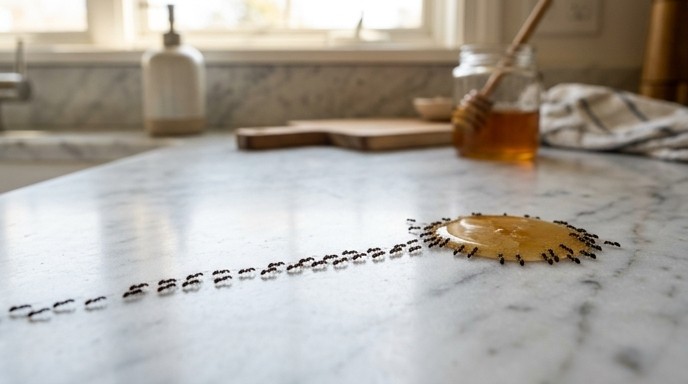
One ant in the kitchen does not automatically mean a colony is living inside the wall. It may be a scout looking for food or water. A trail that repeatedly returns to the same crack is different. That calls for more than killing the ants you can see: trace the route, remove what attracts them, and use a slow-acting bait when appropriate.
The best response depends on the pattern. A lone scout may require nothing more than cleanup and monitoring. A recurring trail can justify baiting or a nest search, while large ants accompanied by coarse sawdust near wood deserve a different inspection.
- Trace first
Find where the ants enter and what they are seeking. - Remove the attraction
Clean crumbs, sweet residue, pet food, garbage, and water. - Bait when needed
Do not spray the route around an active bait station.
Before cleaning, trace the route
Watch the ants for a few minutes and see where they travel. Trails often follow a baseboard, pipe, wire, window frame, or the joint between a counter and wall. Mark or photograph the entry point so you can return to it after cleanup.
At the same time, identify the attraction: a drop of honey, crumbs under the toaster, a pet bowl, garbage, a damp sponge, or a leak beneath the sink can keep the route active.
Why the order matters
If you erase everything immediately, the entry point may become harder to find. If you plan to bait a recurring trail, workers need to reach the bait and return to the colony. Trace first, then choose the response that fits the problem.
What are you seeing?
Select a situation to open the next step.
One or two occasional ants
Remove them with a soapy sponge or vacuum, clean the surface, and monitor for the next several days. A bait may be unnecessary if no trail develops.
A recurring trail to food or water
Remove accessible food and water while keeping the entry route easy to identify. Place a labeled slow-acting bait nearby and do not use an insecticide spray around it.
Ants emerging from an outlet or wall void
Do not pour water, vinegar, oil, insecticide, or powder into the opening. Liquids around electricity are hazardous, and a random treatment may only move the route. Contact a professional if activity is substantial or keeps returning.
Large ants, winged ants, or coarse sawdust
These can be signs of carpenter ants, particularly near damp or damaged wood. Carpenter ants do not eat wood; they remove particles while excavating galleries. Confirm the species and have the area assessed.
How to remove visible ants and their scent trail
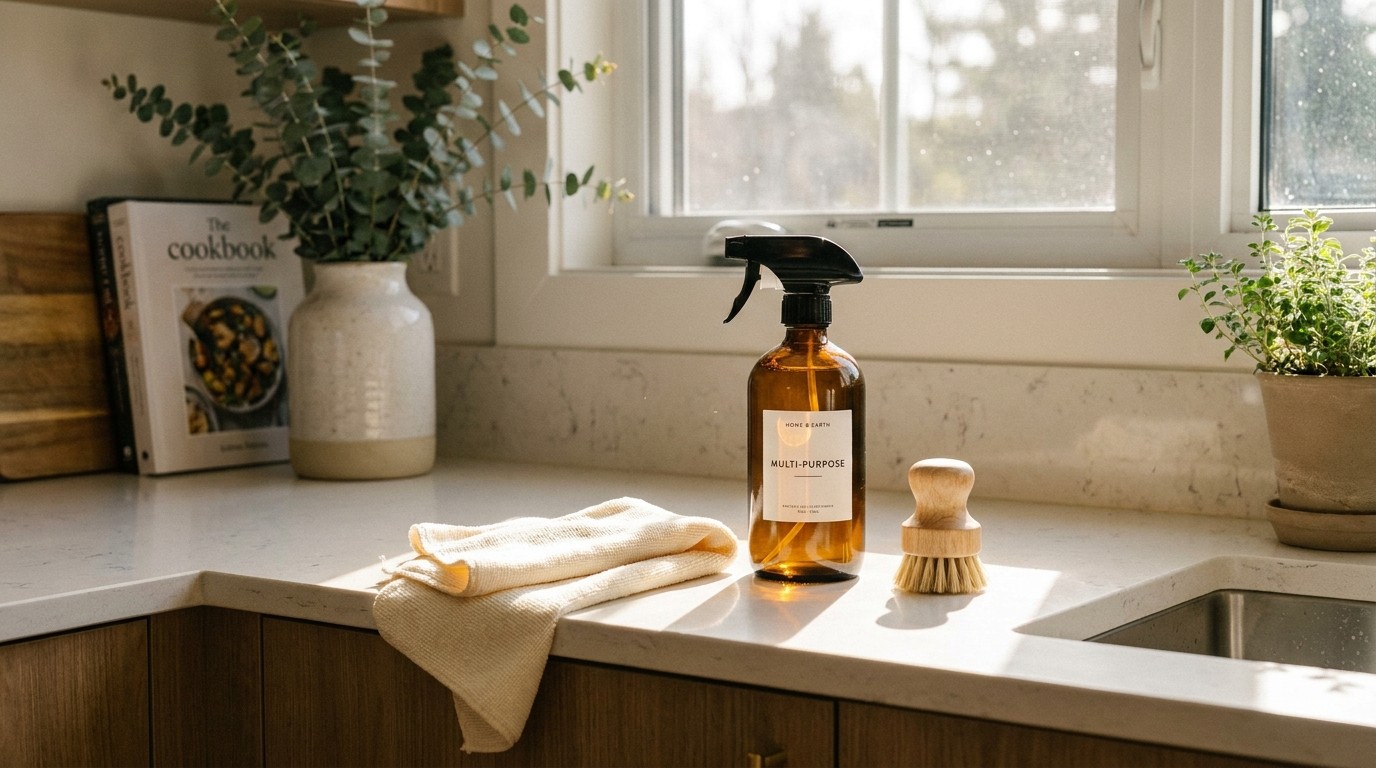
For most washable surfaces, a sponge or cloth with water and a small amount of dish soap is enough. Collect visible ants, then wipe the trail, baseboard, and entry area thoroughly. Soapy water temporarily removes foragers and disrupts the scent route followed by other workers.
A diluted vinegar solution should be used only on acid-resistant surfaces. Avoid marble, limestone, other natural stone, unsealed grout, or any finish whose manufacturer recommends a neutral cleaner. Rinse food-contact counters with clean water after cleaning and dry them.
Useful for occasional ants, visible trails, and final cleanup after the colony is under control.
Kills or repels only some foraging workers and can prevent them from carrying bait back to the nest.
When to use bait and how it works
If the trail returns after cleanup, bait is usually more useful than another contact spray. Ant bait combines attractive food with a slow-acting active ingredient. Workers collect it and share food within the colony.
- Choose a product labeled for indoor household ants. Read the label before opening or placing it.
- Place the station near the route or entry point. Keep it inaccessible to children and pets and away from dishes and exposed food.
- Remove competing food. Crumbs, honey, syrup, and pet food may be more attractive than the bait.
- Do not spray insecticide nearby. A spray may kill or repel workers before they return to the colony.
- Monitor for the period stated on the label. Baits are not immediate. If ants ignore one, adjust the location or choose another labeled formulation rather than mixing chemicals yourself.
Skip open homemade powders
Do not leave baking soda, borax, boric acid, or other powders mixed with sugar in bottle caps. Homemade concentrations, effectiveness, and access by children or animals are difficult to control. The claim that baking soda and sugar reliably destroy a colony while remaining completely safe for pets is not well supported.
Do vinegar, lemon, cinnamon, and essential oils repel ants?
Strong odors may redirect ants temporarily, but they do not remove food, close the entry point, or control the colony. Cinnamon or lemon at one crack may simply shift the trail elsewhere. These scents are not substitutes for sanitation, exclusion, and an appropriate bait.
Concentrated peppermint, clove, cinnamon, and citrus oils are not automatically safe because they are natural. The ASPCA warns that concentrated essential oils can be hazardous to pets. Do not apply them where a cat or dog can step in the oil, lick the surface, or knock over the container.
Remove food, water, and entry points
- Clean crumbs, grease, and sweet spills promptly. Check beneath the toaster, coffee maker, and feeding bowls.
- Store food in tightly sealed containers. Include sugar, cereal, dried fruit, cookies, and pet food.
- Pick up pet food after feeding. Wash the bowl and wipe the surrounding floor once ants have found the area.
- Correct persistent moisture. Repair dripping faucets or drain traps, dry sponges, and empty standing water beneath plant pots.
- Seal the entry after activity declines. Inspect joints around pipes, windows, doors, and baseboards.
- Check the exterior. Branches touching the building, foundation cracks, and vegetation against the wall can provide access.
When to call a pest professional
Seek professional help when sanitation, exclusion, and a correctly used bait do not reduce activity; ants repeatedly emerge from multiple walls or outlets; numerous winged ants appear indoors; or coarse sawdust accumulates near damp wood.
Large black ants alone do not prove that carpenter ants are damaging the structure; several species can look similar. A professional can identify the ant, locate the nest, and avoid random pesticide applications inside walls or electrical spaces.
The bottom line
Long-term ant control does not begin with a stronger spray. Trace the route, remove food and water, then match the response to the pattern: soapy cleanup for occasional ants or a labeled slow-acting bait for a trail that returns. Once activity declines, clean the route and close the entry point.