A rug, heavy curtains, or acoustic panels can make a room more comfortable to listen and talk in. They cannot turn an ordinary rental into a soundproof studio. Before buying anything, identify the type of noise and the path it takes into or through the room. That distinction determines whether a simple change will help.
Quick diagnosis
- Voices and door slams from the hallway: inspect the door perimeter and bottom gap first.
- Traffic and voices outside: check the window seals and closure; curtains have only a limited effect.
- Echo from speech, a TV, or bare surfaces: rugs, curtains, upholstered furniture, or acoustic panels can help.
- Your footsteps on a hard floor: a rug with a resilient pad can reduce impact noise in the room and for the neighbor below.
- Footsteps from above or low bass through the building: décor rarely fixes the transmission path; source-side treatment or building work is usually needed.
What no-renovation methods can—and cannot—change
Airborne noise includes voices, music, and traffic. It travels through partitions and through weak points such as gaps, doors, windows, ventilation paths, and wall-to-floor junctions.
Impact and structure-borne noise begins when footsteps, moving furniture, or equipment make a building element vibrate. It is generally most effective to control this noise at its source—for example, with a resilient floor treatment in the apartment above.
Reverberation is sound reflecting around the room itself. This is where porous panels, textiles, rugs, and soft furniture work well. They can reduce echo without making the wall block a neighbor’s voice like a purpose-built sound-insulating assembly.
1. Find the dominant sound path
During a quiet period, listen near the door leaf, bottom gap, window joints, shared wall, and the corners where walls meet the floor and ceiling. If hallway voices become much clearer at the door, start there instead of covering an unrelated wall with foam. If the sound is similarly strong near several surfaces, it may be flanking through floors, ceilings, or junctions.
A phone sound-meter app can be useful for a rough before-and-after comparison in the same position and under similar conditions. It is not a substitute for a calibrated meter or a professional survey when compliance, a formal complaint, or product performance must be established.
2. Seal an ordinary door without defeating ventilation or safety features
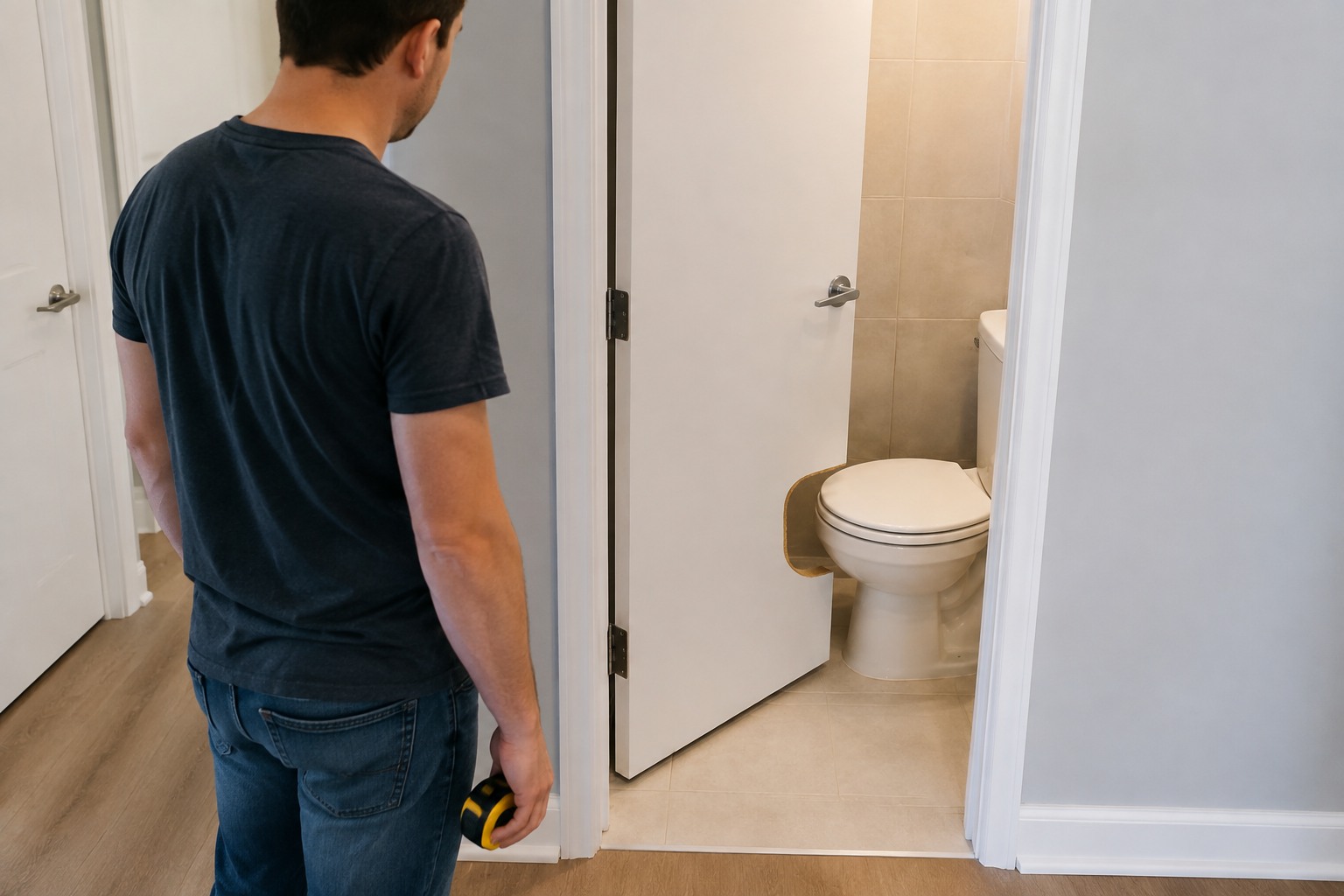
For hallway noise, restoring a close fit around the door is often the most useful low-cost step. Close the door and look for visible light, uneven contact, or an obvious bottom gap. Replace worn weatherstripping with a rubber profile of the correct thickness; a removable draft stopper or a properly fitted door-bottom seal may help at the threshold.
Do not choose the thickest seal by default. An oversized profile can prevent the latch from engaging or strain the hinges, while an undersized one leaves the leak open. Do not block required air paths or alter a fire- or smoke-rated door in a way that affects its operation. A warped frame or a very lightweight door may need more than weatherstripping.
3. Check the window before buying “soundproof” curtains
If outdoor noise is strongest near the frame, inspect worn seals, sash closure, and hardware adjustment. A damaged installation joint or noticeable air leakage is better assessed by a competent window professional; decorative tape over a faulty joint is not a repair.
Heavy, pleated curtains that extend beyond the opening can reduce reflections from the glass and may slightly soften higher-frequency outdoor sound. They do not replace an airtight window, secondary glazing, or an acoustically rated window system. Keep fabric clear of heaters and do not cover trickle vents or other required air inlets.
4. Use a rug and resilient pad for the right problem
A rug is most useful over laminate, tile, or another hard floor. It softens the sound of your own steps and reduces some reflections in the room. A dense, resilient rug pad can improve the result. Make sure it is slip-resistant, lies flat at the edges, and is compatible with underfloor heating if present.
This primarily treats noise created on your floor. Putting a rug in your apartment will do little for footsteps from the apartment above, because those vibrations are already traveling through the floor slab and adjoining elements.
5. Treat a bookcase or wardrobe as a modest supplement
A filled bookcase against a shared wall creates an irregular surface that scatters some reflections. A substantial closed wardrobe may add a small local benefit, but furniture does not seal the entire partition and is not equivalent to a tested sound-insulating lining.
Do not cover ventilation, overheated electrical outlets, or access to services. Secure tall furniture against tip-over with fixings appropriate for the wall construction, and obtain the landlord’s permission before drilling in a rental.
6. Add absorption only when echo is the problem
Acoustic PET panels, properly enclosed mineral-fiber panels, dense curtains, and other textile elements can reduce reverberation. The change will be most noticeable in a room with large bare surfaces. You rarely need to cover every wall: start with the strongest reflection areas and listen before adding more.
Check the product’s intended use, composition, mounting instructions, and documented fire performance. Packaging foam, unknown soft boards, and egg cartons are not safe or predictable substitutes for an acoustic product. Even a good absorber reduces reflections; it does not block voices or bass passing through a wall.
When simple methods are unlikely to work
Footsteps from above, a subwoofer, an elevator, pumps, ventilation equipment, or sound traveling through several building elements can indicate structure-borne or flanking transmission. More curtains are not the answer. The useful next step is an acoustic assessment and a solution designed for the specific path. Do not modify shared ventilation, service penetrations, or fire-resisting construction in an apartment building.
A practical order of work
- Identify the most disruptive noise and where it is loudest.
- Address obvious leaks around an ordinary door or restore defective window seals first.
- For echo, add one absorptive element and compare the result before buying more.
- For footsteps generated in your room, use a rug with a resilient pad.
- If the improvement is negligible, stop layering random materials: you are probably treating the wrong transmission path.
A realistic no-renovation goal is to improve acoustic comfort: reduce some leakage through gaps, soften footfall, and make the room less reverberant. Meaningful sound insulation normally requires an airtight, correctly designed assembly that also accounts for flanking paths.