Refrigerator safety does not depend on finding a “perfect” shelf for every package. It depends on four things: the actual temperature, separation of raw food from ready-to-eat food, time without refrigeration, and clean surfaces. Organization is useful when it supports those controls.
One correction to many online refrigerator diagrams is important: the top is not always the warmest or coldest area. Temperature patterns vary with the appliance design, vent location, and how often the door opens. Your refrigerator manual and an appliance thermometer are more reliable than a universal diagram.
The safe baseline
- Refrigerator: aim for 40°F (4°C) or below.
- Freezer: 0°F (−18°C) or below.
- Perishable food outside refrigeration: no more than 2 hours, or 1 hour when the air temperature is above 90°F (32°C).
- Main shelf rule: ready-to-eat food stays above raw meat, poultry, and seafood, which should be sealed and kept low.
1. Check the temperature, not just the control dial
The dial shows a setting, not necessarily the temperature around your food. Place an appliance thermometer in the middle of the refrigerator without pressing it against the back wall. Check it after the door has remained closed for several hours.
If the refrigerator remains above 40°F (4°C), lower the setting, uncover blocked vents, and inspect the door seal. Allow the appliance the time specified in its manual to stabilize. If it still cannot hold a safe temperature, contact a qualified service provider; rearranging the shelves will not solve a cooling fault.
2. Organize shelves by contamination risk
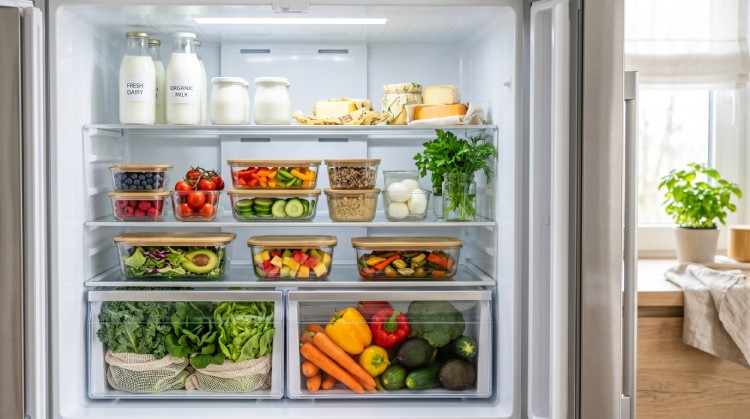
The main purpose of the layout is to prevent liquid from raw animal products from reaching food that will not be cooked again. The best location for milk or produce can vary by model, but arranging food by contamination risk remains useful.
🍽️ Upper and middle shelves
Store: leftovers, ready-to-eat foods, and dairy products.
Rule: keep containers covered and leave enough room for cold air to circulate.
🥩 Bottom shelf
Store: raw meat, poultry, fish, and seafood.
Rule: use a sealed container or rimmed tray so liquid cannot reach other food.
🥬 Crisper drawers
Store: fruit and vegetables.
Rule: use the humidity controls if provided and prevent contact with raw animal products.
🚪 Door
Store: condiments, drinks, and foods that tolerate temperature changes better.
Rule: do not use this area for highly perishable food. Keep refrigerated eggs in their original carton on an interior shelf.
A tidy layout is not a guarantee. Damaged packaging can leak, and contaminated hands or cutting boards can transfer germs regardless of shelf height.
3. Chill cooked food quickly in smaller portions
Do not leave a large pot of soup or stew on the counter for hours while waiting for it to become completely cold. Divide it among clean, shallow containers so heat can escape faster. Small portions of warm or hot food can go into the refrigerator; leaving perishable food at room temperature for too long is the greater risk.
Refrigerate cooked food and other perishables within 2 hours, or within 1 hour when the temperature is above 90°F (32°C). Label leftovers with the preparation date. Place newer items behind older ones so food that needs to be used first remains visible.
4. Treat storage times as limits, not promises
The times below are general guides for food kept continuously at a safe temperature. Manufacturer directions and a use-by date take priority. A date cannot make food safe if the package is damaged, the temperature history is unknown, or the food spent too long unrefrigerated.
Approximate refrigerator times
- 1–2 days: raw poultry, ground meat, raw fish, and seafood.
- 3–5 days: raw beef, pork, veal, and lamb steaks, chops, and roasts.
- 3–4 days: most cooked leftovers.
For meat thawed in the refrigerator, use the relevant time after thawing. Food thawed in a microwave or in leak-proof packaging under cold water should be cooked immediately. Hot water and the kitchen counter are not safe thawing methods.
5. Clean in response to spills and soil—not an arbitrary date
There is no universal household rule requiring a full refrigerator deep-clean every two weeks. Wipe spills immediately, especially liquid from raw meat, check regularly for spoiled or expired food, and clean shelves when they become soiled.
Before a full clean, read the appliance manual and disconnect power if instructed. Move food to a cooler, wash removable parts with warm water and mild detergent, rinse, and dry. If disinfection is needed after contamination by raw animal products, use a product suitable for that surface and follow its label. Never mix cleaning products, and do not treat baking soda or vinegar as universal disinfectants.
6. Prepare for a power outage before it happens
Keep appliance thermometers in the refrigerator and freezer, freeze gel packs or containers of water in advance, and avoid opening the doors during an outage. The temperature history is more useful than smell or appearance when deciding what can be kept.
Quick post-outage check
The power was out for no more than 4 hours and the door stayed closed
Official guidance says food in an unopened refrigerator generally remains safe for up to 4 hours. Once power returns, check the temperature and restore safe refrigeration as quickly as possible.
The outage lasted more than 4 hours or the duration is unknown
Discard refrigerated perishables such as meat, poultry, fish, milk, eggs, and leftovers unless reliable temperature information shows they remained safe. Never taste food to determine whether it is safe.
What about the freezer?
With the door closed, a full freezer can hold a safe temperature for about 48 hours and a half-full freezer for about 24 hours. Food may be refrozen or cooked if it still contains ice crystals or is at 40°F (4°C) or below, although refreezing may reduce quality.
A five-minute refrigerator setup
- Place an appliance thermometer in the middle of the refrigerator.
- Reserve an upper or middle area for leftovers and ready-to-eat food.
- Put a rimmed tray for raw meat and seafood on the bottom shelf.
- Label today’s leftovers with the date.
- Move food that should be used first to the front.
- Check that packages are not blocking the air vents.
If you make only one change, start with the thermometer. Without a real measurement, even a neatly arranged refrigerator may be holding food too warm. The next most useful change is a sealed, rimmed container for raw foods on the lowest practical shelf.
Sources
- CDC: refrigeration temperatures, the two-hour rule, and safe thawing.
- FDA: appliance thermometers, chilling leftovers, shelf hygiene, and egg storage.
- FoodSafety.gov: cold food storage times.
- FoodSafety.gov: refrigerator and freezer decisions after a power outage.
- UK Food Standards Agency: household chilling and refrigerator guidance.