Spooky costumes, grinning pumpkins and children asking for candy: that is how many of us picture Halloween. Its older name tells a different part of the story. Halloween comes from All Hallows’ Eve — the evening before All Saints’ Day.
How did a day honoring the saints become intertwined with stories about spirits? And when did costumes and candy enter the picture?
What does All Hallows’ Eve mean?
The old English word hallow meant “saint.” All Saints’ Day, observed by Catholics on November 1, was also called All Hallows’ Day. That made the evening of October 31 All Hallows’ Eve. Over time, the longer name was shortened to Halloween.
There is another date nearby: November 2 is All Souls’ Day, the Commemoration of All the Faithful Departed. People pray for the dead, visit the graves of loved ones, bring flowers and light candles. Depending on local custom, cemetery visits may also take place on November 1 or in the days that follow. The familiar sight of a cemetery glowing with candles belongs to this time of year, but it does not describe Halloween itself. The Library of Congress explains the three days; the Vatican discusses remembrance and cemetery visits.

Where does Samhain fit in?
Before Christianity spread through Ireland and other Celtic regions, people observed Samhain at the end of the harvest season and the beginning of the darker part of the year. Bonfires, gatherings and stories of spirits became associated with it. The belief that the boundary between the living and the otherworld was thinner at this time gave late October a special place in folklore.
A persistent myth is also attached to Samhain: some accounts call it the name of a Celtic god of death. That explanation appeared in later writings about the festival, but early sources do not confirm the existence of a deity named Samhain. Research on the origins of this interpretation.
When Christian observances in early November became part of life in these regions, older customs did not disappear overnight. They changed, mixed with newer ones and survived differently from place to place. Halloween’s history contains both threads, along with many later additions. More on Samhain and Halloween from the Library of Congress.
Why did people begin dressing up?
Masks and disguises have long appeared in folk celebrations. In Halloween traditions, they are often connected with old beliefs about spirits: a strange appearance might frighten them away or keep a person from being recognized. But today’s costumes are the product of centuries of change, not an untouched custom handed down from the ancient Celts.
In Ireland and Scotland, a custom known as guising later took hold. Disguised visitors went from house to house, sometimes singing, reciting a poem or telling a joke in exchange for a treat. There was also souling: visitors asked for food and promised to pray for the dead in return.
How did treats become candy?
Irish and Scottish immigrants brought their autumn customs to North America, where those customs changed with life in towns and neighborhoods. Children began visiting nearby homes in costume, and householders offered treats. The practice became especially familiar in the United States in the mid-twentieth century. Individually wrapped candy gradually replaced other offerings. That is how the modern trick-or-treat tradition took shape.
Why a pumpkin?
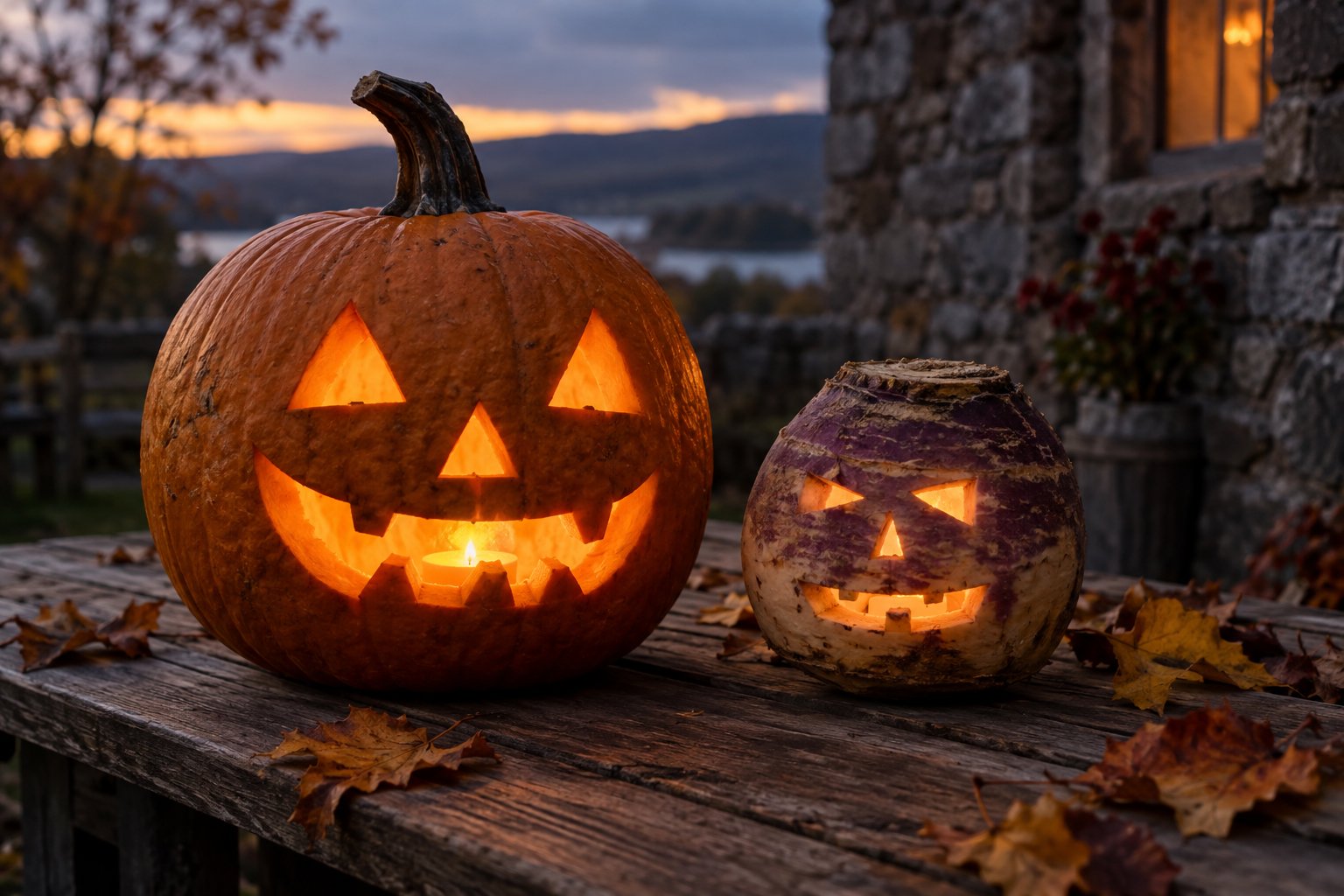
The first lanterns carved with faces were not made from pumpkins. In Ireland, people used turnips. Once the custom spread to North America, pumpkins proved a more convenient choice: they are larger and easier to carve and light from within.
So there is more than one story behind the word “Halloween.” Seasonal customs, the Christian calendar, folk legends and a much later children’s celebration all met along the way. And alongside the costumes and pumpkins, another early-November custom remains: quietly remembering loved ones and lighting candles for them.