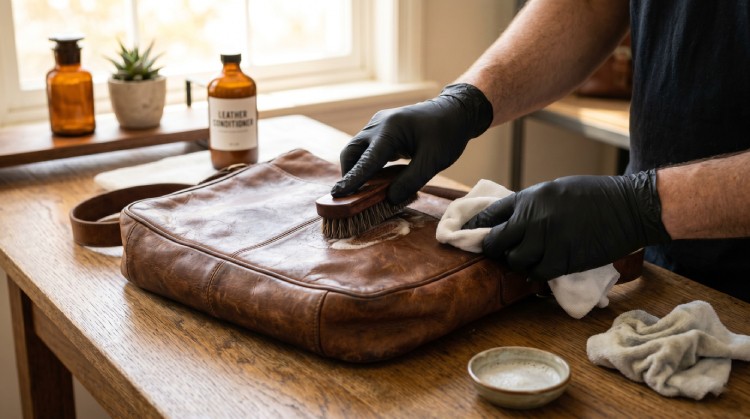
A white, green, or dark coating on a leather jacket or suede shoes is not a stain to immediately soak with alcohol or vinegar. First, work out whether it is actually mold, how far it has spread, and what material you are dealing with. Finished leather, aniline leather, nubuck, and suede should not be cleaned with the same recipe.
Home cleaning is reasonable only for a small, dry area of surface growth on a sturdy item made from finished leather. If the growth is damp, keeps returning, has reached the lining, or appeared after flooding, the problem goes beyond appearance. You need to address the source of moisture and decide whether the item can be restored safely.
🔎 Should you clean it at home?
- You may be able to proceed carefully: there are one or two small, dry patches on finished leather, and the item is not especially valuable or historically important.
- Call a specialist: the material is suede, nubuck, or aniline leather; the item is valuable; the finish is complex; or mold has reached a lining or filling.
- Do not start cleaning yet: the item is wet, the growth smears, the affected area is extensive, or mold is also present in the closet, on the wall, or on nearby belongings.
Protect yourself and nearby belongings first
🛡️ Basic safety precautions
- Wear disposable nitrile or rubber gloves.
- If you will disturb dry growth, wear a well-fitting N95 respirator and protective eyewear.
- Do not clean the item near children, pets, food, or clean clothing.
- Do not mix alcohol, bleach, vinegar, ammonia, or other cleaners.
- Afterward, wash your hands, clean the work surface, and seal disposable wipes in a bag before discarding them.
People with asthma, mold allergies, chronic lung disease, or weakened immune systems should not clean mold themselves. The CDC identifies these groups as more likely to face health risks during cleanup.
Is it definitely mold?
On leather, mold may appear as a loose, powdery, or web-like coating in white, green, gray, or black, sometimes with a musty odor. However, pale wax residue from an old conditioner, fatty spew from the leather, and salt crystals left after water exposure can look similar.
Do not put your face close to the mark to smell it, and skip improvised swab tests. If the coating is unclear and the item is valuable, antique, or delicately dyed, have it examined by a leather-care specialist or conservator.
🧭 Find your situation
How to use this guide: select a row or its arrow to expand the recommendation.
The growth is dry and powdery, and the patch is small
Isolate the item from nearby belongings. If it is finished leather, allow it to dry completely, then carefully remove loose material with a HEPA-filtered vacuum on low suction before spot-cleaning with a product approved by the manufacturer.
The growth is damp or smears when touched
Do not rub or vacuum the surface because the material is not dry enough. Move it to a dry, isolated place with air movement, away from heaters and direct sunlight. Seek professional help if the affected area is large or the growth has returned.
The mold is on suede, nubuck, or aniline leather
Do not use a general-purpose mixture of alcohol and water. These materials can darken, lose their nap, or develop water marks. At home, limit your first response to dry isolation. Use any specialty product only when the manufacturer permits it and only after a patch test; visible growth is better left to a specialist.
The mold has reached a lining, insole, or filling
Porous inner materials are much harder to clean than an exterior surface. Do not cover the odor with fragrance. Shoes, bags, or furniture need professional assessment; a heavily affected item may sometimes be more practical to discard.
The item is valuable, vintage, or sentimental
Do not experiment with alcohol, vinegar, saddle soap, or conditioner. Even successful removal of the visible growth cannot guarantee that the original color will return. Contact a conservator or a leather-care specialist.
How to clean a small, dry patch on finished leather
1. Isolate the item and let it dry completely
Do not put it back in the closet. A dry item can be placed temporarily in a separate bag or container before cleaning so particles do not spread to nearby belongings. Do not seal damp leather in plastic; trapped moisture can make the problem worse.
Dry it at room temperature in a well-ventilated place. Avoid a hair dryer, hot radiator, or direct sunlight. Rapid heating can stiffen or distort leather and damage its finish.
2. Remove only loose, dry growth
The Canadian Conservation Institute recommends a HEPA-filtered vacuum for moldy leather objects. Hold the nozzle close to the surface without pressing it down, and use a soft brush to direct loose material toward the airflow. For thin leather, use the lowest suction and a protective screen over the nozzle.
Do not use a standard vacuum without a HEPA filter: it may return fine particles to the room. Avoid vigorously brushing dry mold into indoor air as well.
3. Patch-test the cleaner
Start with a product the item's manufacturer approves for that specific type of finished leather. Apply it to a clean, light-colored cloth rather than directly to the item. Test an inside fold or another inconspicuous area, then allow the test spot to dry completely.
Stop if color transfers to the cloth or the surface darkens, becomes sticky, or loses its sheen. If you cannot identify the finish, do not keep escalating to stronger products by trial and error.
4. Clean without soaking the leather
Use a barely damp, not wet, cloth with the approved product. Work across the small panel or section rather than scrubbing only the center of the mark, which can leave an obvious outline. Do not spray liquid directly onto the leather or try to soak it through.
Use a second clean cloth to remove residue if the product instructions require it. Turn to a clean section of cloth after each pass so you do not spread the surface growth.
5. Let it dry and reassess
Allow both sides of the leather to dry completely. A stain or color change may remain after the surface growth is removed; that is not automatically a reason to repeat the process with a stronger cleaner.
Apply conditioner or protective cream only if it is recommended for that type of leather. Conditioner does not remove mold and cannot replace moisture control. Patch-test it separately because some products darken leather.
What not to do
- Do not try to “sterilize” the item. Removing every spore from a porous material is not a realistic promise. The goal is to remove visible growth, reduce contamination, and correct the moisture problem.
- Do not use chlorine bleach. It can damage dye, finishes, stitching, and metal hardware.
- Do not apply a 1:1 alcohol solution to every leather or suede item. That recipe appears in older advice, but modern finishes and dyes vary, and alcohol may leave a pale mark or dry the surface.
- Do not treat saddle soap as a universal cleaner. The Canadian Conservation Institute notes that it is highly alkaline and can degrade leather or leave a white deposit.
- Do not seal a damp item in a plastic bag or return it to storage before it is completely dry.
- Do not mix cleaners or add vinegar, alcohol, or essential oils to a commercial product.
What about suede and nubuck?
Suede and nubuck need a different approach. Their nap can flatten easily, and liquids may leave outlines. Claims that an alcohol solution will “evaporate quickly and definitely not harm the material” are too risky to follow.
A small amount of dry surface growth may be isolated and carefully removed with a HEPA-filtered vacuum on the lowest suction if the item's construction allows it. Leave wet cleaning to a specialist. If the manufacturer permits a dedicated suede or nubuck cleaner, test it in a hidden area and follow the instructions exactly.
After professional or otherwise appropriate cleaning, the nap may be restored with a suitable brush. For routine maintenance, see The LINES guide to cleaning suede without damaging the material.
How to keep mold from returning
Mold returns because the conditions that support growth are still present, not because you missed a single “invisible spore.” Check the back of the closet, exterior walls, pipes, condensation, and adjacent storage boxes. If mold is present beyond the item itself, the whole storage area needs attention.
- Use a hygrometer to monitor humidity. The EPA recommends keeping indoor relative humidity below 60%, ideally between 30% and 50%.
- Keep leather goods away from cold or damp walls and leave room for air to circulate.
- Let shoes, bags, and jackets dry fully before storage.
- For long-term storage, use a clean, breathable cover if that matches the manufacturer's care guidance.
- Silica gel can help inside a small, closed container only when there is enough of it and it is regularly reconditioned or replaced. It cannot compensate for a leak or a damp closet.
- Inspect stored items periodically, especially after a warm, humid season.
Sources and further reading
- CDC: personal protection during mold cleanup and higher-risk groups.
- CDC: mold, moisture, and possible health effects.
- US EPA: limits of home cleanup and porous materials.
- US EPA: humidity control and mold prevention.
- Canadian Conservation Institute: removing mold from leather.
- Canadian Conservation Institute: leather care and saddle soap cautions.
Conclusion
A small, dry patch on finished leather can sometimes be cleaned carefully at home. With suede, nubuck, aniline leather, valuable pieces, or an affected lining, it is safer to stop early and consult a specialist. A good result depends less on the strength of a cleaning solution than on identifying the material, controlling particles, and fixing the source of moisture.