The World Heritage List is not a ranking of the planet’s most photogenic places. It includes cultural and natural sites considered exceptionally valuable not only to one country, but to humanity as a whole.
Some preserve evidence of geological processes that unfolded over millions and billions of years. Others reveal how earlier societies built cities, managed water, or adapted to difficult terrain. There are also places where the natural processes for which they are protected continue today.
This selection is not an attempt to identify UNESCO’s ten “best” sites. It brings together very different examples to show the range of World Heritage—and why certain places deserve to be understood, not merely photographed.
1. Grand Canyon National Park, United States
The scale of the Grand Canyon is extraordinary, but its importance goes beyond the view. Layers of rock exposed in the canyon walls preserve evidence of Earth’s geological history.
The canyon extends for roughly 445 kilometres and approaches 1.5 kilometres in depth. The Colorado River and continuing erosion are still reshaping the landscape. The dramatic change in elevation also creates several environments within the park, from desert conditions below to conifer forests along the rims.

2. Historic Sanctuary of Machu Picchu, Peru
Machu Picchu is often described as a lost Inca city, although local people knew of its existence long before the archaeological complex became widely known beyond Peru in 1911.
The World Heritage property encompasses much more than the stone citadel standing more than 2,400 metres above sea level. It covers a broad area where the Andes meet the upper Amazon Basin and architecture is integrated with mountain slopes, forest, and several natural habitats.
About 200 structures, together with terraces, stairways, and drainage systems, demonstrate how precisely the Inca worked with difficult terrain. The stonework does not simply sit on the mountain: it follows its shape and helps stabilise the slopes.

3. Galápagos Islands, Ecuador
The Galápagos Islands were among the first properties added to the World Heritage List. The archipelago lies about 1,000 kilometres from mainland Ecuador, where several ocean currents meet.
Isolation, volcanic activity, and the different conditions found across individual islands encouraged the development of unusual species and local forms of life. Marine iguanas, giant tortoises, flightless cormorants, Galápagos penguins, and several birds live here. Observations made after Charles Darwin’s 1835 visit influenced his thinking about evolution.
UNESCO protects not only the islands but also the marine environment around them. The connection between land and ocean is especially visible here: sea lions, birds, and iguanas depend on both ecosystems.

4. Stonehenge, Avebury and Associated Sites, United Kingdom
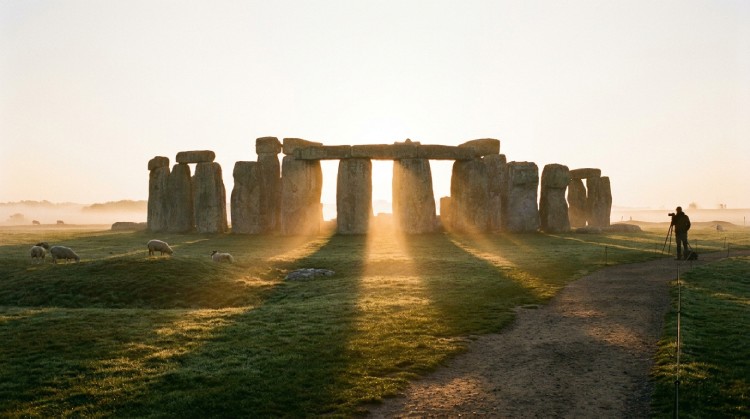
On the World Heritage List, Stonehenge does not stand alone. The property joins two extensive archaeological landscapes—Stonehenge and Avebury—with burial sites, earthworks, ancient avenues, and evidence of settlements.
Stonehenge is regarded as the world’s most architecturally sophisticated prehistoric stone circle, while Avebury contains its largest prehistoric stone circle. These landscapes were shaped and used for roughly two thousand years, from the early Neolithic to the Bronze Age.
The precise purposes of individual monuments have not been established. They are associated with ceremony, burial, and observations of seasonal cycles, but describing Stonehenge simply as an “ancient observatory” would be too reductive.
For a closer look at the complex and its archaeological discoveries, read The LINES guide to the mysteries of Stonehenge.

5. Acropolis, Athens, Greece
The Acropolis is more than the Parthenon. The rocky hill preserves an ensemble that also includes the monumental Propylaea, the Erechtheion with its Porch of the Caryatids, and the Temple of Athena Nike.
Its best-known buildings were created in the fifth century BC, when Athens pursued an ambitious construction programme under Pericles after the Greco-Persian Wars. The architecture of the Acropolis influenced buildings far beyond Greece, from European Neoclassicism to government institutions in many parts of the world.

6. Historic Centre of Rome, Italy
The Colosseum is often called a UNESCO site, but it is officially part of a much larger property: the Historic Centre of Rome, together with the extraterritorial properties of the Holy See and the Basilica of Saint Paul Outside the Walls.
The site’s value lies in almost three millennia of urban history. Ancient forums, the Pantheon, and the Colosseum exist beside early Christian basilicas, Renaissance palaces, Baroque squares, and the streets of a modern city.
Rome has not been frozen within a single historical period. Successive generations rebuilt it, reused materials, and gave older structures new purposes.

7. Taj Mahal, India
The Taj Mahal is a white-marble mausoleum built in Agra by order of the Mughal emperor Shah Jahan in memory of his wife Mumtaz Mahal. The principal structure was constructed from about 1632 to 1648, while other parts of the ensemble were completed later.
It is frequently described only as a monument to love, but the complex has much broader architectural significance. Mughal, Persian, and Indian traditions meet in its carefully controlled proportions, calligraphy, relief carving, and stone inlay.
The mausoleum stands not at the centre of the garden but at its far end beside the Yamuna River. This decision created a deep perspective and made the building the visual conclusion of the entire space.

8. The Great Wall, China
The Great Wall is neither one continuous structure nor the project of a single emperor. It is a complex network of walls, passes, fortresses, beacon towers, and natural defensive barriers built by different states and dynasties from the third century BC to the seventeenth century AD.
According to UNESCO, the system extends for more than 20,000 kilometres. Its sections vary greatly, from well-preserved Ming masonry to earlier fortifications made from rammed earth.
The Wall was more than a military barrier. It influenced human movement, trade, exchanges between agricultural and nomadic societies, and the ways in which China understood its borders.

9. Angkor, Cambodia
Angkor Wat is only the best-known temple within an enormous archaeological complex. The World Heritage property covers about 400 square kilometres and contains the remains of several capitals of the Khmer Empire dating from the ninth to the fifteenth centuries.
Roads, canals, embankments, and large reservoirs survive alongside the temples. This water system helped sustain a major urban environment and shows Angkor not as a collection of romantic jungle ruins, but as a highly organised cultural landscape.
The complex includes Angkor Wat, the fortified city of Angkor Thom with the Bayon temple, Ta Prohm, Preah Khan, and dozens of other monuments.

10. Serengeti National Park, Tanzania
Serengeti National Park protects around 1.5 million hectares of savannah and lies at the heart of a much larger ecosystem extending across Tanzania and Kenya.
The region is best known for the Great Migration. About two million wildebeest and hundreds of thousands of zebras and gazelles move in search of water and fresh pasture, with predators following the herds. This is not one column of animals or a spectacle that begins on the same date each year, but a continuous cycle shaped by rainfall.
The Serengeti matters for more than migration. It supports one of the world’s largest systems of interaction between big herbivores and predators, as well as habitats for elephants, black rhinoceroses, cheetahs, African wild dogs, and hundreds of bird species.

What UNESCO status actually means
UNESCO does not own these places or manage their ticket sales. World Heritage properties remain under the responsibility of national governments, local authorities, and communities. Inscription recognises their Outstanding Universal Value, but it does not automatically protect them from overtourism, development, climate change, or political decisions.
For a traveller, the implication is simple: UNESCO status is more than a mark of quality beside a landmark’s name. It is a reminder to leave as little damage as possible.
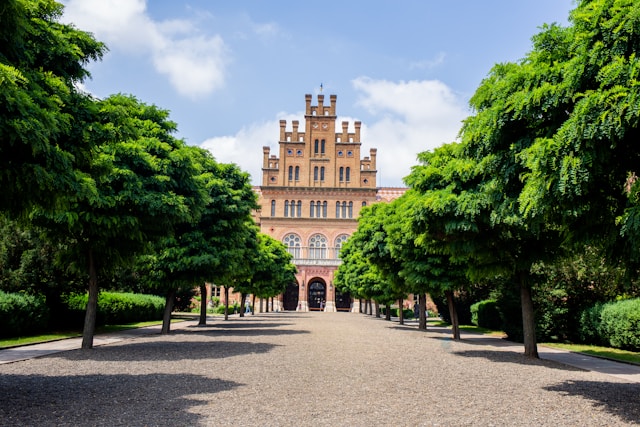
A first encounter with World Heritage does not have to begin with a long-haul flight. Ukraine’s inscribed properties include Saint Sophia Cathedral in Kyiv, the Historic Centre of Lviv, the ancient beech forests of the Carpathians, and the Residence of Bukovinian and Dalmatian Metropolitans in Chernivtsi. The LINES explores the last of these in our feature on Chernivtsi University.