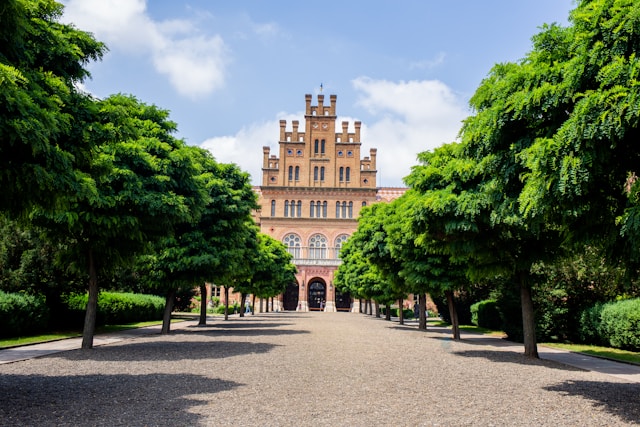
Among the variety of architectural monuments in Ukraine, there is one that consistently evokes admiration, a skipped heartbeat, and a sense of absolute fairytale. It is often called the "Ukrainian Hogwarts," but its true history is much deeper, more complex, and grander than any fantasy novel. We are talking about the former Residence of Bukovinian and Dalmatian Metropolitans, and now — the central buildings of Yuriy Fedkovych Chernivtsi National University.
This architectural ensemble is a true pearl of Chernivtsi and, since 2011, has been deservedly recognized as a UNESCO World Heritage site. Majestic towers, slender brick walls, roofs covered with glazed tiles featuring Hutsul ornaments — all this creates a unique atmosphere that attracts thousands of tourists from all over the world. But how did such a miracle appear on the territory of modern Ukraine?
The Genius of a Young Architect
The history of this masterpiece began in the mid-19th century thanks to the efforts of Bishop Yevhen Hakman. It was he who convinced the Austrian Emperor Franz Joseph I of the need to build a new residence that would match the status of the capital of Bukovina. In 1864, the emperor issued a decree to begin construction.
The project was entrusted to an incredibly talented Czech architect, Josef Hlávka. At that time, he was only 29 years old! His brilliant idea was to masterfully combine seemingly incompatible architectural styles in this building: austere Byzantine monumentality, Romanesque massiveness, Gothic elegance, and bright motifs of Bukovinian folk architecture.

An 18-Year Construction: Egg Yolks and Perfect Bricks
Only the best local materials were used for the construction. Hlávka approached the process with unprecedented meticulousness. Specifically for this grandiose project, two new brick factories and one ceramic factory were opened in Chernivtsi, and stone was brought from surrounding Bukovinian quarries.
There is a legend (which local guides love to tell) that the mortar for laying the bricks was made with the addition of chicken eggs and organic additives (even animal blood) for incredible strength. And every single brick was carefully checked for sound and durability: a master would drop it from a height of 20 meters, and if it broke, the entire batch was rejected.
- Years of construction: 1864 - 1882
- Budget: 1,750,000 guilders (an astronomical sum for those times)
- Architect: Josef Hlávka
- Area: About 12 hectares (including the park)
Interior: Halls That Remember Emperors
If the facades of the university make you stop in awe, the interior decoration will leave you breathless. The ensemble consists of three main buildings: the Main (Metropolitan), Seminary (with a church), and Monastery.

The Marble (Synodal) Hall
It was once considered one of the most beautiful halls in Europe. Its walls were covered with genuine marble of various shades, and the ceiling was decorated with incredible frescoes. Unfortunately, during the Second World War, in 1944, the hall was seriously damaged by a massive fire that destroyed the synodal library. What we see today is the result of filigree restoration by masters who rebuilt it using Hlávka's original drawings.
The Red Hall
This is perhaps the most valuable room of the residence, as it has preserved its authentic appearance untouched since the 19th century. Its walls are decorated with luxurious Chinese red silk (and this is not wallpaper, but real fabric!), and the carved wooden ceiling resembles a precious jewelry box. Original Venetian mirrors also hang here.

Church of the Three Holy Hierarchs
In the center of the Seminary building is the Church of the Three Holy Hierarchs. It is a true masterpiece not only of architecture but also of engineering. The acoustics in this temple are so perfect that they are compared to the best opera houses in the world. Every sound here resonates and amplifies many times, so church singing within these walls gives you goosebumps.
The Dendrological Park: The Green Heart of the University
Behind the main building lies a magnificent dendrological park covering almost 5 hectares, also designed by Josef Hlávka. Exotic trees and shrubs from all over the world are gathered here. One of the main attractions of the park is a rare cork tree and a tulip tree. Right in the center of the park is a bronze bust of the brilliant architect, looking at his creation.

Legends and Mysticism: Mirrors and Dungeons
Like every majestic building, Chernivtsi University is shrouded in urban legends.
- The Mirror of Youth: Huge Venetian mirrors hang in the Red Hall. Legend has it: if a woman looks into one of them, she will rejuvenate by 10 years, and if a man does, all his sins will be forgiven. That's why there is always a line of female tourists near these mirrors.
- Secret Passage: It is rumored that a vast network of dungeons exists beneath the university, the longest tunnel of which leads all the way to the Chernivtsi railway station. The architect supposedly planned it for the safe evacuation of the clergy in case of war.
- Masonic Signs: Attentive tourists notice not only Christian crosses on the towers of the complex but also the Star of David (on the clock tower). This was a symbol of the deep tolerance of Bukovina, where different confessions and nations coexisted peacefully.

A Legacy That Lives On
The greatest phenomenon of this landmark is that it is not just a "dead" museum with dusty exhibits. Today, life boils within these historical walls — ordinary Ukrainian students study here. The symbiosis of the past and present creates a unique energy here. Students with laptops rush to lectures through corridors where metropolitans, emperors, and distinguished European guests majestically strode over a century ago.
"The residence in Chernivtsi is not just a building; it is a symphony in brick and stone, where every detail has its meaning and tells the story of an entire region."
Excursions around the territory and halls of the university are held daily from 10:00 to 17:00 (the schedule should be clarified on holidays). Entrance to the territory is paid, but the fee is symbolic. Be sure to take a ticket with a local guide — only this way will you be able to get inside the closed state halls, learn all the secrets, and see the Red Hall with your own eyes!
Main article photo: Roman Synkevych on Unsplash