July does not offer one perfect night when everything appears at once. Early in the evening, you can learn the Summer Triangle. Closer to midnight, the brightest part of the Milky Way emerges above the southern horizon. By late July, several meteor showers begin to overlap. Most of these sights require no telescope—the right time and location matter far more.
Find the Summer Triangle, the Moon, and the brightest visible planets.
Look for the Milky Way, Scorpius, and occasional meteors.
Plan it near new moon or around a meteor-shower maximum.
Check the conditions before the date
Exact lunar phases, planet positions, and meteor-shower maximum times shift slightly from year to year. Even the correct date is of little use under thick cloud or when a bright Moon washes out faint stars. Before leaving, check the cloud forecast, Moon phase, and a sky map set to your own location.
The Milky Way’s central region and the radiants of the more southerly showers remain fairly low for mid-northern latitudes. A site with a clear southern horizon—free of buildings, trees, and bright lights directly ahead—is especially valuable.
1. The Summer Triangle is the easiest place to begin
Vega, Deneb, and Altair form a large triangle visible even from many cities. Start with Vega, one of the brightest stars in the summer sky. Deneb belongs to Cygnus, while Altair sits in Aquila. As your eyes adjust, the fainter star fields of the Milky Way become easier to notice between them.
The Summer Triangle is not a constellation but an asterism—a recognizable pattern made from stars in different constellations. It is an excellent anchor for learning the sky without constantly checking an app.
2. The Milky Way above the southern horizon
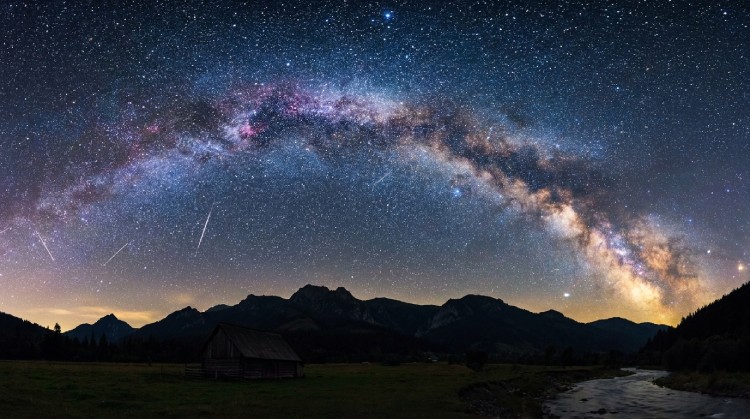
Photographs make the galaxy look colorful and highly contrasted, but to the unaided eye it resembles a pale, uneven band. Its richest summer section lies toward Sagittarius and Scorpius. In Sagittarius, look for the Teapot asterism; under a dark sky, the Milky Way appears to rise from its spout like steam.
Choose a night near new moon, wait until evening twilight has ended, and avoid bright screens for at least 20 minutes. If the band does not appear immediately, be patient. Your eyes need time, and clear, transparent air can matter as much as distance from a city.

3. Antares, Scorpius, and the M4 star cluster
Low in the south, find reddish Antares, the brightest star in Scorpius. A curved chain of stars below and to one side forms the scorpion’s tail and stinger. At mid-northern latitudes, the constellation never climbs especially high, so an unobstructed horizon makes a substantial difference.
The globular cluster M4 lies near Antares. It disappears easily into urban glow, but under a dark sky you can try to locate it with 10×50 binoculars. A small telescope shows the pale, hazy patch more clearly.
4. A young Moon beside an evening planet
A few days after new moon, a thin crescent appears low in the west. Depending on the year, Venus, Mars, Mercury, or a bright star may seem close beside it. The pairing does not mean the objects are physically near each other; they merely appear along similar lines of sight from Earth.
This is an easy target for a short observation or a phone photograph. Begin looking after sunset, but never aim binoculars toward the Sun while it is still above the horizon.

5. July’s full Moon near the horizon
The full Moon is most dramatic as it rises. Framed by buildings, trees, or distant hills, it can appear unusually large. This is the familiar Moon illusion rather than a real change in the satellite’s size.
The name Buck Moon is common in North American calendars. It is a cultural name for July’s full Moon, not a separate astronomical phenomenon. Full moon is not the best time for telescopic lunar detail because direct illumination flattens the relief. Craters stand out more clearly along the boundary between light and shadow during other phases.

6. Southern Delta Aquariids
This shower is active from mid-July into the second half of August, with its maximum usually arriving in late July. For Northern Hemisphere observers, the radiant remains relatively low in the southern sky, so visible rates are lower than they are farther south.
Go out after midnight, lie back, and watch a broad area of sky. Published peak rates describe ideal conditions. City light, clouds, and a bright Moon may reduce the display to only a handful of obvious streaks.
7. Alpha Capricornids and occasional bright fireballs
The Alpha Capricornids do not produce a dense “star storm”; even under good conditions, rates are low. Their appeal lies elsewhere: the slow meteors can include conspicuous fireballs. Their activity overlaps the Southern Delta Aquariids, so late July can bring meteors traveling in noticeably different directions.
There is no need to stare directly at Capricornus. Meteor trails often look longer farther from the radiant. Watch a broad area roughly halfway between the horizon and the zenith.
8. The first Perseids before the August peak
The Perseids become active in the second half of July, although their famous maximum comes in August. By late July, the first fast Perseids may join the Delta Aquariids and Alpha Capricornids. If you trace their paths backward, they appear to lead toward Perseus.
You do not need to classify every meteor. For casual observing, a dark sky, a wide view, and patience matter more. Meteor activity arrives unevenly, so several quiet minutes do not mean the night is over.

How to plan one observing evening
- After twilight
Find the Summer Triangle, a young Moon, or an evening planet. - Toward midnight
Turn south for Antares, Scorpius, and the Milky Way. - After midnight
Put the binoculars aside and watch for meteors with the unaided eye.
This is not a universal timetable. In July, twilight length and object altitude depend on the date, latitude, and your horizon. A planetarium app lets you preview the sky for the exact night before making the trip.
What to bring
- a sleeping mat or reclining chair;
- a warm outer layer, even after a hot day;
- a red flashlight or red-screen mode;
- 7×50 or 10×50 binoculars for M4 and rich star fields;
- a warm drink and power bank for a longer session.
Give your eyes 20–30 minutes to adapt and resist checking the phone after every meteor. A star chart is the simplest navigation tool; never use a laser pointer near aircraft or flight paths.
The most useful rule for July skies
Choose a dark, moonless night for the Milky Way, an open eastern horizon for the full Moon, and several hours after midnight for meteors. One night is rarely ideal for all three.
Where to confirm the exact dates
Before each July, update only the variable part of the plan: lunar phases, Moon–planet pairings, comet visibility, and moonlight conditions during meteor-shower maxima. For planets, always set the sky map to your own city. An event that is convenient in another country may happen below your horizon or in bright twilight.
July landmarks
NASA: the Summer Triangle and other asterisms · NASA Night Sky Network: Scorpius, Antares, and M4
Meteors
NASA: meteors and meteor showers · International Meteor Organization: annual shower calendar
Annual changes
NASA Skywatching · Moon phases for a selected city