Stonehenge is easy to imagine as a mystery frozen in time: a circle of stones on an open plain, unknown builders, and dozens of theories about its purpose. Archaeologists, however, know far more about it than this familiar image suggests. They have identified the principal stages of construction, traced most of the stones to their source regions, and found evidence of people arriving from distant parts of Britain.
The central question remains. We still cannot say exactly what happened inside the stone circle. But the boundary between archaeological evidence, informed interpretation, and later legend is becoming much clearer.
Stonehenge is more than a stone circle
The monument stands on Salisbury Plain in the English county of Wiltshire. Together with Avebury and their associated archaeological sites, it forms a UNESCO World Heritage property.
The famous stone circle is only the centre of a much larger prehistoric landscape. Nearby are burial mounds, earthworks, the processional route known as the Avenue, the settlement at Durrington Walls, and the timber monument of Woodhenge. People used this landscape for burial, gathering, and ceremony for roughly two thousand years.
Stonehenge should therefore not be understood as a structure completed from a single plan within one generation. Its appearance changed repeatedly.
How Stonehenge changed
Select a period to open that stage of the story.
About 3000 BC — the first Stonehenge
The earliest monument was a circular earthwork about 100 metres across, enclosed by a ditch and banks. Inside it was a ring of 56 pits now known as the Aubrey Holes.
Cremated human remains were buried here. The first Stonehenge was therefore associated with the dead before its famous stone arches appeared.
About 2500 BC — the stone circle
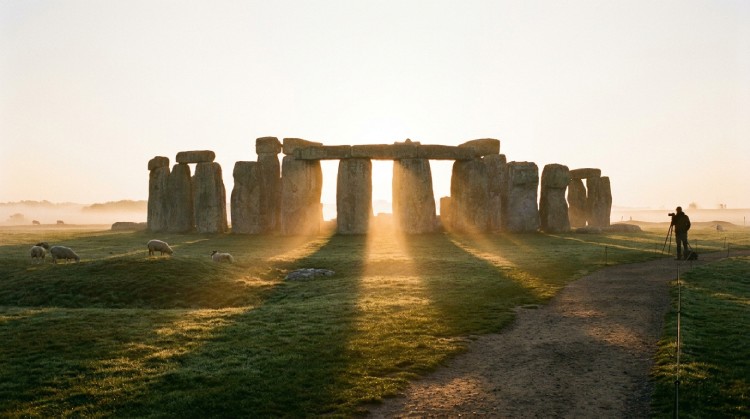
Large sarsen blocks were brought to the centre and arranged as an outer circle and inner trilithons—structures made from two upright stones supporting a horizontal lintel.
This is when Stonehenge began to assume the form recognised today. Smaller stones, conventionally called bluestones, were also being placed within the complex.
About 2300–2200 BC — the stones rearranged
The bluestones were moved into a new circle and inner oval. Stonehenge was also connected to the River Avon by a broad earthwork route known as the Avenue.
Its final stretch follows the same axis as the central monument.
About 2100–1500 BC — barrows and carvings
Hundreds of burial mounds appeared across the surrounding landscape. Images of axes and daggers were carved into several stones. Building gradually ceased, although the place retained a special significance long afterwards.
The familiar statement that “Stonehenge was built 4,500 years ago” tells only part of the story. The stone circle did take shape around that time, but the complex began earlier and continued to change for many centuries.
Where did the stones come from?
Stonehenge was built with several kinds of stone rather than one uniform material.
Sarsens
The largest upright blocks and horizontal lintels are made from sarsen, an exceptionally hard sandstone. Geochemical analysis connects most of them with West Woods in the Marlborough Downs, about 25 kilometres from Stonehenge.
Some sarsens weigh more than 40 tonnes. Moving such loads even a few dozen kilometres would have required a large and carefully organised workforce.
Bluestones
Most of the smaller stones came from the Preseli Hills in west Wales, about 250 kilometres from the monument. “Bluestone” does not mean that every one has the same colour or composition. It is a broad name for several rock types brought from outside the local area.
Archaeologists still debate their route. The stones may have travelled part of the way by water, but no single transport route has been proved.
The Altar Stone
The six-tonne Altar Stone lying near the centre of the complex has a separate story. It was once linked with Wales, but a study published in Nature in 2024 traced its geological signature to north-east Scotland.
The probable source lies more than 750 kilometres away. We do not know how the stone made that journey, but its origin points to much wider connections between Neolithic communities in Britain than researchers once assumed.

How were the great stones raised?
Stonehenge’s builders left no written account, so their precise methods of transport and construction remain unknown.
The stones were probably dragged on wooden sledges with ropes, while earth ramps, timber frames, and levers may have helped raise them. An upright could be gradually tipped into a prepared pit before its base was secured with chalk rubble.
Positioning the lintels was no less demanding. One possibility is that a timber platform was built up beneath each stone until it reached the required height.
The joints are remarkably precise. Projections carved into the tops of the uprights fitted into hollows in the lintels, while neighbouring lintels were also joined to one another—much as a skilled craftsperson might connect pieces of timber.

Why was Stonehenge built?
Stonehenge may have served several purposes, and those purposes could have changed with the monument itself.
Its earliest phase was used as a cemetery. Later, the stone circle may have become a setting for ceremonies connected with the dead, the sun, and the changing seasons. At nearby Durrington Walls, archaeologists have found remains of a settlement and evidence of large feasts. People travelled there from different parts of Britain, perhaps to take part in seasonal gatherings.
The monument’s alignment with the solstices is evidence, not legend. Viewed from the centre, the sun rises near the Heel Stone at the summer solstice. In the opposite direction, the winter-solstice sunset once passed between the uprights of the tallest trilithon.

This shows that the sun’s movement mattered to the builders. Calling Stonehenge a complete observatory or a precise stone calendar, however, goes beyond the evidence. The stones may have helped mark important points in the year, probably as part of broader ceremonial practices.
Some archaeologists believe that the winter solstice may have been especially significant. Evidence of large feasts at Durrington Walls points to gatherings at this time. During the darkest part of the year, communities may have met to mark the passing season and anticipate the return of longer days.
What science has revealed about Stonehenge’s people
Analysis of cremated remains has offered clues about the people buried near the monument. In a 2018 study, researchers examined bones belonging to 25 individuals. At least ten of them had spent the final years of their lives away from the chalk landscape around Stonehenge.
The isotope values are compatible, among other areas, with west Wales—the region from which the bluestones came. This does not prove that every one of these people was born there or personally transported the stones. It does support the picture of Stonehenge as part of an extensive network through which people, materials, and ideas moved.
The best-known myths about Stonehenge
The Druids built it
Druids became closely associated with Stonehenge in art and popular culture from the seventeenth to the nineteenth centuries. The stone circle, however, was erected more than two thousand years before the first surviving written references to Druids.
Modern followers of Druid traditions hold ceremonies there, but they are not the direct historical descendants of the monument’s builders.
Merlin carried the stones
Geoffrey of Monmouth popularised this story in the twelfth century. In his account, Merlin used magic to transport the giant stones from Ireland.
The legend matters as part of Stonehenge’s cultural history, not as an explanation of its origin. By the time it appeared, the people who had built the monument had been unable to tell their own story for several millennia.
Only aliens could have done it
The precise joints and enormous weight of the stones are genuinely impressive, but extraterrestrial technology is unnecessary to explain them. Archaeological experiments show that large stones can be moved and raised with ropes, timber, levers, and coordinated labour.
The mystery is not whether human beings were capable of the work. It is how they organised a project sustained over so many generations, and why it mattered enough to continue.
Every stone came from Wales
A substantial number of the smaller bluestones came from Wales. The great sarsens were brought from the much nearer Marlborough Downs, while current evidence points to a Scottish origin for the Altar Stone.
A mystery made richer by every discovery
Science has not produced one simple explanation for Stonehenge—and there may never have been one. It began as a place of burial; later generations raised stones, built a ceremonial avenue, and gathered at significant moments in the year.
We do not know the words spoken among the stones, and we cannot reconstruct every ritual. What we do know is no less remarkable: communities across Britain maintained connections, moved multi-tonne stones over immense distances, and returned to the same place over many generations.
The human story of Stonehenge ultimately proves more compelling than most legends of magic or aliens.
Sources
- English Heritage: A timeline of Stonehenge
- English Heritage: Building Stonehenge
- English Heritage: Understanding Stonehenge
- UNESCO: Stonehenge, Avebury and Associated Sites
- Clarke et al., Nature, 2024: A Scottish provenance for the Altar Stone of Stonehenge
- Snoeck et al., Scientific Reports, 2018: Strontium isotope analysis of cremated remains