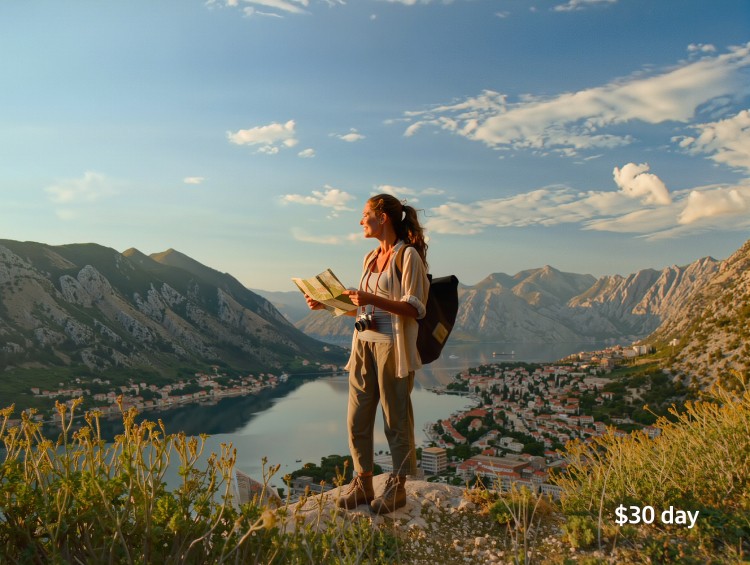
Thirty dollars a day sounds like a ready-made travel budget: multiply it by the number of days and start booking. In reality, that number means very little until you know what kind of accommodation, food, transport and activities it is supposed to cover.
In Laos or Vietnam, it is still possible to stay near that figure without feeling as though every decision is an exercise in deprivation. In Montenegro or on the Albanian coast in summer, $30 may not even cover reasonable accommodation. Georgia, Armenia and Bulgaria sit somewhere in between: the budget can work, but only for certain routes and styles of travel.
We revisited all seven countries from the previous version of this article and compared them with traveler spending data available in 2026.
What a $30 daily budget means here
Our estimates cover one person’s expenses after arrival, excluding international travel. They assume that the traveler:
- shares a simple double room or stays in a hostel;
- eats mainly at inexpensive local restaurants;
- uses public transport;
- does not move between cities constantly;
- mixes paid sights with free walks and activities.
The figure does not include flights, travel insurance, visas, expensive excursions, car rental, alcohol or shopping.
If you are traveling alone and want a private room, $30 a day will be too little almost everywhere on this list. Nor does it describe a resort holiday or an itinerary built around private transfers.
The result at a glance
Where a $30 daily budget still works
$30 works
- Laos$20–30 · a simple, independent itinerary
- Vietnam$25–35 · without expensive tours or frequent transfers
Possible with trade-offs
- Georgia$25–40 · if you travel slowly
- Armenia$25–40 · easier in Yerevan, harder with day trips
- Bulgaria$30–45 · mainly outside the coastal high season
Plan a larger budget
- Albania$45–65 · higher on the coast
- Montenegro$55–75 · $30 is too little for a typical holiday
These are planning ranges, not fixed prices. They were checked in August 2026; actual costs vary by city, season and whether you share accommodation.
Laos: $30 still leaves some room to maneuver
Laos is the strongest fit in this list. Traveler spending data puts a typical trip at roughly $22 per day, although the figure changes noticeably by destination and activity.
In Vientiane, Vang Vieng or Luang Prabang, you can find a simple room, eat at local restaurants and get around without relying on taxis. A $30 budget may even leave a little room for admission fees or bicycle rental.
The high-speed railway, organized excursions, private transfers and frequent moves can quickly undo the calculation. Luang Prabang may also cost more on popular dates.
Vietnam: realistic if you choose one region
Travelers following a very economical itinerary spend about $24 per day in Vietnam on average. That means simple accommodation, local food, public transport and a limited number of paid activities.
It is easier to stay near the target in Da Nang, Da Lat, Nha Trang or Ninh Binh. Hanoi and Ho Chi Minh City can also be affordable, but popular excursions and tourist districts raise the average quickly.
The budget begins to unravel once it includes a Ha Long Bay cruise, domestic flights, private cars, resort islands or daily organized tours.
Scooter rental should not be presented as a universal money-saving trick. You need the appropriate licence, experience, a helmet and insurance that genuinely covers this type of transport.
Georgia: affordable in the city, more expensive in the mountains
A day in Georgia can fit within $30, particularly if you share a room, use the metro and marshrutkas, and eat where locals do.
However, the old estimate that placed a room in central Tbilisi or Batumi at $10–18 cannot be treated as a universal benchmark. In 2026, typical traveler spending in Georgia is closer to $38 per day, while hotel prices rise substantially in summer.
Kakheti, Kazbegi, Svaneti and other mountain regions require extra transport. Add a private tour or regular taxi rides and the daily total can easily move beyond $40.
Armenia: affordable daily life, but the sights are spread out
Accommodation, public transport and everyday cafés remain affordable in Armenia. Budget travelers may spend roughly $25–30 per day, especially outside Yerevan’s most expensive neighborhoods.
The difficulty is geography. Garni, Geghard, Khor Virap, Lake Sevan and Tatev all lie outside the capital. Public transport does not suit every itinerary, while organized tours or a private car quickly add to the total.
A cheap day in Yerevan, therefore, does not translate into the same budget for a trip across the country.
Bulgaria: $30 is the lower limit, not a comfortable budget
Bulgaria remains one of the more affordable countries in the European Union. But the old claim that $20–28 would cover a room in Sunny Beach, full meals and transport is too optimistic.
In Sofia, Plovdiv, Veliko Tarnovo or Ruse, a budget near $30 may work with a hostel bed or inexpensive shared accommodation. On the coast in July and August, accommodation alone can exceed that entire amount.
Travel style also matters. A package holiday and an independent daily budget cannot be compared on daily spending alone: the package may already include travel, transfers and meals.
Albania: the old prices no longer hold
Albania remains more affordable than many Mediterranean destinations, but it is no longer a country where a traveler can expect a “comfortable” holiday for $22–29 a day.
In 2026, budget travelers spend roughly $49 per person on average. In Ksamil and Sarandë during July and August, even a simple room near the sea often costs more than the entire stated daily allowance.
Tirana, Berat, Gjirokastër and Shkodër are better-value choices, particularly in May, June and September. Still, the lack of a convenient passenger rail network leaves travelers dependent on buses, minibuses or more expensive transfers.
Montenegro: beautiful, but no longer exceptionally cheap
Montenegro is the clearest contradiction of the old article’s promise. Current data puts even budget travel at about €52 per day, or roughly $60 depending on the exchange rate.
Budva, Kotor and the coastal resorts are particularly expensive in summer. Accommodation, restaurants, boat trips and transfers between the coast and the mountains make a $30 budget unrealistic.
You can spend less in Bar, Ulcinj or Cetinje, and outside the high season. Even then, it is safer to allow at least $50–60 per day.
Where $30 a day still makes sense
Laos and Vietnam remain the best candidates if you count only expenses after arrival. In Georgia and Armenia, the budget is possible for a slow, city-based itinerary. In Bulgaria, it works as a lower limit outside the coastal high season.
For Albania and Montenegro, the promise of traveling “comfortably under $30” belongs firmly in the past.
Even in Laos, however, low costs on the ground do not guarantee a cheap trip overall. Flights, insurance, visas and transport to the first stop may cost more than several weeks of daily expenses.
You can calculate the full cost, including international travel, in The LINES guide to the cheapest countries to visit in 2026.
Sources
- Budget Your Trip: traveler costs in Laos
- Budget Your Trip: traveler costs in Vietnam
- Budget Your Trip: traveler costs in Georgia
- Budget Your Trip: traveler costs in Armenia
- Budget Your Trip: traveler costs in Bulgaria
- Budget Your Trip: traveler costs in Albania
- Budget Your Trip: traveler costs in Montenegro
- Eurostat: comparative price levels in the EU