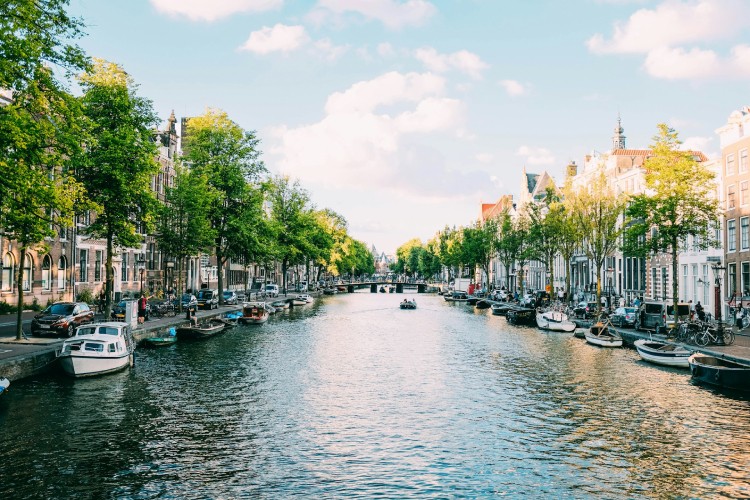
When we think of Amsterdam, the first thing that comes to mind is the endless network of waterways that picturesquely pierce the entire city. There are considerably more canals here than in Venice, and their total length exceeds 100 kilometers (62 miles), connecting around 90 islands via more than 1,500 bridges.
But these world-famous canals were not created for romantic evening boat rides. In the 17th century, during the Dutch Golden Age, they were an absolutely brilliant, massive infrastructure project that transformed a dangerous, swampy area into the wealthiest economic capital of the world.
The Grachtengordel Crescent: A Masterpiece of Urban Planning
The unique system of the three main concentric canals — Herengracht (Patricians' Canal), Keizersgracht (Emperor's Canal), and Prinsengracht (Princes' Canal) — forms a perfect crescent around the historic city center. They were dug entirely by hand over 400 years ago. This intricate network served three vital functions:
- Defense & Drainage: Effective water management and drainage saved the city from constant, devastating floods.
- Trade Logistics: The canals became the perfect transport arteries. Merchants could bring exotic goods on boats directly to the doors of their towering warehouses.
- Urban Expansion: The excavated soil was used to reinforce the banks and create new, stable land for building houses to accommodate a rapidly growing population.
"Amsterdam is a city literally pulled from the water. Every historic house here stands on dozens of wooden piles driven deep into the unstable mud."
Today, the entire Grachtengordel (Canal Ring) district is officially listed as a UNESCO World Heritage site. The absolute best way to experience its true magic is to rent a small, eco-friendly electric boat or simply sit on the bank, legs dangling over the water, enjoying a portion of hot, traditional Dutch fries.
A City on Stilts: How the Houses Stay Afloat
The swampy soil forced the ingenious Dutch to invent a highly specific method of construction. Beneath every historic house, long wooden piles (measuring 15 to 20 meters) are driven down to rest on a solid layer of sand deep underground. For example, the famous Royal Palace on Dam Square sits on a staggering 13,659 wooden piles! Today, due to the aging of the wood and fluctuating groundwater levels, many old houses have noticeably leaned, creating the famous and charming "dancing facades" of Amsterdam.
Life on the Water: The Houseboat Phenomenon
Strolling along the embankments, you will inevitably notice the houseboats (woonboten) tightly moored along the canal edges. Their unique history began shortly after World War II when the city faced a severe housing crisis. At that time, old, decommissioned cargo barges began to be massively converted into temporary apartments for the poor and free-spirited hippies.
Nowadays, the situation has changed dramatically. Owning a houseboat in the center of Amsterdam is a hallmark of luxury. Modern floating homes are fully connected to all city utilities (electricity, gas, central sewage), and their interiors often resemble high-end designer lofts. There are about 2,500 such boats in the city, and obtaining a new mooring permit today is virtually impossible.
Tips for the Perfect Canal Stroll
To make your encounter with the canals truly unforgettable, try exploring them at different times of the day. Early in the morning, a mystical mist often rolls over the water, and the bridges are completely devoid of tourists. In the evening, the canals transform into a fairytale as thousands of yellow lights illuminate the arches of the bridges (the absolute best view is at the intersection of Reguliersgracht and Herengracht, where you can see 15 bridges at once from a single spot!).