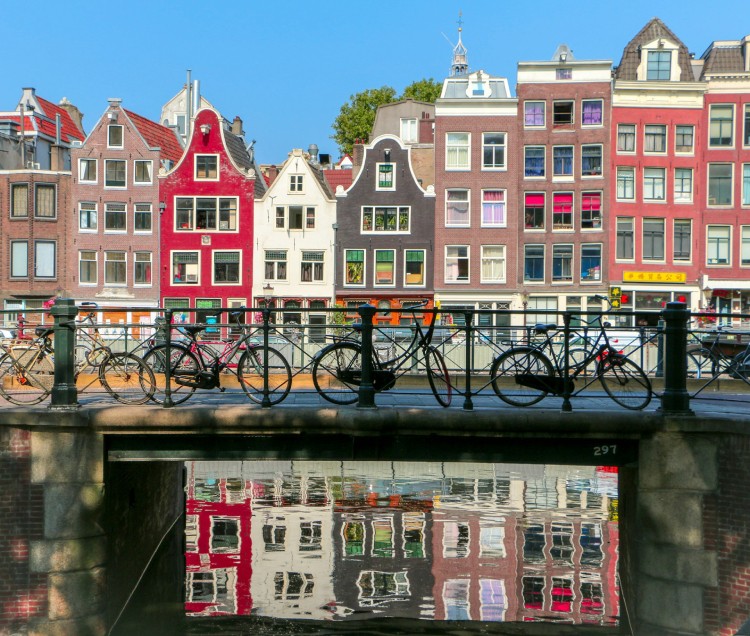
In Amsterdam, a bicycle is not a tourist attraction but an everyday form of transport. People ride to work, take children to school, carry groceries and hurry to catch trains. The city has up to 400 kilometres of cycle paths, but good infrastructure does not necessarily make a first ride through the centre easy.
Local cyclists move quickly, know the junctions well and expect everyone around them to behave predictably. Before renting a bike, it helps to understand not only the road signs but also the rhythm of the city.
Should a tourist rent a bike?
If you can ride confidently, look over your shoulder without drifting and stay calm in dense traffic, a bicycle can help you see far more of Amsterdam in a day.
The city centre, however, is not a good place to learn. Narrow streets, tram tracks, busy junctions, cargo bikes and streams of commuters leave little time for hesitation.
- practise on a quiet street or a calm section of your route;
- plan the route in advance so you do not need to search the map while moving;
- do not start near Amsterdam Centraal during rush hour;
- consider a guided bike tour if riding in city traffic makes you nervous.
The busiest periods are roughly 08:00–09:00 and 17:00–18:00. If you are not in a hurry, take your first ride when the commuting rush has eased.
The biggest myth: cyclists are not “always right”
Amsterdam’s extensive cycling infrastructure gives cyclists priority in many situations, but there is no universal rule saying that a cyclist is always right.
At a junction, check:
- traffic lights;
- road signs;
- road markings;
- the direction of traffic;
- white triangles called haaientanden, or “shark’s teeth”.
If the points of the triangles face you, you must give way to traffic on the priority road. At an uncontrolled junction, traffic approaching from the right generally has priority, although signs and markings override this basic rule.
A tram should not be treated like an ordinary car either. It cannot swerve or stop quickly, so do not try to slip across its path unless you are certain that you have both enough time and the right of way.
A zebra crossing is not decoration
The previous version of this article advised visitors not to rely on pedestrian crossings. That wording was incorrect.
Drivers, including cyclists, must give way to pedestrians who are crossing or clearly waiting to cross at an uncontrolled zebra crossing. Where pedestrians have their own traffic lights, follow the signal.
The practical rule for visitors is simple: do not copy individual locals who break the rules. Slow down before a crossing and be ready to stop.
Seven rules to learn before your first ride
Keep to the right
Use the cycle path or lane in the correct direction and keep to the right, leaving room for others to pass. Do not ride on the pavement or enter pedestrian streets where cycling is prohibited.
Red surfacing often indicates a cycle route, but colour alone is not enough. Look for bicycle symbols, signs and the direction of the traffic flow.
Do not stop in the cycle lane
If you need to check the route, answer a message or take a photograph, pull over somewhere safe first. Stopping suddenly in the flow is much like stopping a car in the middle of a traffic lane.
Signal turns with your hand
Before turning, look behind you, make sure there is room and then signal with your hand. The gesture does not give you automatic priority; it tells others what you intend to do.
You do not need to keep your arm extended throughout the turn. What matters is signalling early and avoiding a sudden change of direction.
Overtake on the left
Before overtaking, check that nobody is already passing you. Move back to the right afterwards, but leave enough space for the cyclist you have just passed.
Cyclists may ride two abreast in the Netherlands when they are not obstructing other traffic. On busy routes, visitors are usually better off riding in single file.
Keep your phone in a pocket or mount
Holding a phone or another electronic device while cycling is illegal. The rule covers not only calls and messages but also checking a map.
You may use navigation in a fixed mount as long as it does not distract you. To change the route or enter an address, stop completely in a safe place.
Use lights after dark
A bicycle must have working front and rear lights after dark. Check them before leaving the rental shop even if you expect to return before evening: plans can run late, and poor weather can quickly reduce visibility.
A bell is a warning, not an argument
A short ring usually means “I am approaching” or “You are blocking the cycle path.” It is rarely meant as a personal insult.
A bell does not give anyone the right to ride through a crowd. If pedestrians or an unpredictable situation are ahead, slow down first.
How to cross tram tracks safely
Tram tracks are one of the most common difficulties for first-time cyclists in Amsterdam. A narrow tyre can drop into the rail groove, causing the front wheel to stop or turn abruptly.
Cross the rails at as close to a right angle as possible. If your approach is too shallow, adjust your line before reaching the track and check the traffic behind you first.
Do not turn sharply on the rail or brake over it with the front wheel. Metal becomes slippery in the rain, so reduce your speed before you reach the tracks.
If you cannot find a safe angle or the traffic is too dense, there is nothing wrong with getting off and walking the bike across.
How to park without searching for your bike at Fietsdepot
In Amsterdam, you cannot leave a bicycle wherever there happens to be an empty space. Use a marked parking area, a rack or an indoor bike parking facility.
- bridges;
- traffic signs;
- lampposts;
- railings where it blocks the way;
- trees or private property.
In busy parts of the city, an improperly parked bike may be removed and taken to the municipal Fietsdepot. If this happens to a rental bike, contact the rental company first: identification, the key and proof of rental may be needed to recover it.
Use two locks to reduce the risk of theft. A ring lock secures the rear wheel, while a chain should fasten the frame to the bicycle rack. Do not secure only a wheel, as it can be removed while the lock stays behind.
Why some parking facilities are free for seven days and others for one
In 2026, the rules depend on the operator.
After this period, the bicycle may be removed and taken to Fietsdepot.
A charge may apply once the free period has ended.
The underground Stationsplein facility in front of the central station has around 7,000 spaces. Together, the two large underwater parking facilities on either side of the station hold approximately 11,000 bicycles.
Read the information at the entrance before leaving the bike. The rules of that particular facility determine the free period, check-in method and any fee.
Amsterdam rewards predictable riding
You do not need to match the speed of local cyclists to ride confidently in Amsterdam. Holding a steady line, signalling your intentions, keeping the cycle path clear and reading each junction carefully matter far more.
A bicycle changes the way Amsterdam fits together: neighbourhoods feel closer, and a day no longer has to revolve around the historic centre. The ride is most enjoyable when you treat the bike not as an attraction but as transport with clear rules.