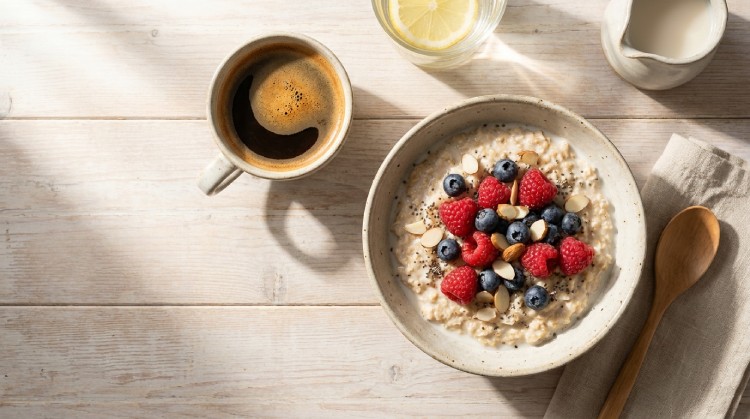
Oatmeal with berries may feel more satisfying than a pastry, but not because fiber has special powers before noon. There is no convincing evidence for one universal “best time” to eat it. Breakfast matters for a more practical reason: it is one opportunity to add whole grains, fruit, vegetables, beans, nuts, or seeds to your day.
If you are not hungry in the morning, you do not need to force down breakfast for the sake of fiber. What matters more is getting it from a variety of foods across the day instead of trying to fit the entire target into one bowl.
Higher-fiber foods can improve feelings of fullness. Breakfast is a convenient place for them, particularly when the usual alternative is white toast, sugary cereal, or a pastry.
Morning fiber does not “program” appetite, eliminate snacking, or guarantee that someone will eat fewer calories at lunch and dinner.
Does fiber really affect appetite control throughout the day?
Fiber is only one influence on fullness. Protein, fat, meal volume and texture, calorie content, sleep, activity, and individual response all matter. Fiber is not a single substance, either: different fibers vary in solubility, viscosity, and fermentation. Not every type forms a gel, and not every high-fiber food affects appetite in the same way.
A 2025 systematic review brought together 48 randomized crossover studies of cereal fiber. The authors found a fairly consistent favorable direction for subjective satiety, but a much weaker pattern for how much food people actually ate when given free access. In other words, “I feel fuller” does not always translate into “I consume fewer calories.” The review also does not establish that breakfast is superior to every other time of day.
What the headline-making 2026 trial actually found
The study frequently cited in favor of a high-fiber breakfast included just 19 adults with overweight or obesity. Each participant followed a higher-fiber weight-loss diet for 28 days and a higher-protein diet during another period. Researchers provided all food, and both plans placed 45% of daily energy in the morning.
- 19 participants
This was a small controlled trial, not a cross-section of the general population. - Two full-day diets
The comparison was not one bowl of oatmeal versus one omelet; it covered everything participants ate. - The same morning emphasis
Both diets put the largest share of energy early in the day, so the trial cannot identify a best time for fiber.
Average weight loss was greater on the higher-fiber diet, and the abundance of several groups of gut bacteria described as potentially beneficial increased. The higher-protein diet, however, was better at suppressing subjective appetite. Those findings are worth studying further, but they do not support a promise that breakfast fiber controls hunger through the evening.
How much fiber belongs in the day?
The World Health Organization recommends that adults consume at least 25 grams of naturally occurring dietary fiber each day, primarily from whole grains, vegetables, fruit, and pulses. That is a whole-day target, not a breakfast assignment.
On U.S. Nutrition Facts labels, the Daily Value is 28 grams for a 2,000-calorie diet. The FDA considers 5% Daily Value or less per serving low and 20% or more high. Those percentages are useful for comparing packaged foods, but individual needs vary with energy intake and health circumstances.
A practical way to think about fiber is as a series of opportunities: a source at breakfast, vegetables or beans at lunch, fruit or nuts as part of a snack, and another plant food at dinner. This pattern adds variety and is often easier on the digestive system than a large dose at one meal.
A breakfast formula that does not rely on one “superfood”
- Start with a fiber source: oats, a true whole-grain cereal, whole-grain bread, or beans.
- Add another plant food: berries, an apple or pear with the skin, tomatoes, greens, or other vegetables.
- Include protein: plain yogurt, cottage cheese, eggs, beans, tofu, or another option that fits your diet.
- Finish for flavor and texture: a small serving of nuts or seeds if they work for you.
You do not need every example at once. The point is to pair fiber with the other parts of a complete meal, not simply sprinkle seeds over a breakfast that does not satisfy you.
Four familiar breakfasts, made more substantial
- Oatmeal
Add berries or a chopped apple, then include plain yogurt or another protein source alongside it. - Eggs or an omelet
Cook vegetables into the eggs and add beans, whole-grain toast, or a whole-grain tortilla. Eggs themselves contain no fiber. - Yogurt or cottage cheese
Pair it with berries, a pear, oats, or a modest portion of nuts instead of relying on a sugary fruit-flavored cup. - Toast
Choose a bread with a whole grain listed first, then add nut butter and fruit or pair it with vegetables, eggs, or a bean spread.
A smoothie can retain fiber when it contains whole fruit, vegetables, oats, or seeds. Still, a drink is easy to consume quickly and may not satisfy you in the same way as foods you chew. Juice without pulp is not nutritionally interchangeable with whole fruit.
Reading a cereal or bread label
“Multigrain,” “wheat,” “made with whole grains,” and a brown color do not tell you how much fiber a product contains. Check the ingredient list and the Dietary Fiber line on the Nutrition Facts panel. A whole grain should appear near the beginning of the ingredients, and the fiber number lets you compare realistic serving sizes.
Also look at added sugars. A cereal can contain some fiber and still be more dessert-like than breakfast-like. Likewise, a bar with isolated fiber is not nutritionally identical to oats and fruit simply because the grams match; whole foods bring different combinations of water, protein, fats, and micronutrients.
Increase fiber gradually if your current intake is low
A sudden jump from a low-fiber diet to large servings of bran, beans, and seeds can cause gas, bloating, or changes in bowel habits. Increase the amount gradually and pay attention to tolerance. Drink enough fluid for your thirst, activity, climate, and medical needs; there is no single water target that is right for everyone.
If you are considering psyllium for constipation or another specific purpose, see The LINES’ separate guide to psyllium benefits and safe use. Supplements can require specific fluid instructions and may affect the timing of some medications.
When general advice is not enough
If you have irritable bowel syndrome, inflammatory bowel disease, narrowing of the digestive tract, have recently had certain surgeries, or have been prescribed a low-fiber diet, increases should be individualized. Persistent pain, blood in the stool, unintentional weight loss, or a lasting major change in bowel habits deserves medical assessment rather than a breakfast experiment.
The bottom line
Breakfast does not have a proven monopoly on the benefits of fiber. It can still be a useful first step: swap a refined grain for a whole grain, eat whole fruit instead of juice, or add vegetables or beans to a savory meal. The best time to eat fiber is the time that helps you get a varied, tolerable amount consistently across the day.
Sources
- World Health Organization — carbohydrate and dietary fiber guideline
- FDA — how to understand the Nutrition Facts label
- Fyfe et al., 2026 — randomized trial of morning diet composition, appetite, and gut health
- Mackie et al., 2025 — systematic review of cereal fiber and satiety
- Clark & Slavin, 2013 — systematic review of fiber, appetite, and food intake
- NIDDK — fiber, gradual increases, and fluids