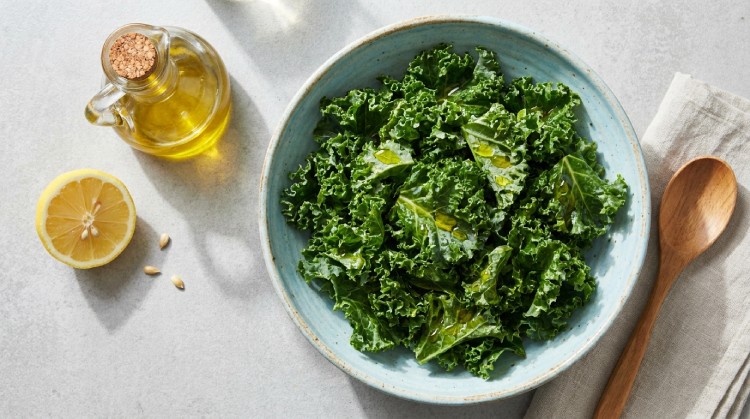
You do not have to eat dry kale out of obligation to benefit from it. The leaves are better in both flavor and texture when they become part of a normal meal — with an oil-based dressing, nuts, seeds, or another source of fat.
There is a scientific reason for that pairing: dietary fat helps the body absorb carotenoids from vegetables. The popular advice to “add a spoonful of oil and unlock 100% of kale’s benefits,” however, oversimplifies the research. The study behind the claim did not involve people, did not test every vitamin, and used a specially prepared sauce that was quite different from a homemade dressing.
Not a superfood — just a useful leafy vegetable
“Superfood” is not a scientific category. The word tells us nothing about how much of a food someone eats, how often they eat it, or what the rest of the meal looks like.
Kale does have a valuable nutrient profile. It provides fiber, vitamin C, folate, and a substantial amount of vitamin K. The leaves also contain lutein, alpha-carotene, and beta-carotene. The body can convert some carotenoids into vitamin A.
That makes kale a useful addition to the diet, not a treatment or a required purchase. If it is expensive where you live or you simply do not enjoy it, broccoli, cabbage, spinach, chard, and other greens can also contribute to a varied eating pattern. No single vegetable is irreplaceable.
Why carotenoids benefit from fat in the meal
Carotenoids do not dissolve well in water. During digestion, the products of fat breakdown help form mixed micelles — microscopic structures that carry fat-soluble compounds toward the intestinal surface.
This does not mean plain kale passes through the body “unused.” Some carotenoids remain accessible without added fat. Having fat in the same meal, however, can increase their bioavailability.
The principle is not unique to kale. Studies using salads with several vegetables also show that fat in a meal affects the absorption of lutein, alpha-carotene, beta-carotene, and other carotenoids.
What the 2025 kale study actually tested
The paper behind the “secret ingredient” headlines was published in the journal Food Nutrition. Researchers compared the bioaccessibility of lutein, alpha-carotene, and beta-carotene from raw and cooked kale.
Several details are easy to lose in a short retelling.
- No people took part
The researchers used a laboratory model that simulated food passing through the mouth, stomach, and small intestine. - One variety and one cooking method
Curly kale was heated at 212°F (100°C) for five minutes. The findings cannot automatically be applied to every variety or cooking method. - The sauce was made in a laboratory
The emulsion contained olive oil, water, and whey protein isolate and was processed under high pressure. It was then diluted to 4% oil. - Only three carotenoids were measured
The study did not measure blood concentrations, health outcomes, or absorption of every vitamin in kale.
What the laboratory model found
Without the emulsion, the measured bioaccessibility of carotenoids from raw kale varied considerably.
- 47% for lutein;
- 0.6% for alpha-carotene;
- 41% for beta-carotene.
- 88% for lutein;
- 49% for alpha-carotene;
- 83% for beta-carotene.
The researchers saw a similar direction of change with cooked kale. The emulsion substantially increased the transfer of carotenoids into the micellar fraction whether it was paired with raw or cooked leaves.
How to interpret those percentages
They do not mean that a person will absorb exactly that share of carotenoids from a kale salad. Laboratory bioaccessibility is only one step between a food and the amount that eventually enters the blood and tissues. The authors themselves said that human studies are needed to confirm the nutritional relevance.
Do human studies support the general mechanism?
A separate randomized crossover trial published in 2023 examined carotenoid absorption from salad in 16 adults. Participants ate the same salad with different fats. The researchers compared olive oil with coconut oil and emulsified fat with nonemulsified fat.
More carotenoids appeared in the blood after the salad with emulsified fat than after the nonemulsified version. Olive oil also produced a better overall result than coconut oil.
This trial supports the general mechanism, but it was not a kale study. Each test meal also contained 28 grams of fat, so the results cannot tell us the minimum amount of oil needed in a homemade salad.
How much oil should you add?
The kale study did not establish a universal serving. There is no reason to drench the leaves in oil or turn every salad into a very high-calorie dish.
The practical takeaway is simpler: kale does not have to be eaten entirely without fat. A normal dressing or another source of fat within the same meal may help with carotenoid absorption.
What to pair with kale
- olive, canola, or sunflower oil;
- tahini or another seed butter;
- walnuts or other nuts;
- sunflower, pumpkin, or sesame seeds;
- avocado;
- another fat-containing food that fits the meal and your eating pattern.
Olive oil is not the only correct option. Canola or sunflower oil can work well when their flavor better suits the dish.
Raw or cooked: which is better?
There is no need to choose one “healthiest” method for every meal.
Raw kale retains its crunch, but mature leaves can be tough and bitter. Slicing them thinly and briefly massaging them with dressing makes the texture softer and more pleasant. The 2025 study did not test massaging as a separate method, so it should not be described as a proven way to “release” every vitamin. It is primarily a useful culinary technique.
Cooked kale is softer, takes up less space on the plate, and pairs easily with grains, beans, eggs, soups, and stews. Heating can reduce some temperature-sensitive compounds, including vitamin C, but that does not make cooked kale nutritionally empty.
In the laboratory study, heating for five minutes did not improve carotenoid bioaccessibility on its own. The emulsion made the larger difference. That finding does not establish that every cooking method has the same effect.
The best method is the one that makes you want to eat the vegetable instead of leaving it at the edge of the plate.
How to prepare the leaves
Rinse kale thoroughly, paying attention to the folds in curly leaves, and dry it afterward. Excess water dilutes dressing and prevents it from coating the surface evenly.
For salad, separate the leafy portion from the thickest central rib and slice it into thin strips. Add the dressing and briefly massage the leaves with your hands. They will become darker, softer, and less coarse.
The central stem is edible and does not have to go in the trash. It simply needs more cooking time. Chop the stems finely and add them to the pan or pot before the leaves. The toughest pieces can also be used in vegetable stock.
Four ways to prepare kale
- Beet and walnut salad
Thinly slice the leaves, then add roasted beets, walnuts, and a dressing made with olive or sunflower oil plus lemon juice or apple cider vinegar. The sweetness of the beets balances kale’s natural bitterness. - Warm garlic side dish
Cook the chopped stems briefly before adding the leaves. Continue until the kale softens and shrinks, then finish with garlic, lemon juice, or a little mustard. Serve with grains, beans, eggs, or fish. - Flexible kale pesto
Blend kale with walnuts or sunflower seeds, oil, garlic, and lemon juice. Add a hard cheese if you like. Serve with pasta, roasted potatoes, grains, or toast. - Soup or stew
Add chopped stems with the other firm vegetables and the leaves closer to the end. Kale works well with beans, lentils, potatoes, and tomatoes. If the dish already contains oil or another source of fat, an additional dressing is unnecessary.
An important note about vitamin K
Kale is high in vitamin K. People taking these medications should avoid sudden large increases or decreases in kale and other leafy greens. The goal is not necessarily to eliminate these foods, but to keep vitamin K intake consistent and discuss major dietary changes with a clinician.
For most people, vitamin K is simply one of the nutritional advantages of leafy greens. It is involved in normal blood clotting and bone metabolism.
If a large serving of raw kale causes bloating or discomfort, start with less or try it cooked. There is no benefit in forcing yourself to eat a food in a form you do not tolerate well.
What to remember
Kale does not become an “elixir of health” when olive oil is added. Pairing leafy vegetables with a source of fat does, however, have a reasonable scientific basis because it can improve the absorption of carotenoids and vitamin K.
The 2025 study illustrates a plausible mechanism, but it used a laboratory digestion model and a specially designed emulsion. Its practical lesson should remain modest: make kale part of a complete meal, prepare it in a way you enjoy, and do not try to extract “100% of the benefits” from one vegetable.
Sources
- Zhu et al., 2025 — culinary processing of kale and carotenoid bioaccessibility
- Yao et al., 2023 — fat type, emulsification, and carotenoid absorption
- NIH Office of Dietary Supplements — vitamin K sources and anticoagulant interactions
- USDA SNAP-Ed — kale nutrition, selection, and uses