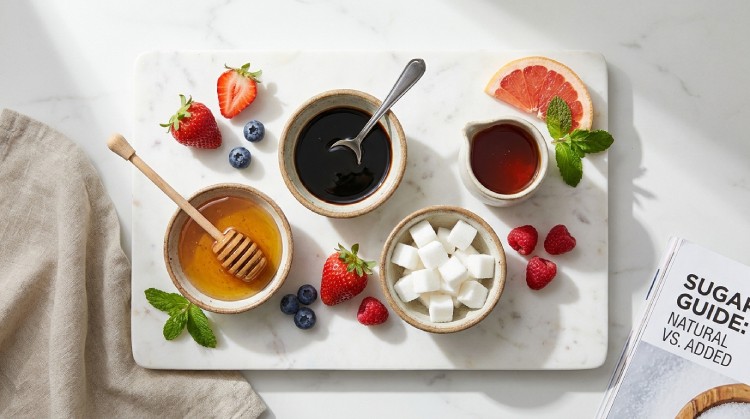
The sugar in an apple, milk, and a soft drink may include some of the same simple molecules. Nutritionally, however, the name of the sugar is only part of the story. The food that carries it matters too.
A whole apple provides water, fiber, and micronutrients, and it requires chewing. A sweetened drink can deliver a substantial amount of sugar in a few minutes without fiber or much fullness. That is why “all sugar is the same” is as misleading as the idea that honey or agave syrup is automatically healthier than table sugar.
Start with three different definitions
Food labels and nutrition guidance use several related terms that should not be treated as interchangeable.
- Total sugars
This includes every simple sugar in a food, whatever its source: naturally occurring lactose in milk, fructose in fruit, and any sugar added by the manufacturer. - Added sugars
These are sugars and sweet ingredients added during processing or home preparation. Sugar stirred into tea, honey drizzled over oatmeal, syrup in coffee, and sugar in a bottled sauce all count. - Free sugars
This broader category includes added sugars plus sugars naturally present in honey, syrups, fruit juice, and juice concentrates. A bottle of juice can therefore have “no added sugar” and still contain free sugars.
Sugars that remain within the structure of whole fruits and vegetables, along with naturally occurring sugar in milk, are not classified as free sugars.
Why a whole apple is not the same as apple juice
In whole fruit, sugar comes with fiber, water, and the physical structure of plant tissue. Fruit also has to be chewed, so it is generally eaten more slowly than juice is consumed.
Juicing removes much of that structure and fiber. One glass may also contain the juice of several pieces of fruit that would take longer to eat whole.
A difference in form, not a forbidden food
This does not make juice “toxic” or whole fruit unlimited. The practical distinction is that whole fruit is generally more filling and is not a source of free sugars, while sugars in juice count toward free-sugar intake.
A smoothie sits somewhere in between. It may retain more fiber than strained juice, but blended fruit is still easy to drink quickly and in a larger quantity than you might eat whole.
How much sugar do dietary guidelines allow?
The Dietary Guidelines for Americans recommend keeping added sugars below 10% of total daily calories. On a 2,000-calorie diet, that is less than 50 grams of added sugar. The FDA uses 50 grams as the Daily Value on the Nutrition Facts label.
Some public-health guidance uses a stricter population target of about 5% of daily energy from free sugars. These figures are general reference points, not identical personal prescriptions. Energy needs vary with age, body size, health, and activity level.
The limits do not refer to every gram of sugar naturally present in whole fruit, vegetables, and unsweetened dairy foods.
How to find added sugar on a food label
On U.S. Nutrition Facts labels, `Total Sugars` includes both naturally occurring and added sugars. The indented `Includes X g Added Sugars` line identifies the amount added during processing. Labels used in some other countries may show only total sugars, which makes the ingredient list especially important.
- Read the ingredient list
Ingredients appear in descending order by weight. If sugar or syrup is near the beginning, it is a major component. A lower position does not always mean very little was used because a product may contain several different sweeteners. - Look beyond the word “sugar”
Added sugar may appear as a syrup, honey, molasses, fruit juice concentrate, or a named simple sugar. An unfamiliar name is not necessarily more dangerous; it is often simply another sweetening ingredient. - Check both total and added sugars
Plain yogurt may contain total sugars because of naturally occurring lactose. A flavored version can contain that lactose plus fruit sugars and added sweetener. - Compare similar products
Compare yogurt with yogurt or cereal with cereal, using the same serving basis. Also consider fiber, protein, sodium, saturated fat, and the ingredient list rather than judging a food by one number. - Use the portion you actually eat
If a food lists 12 grams of sugar per 100 grams and you eat 150 grams, the portion contains 18 grams of total sugar. That does not automatically mean all 18 grams were added.
Common names to look for
- cane sugar, brown sugar, or raw sugar;
- glucose, fructose, dextrose, maltose, or sucrose;
- invert sugar;
- corn syrup or high-fructose corn syrup;
- glucose syrup or malt syrup;
- honey;
- molasses;
- agave, rice, or maple syrup;
- fruit juice concentrate when used as a sweetener.
A quick yogurt label comparison
- ingredients: milk, live cultures;
- total sugars: 4.5 g per 100 g.
Most of the sugar comes from lactose naturally present in milk. No sweetener appears in the ingredient list.
- ingredients: milk, strawberry preparation, sugar, starch, live cultures;
- total sugars: 12 g per 100 g.
The total combines naturally occurring lactose, sugar from strawberries, and added sugar.
The useful conclusion comes from both parts of the label: the ingredient list confirms that sugar was added, while the nutrition panel shows how much total sugar the product contains. On a U.S. label, the `Added Sugars` line supplies the additional breakdown.
What “no added sugar” actually means
The claim means that sugar or another ingredient used for its sweetening properties was not added. A product may still contain sugars that occur naturally in its ingredients.
“No added sugar” does not mean a food contains no sugar, can be eaten without regard to portion size, or is automatically more nutritious than a similar product.
Dried fruit with no added sugar still contains concentrated natural sugar. A sugar-free product may contain non-sugar sweeteners, refined starch, substantial sodium, or saturated fat.
A front-of-package claim describes only one feature. Use the full ingredient list and nutrition panel to judge the product as a whole.
Are honey, brown sugar, and agave any better?
If you prefer the taste of honey or maple syrup, there is no reason to replace it with white sugar. There is also little reason to market these sweeteners as dramatically healthier.
Honey, syrups, coconut sugar, and brown sugar may contain small amounts of minerals or plant compounds. A typical serving usually provides too little to make the sweetener a dependable nutrient source.
Getting a meaningful amount of those nutrients from syrup or sugar would also mean consuming a substantial amount of free sugar. Vegetables, fruits, beans, nuts, seeds, grains, dairy foods, and other nutrient-dense foods are much better sources.
- Honey
Honey consists mostly of sugars. Its strong flavor may help in some recipes if you prefer to use less, but it still counts as free and added sugar in dietary guidance. - Maple syrup and agave
These syrups differ in flavor and in the proportions of individual sugars, but they remain sources of free sugar. “Natural” and “plant-based” do not change that. - Brown and coconut sugar
A brown color does not make sugar equivalent to a whole grain. Differences in mineral content are too small to matter much at moderate serving sizes. - Molasses
Dark molasses can contain more of certain minerals than white sugar, depending on the product and portion. It is still free sugar and is not a do-it-yourself treatment for iron deficiency.
Honey can show antimicrobial effects in laboratory work, and specially prepared medical-grade honey has clinical uses in wound care. Neither point makes a spoonful of culinary honey a treatment in an ordinary diet.
Choose a sweetener for its flavor and culinary function, not because it has been marketed as “healthy sugar.”
Do you need to give up sweets entirely?
For most people, the goal is not an absolute ban. A limited amount of added sugar can fit into an otherwise varied eating pattern.
The most useful change is usually not finding the perfect syrup, but reducing foods and drinks that make it easy to consume a lot of sugar without noticing:
- soft drinks, sweet tea, and energy drinks;
- flavored syrups in coffee drinks;
- sweetened yogurt and dairy desserts;
- cereals, granola, and bars with several sweeteners;
- bottled sauces;
- frequent large servings of baked goods and candy.
If you are used to very sweet flavors, reduce them gradually. Add fruit or berries to plain yogurt or oatmeal, order fewer pumps of syrup in a drink, or mix a sweetened cereal with an unsweetened one.
A separate note for people with diabetes
“No added sugar” does not mean a food will have no effect on blood glucose. Total carbohydrate, portion size, the rest of the meal, medication, and individual response all matter.
People with diabetes should follow an individualized eating plan developed with their clinician or registered dietitian rather than relying on a single marketing statement.
What to remember
You do not need to memorize dozens of sugar “aliases” or fear every ingredient ending in “-ose.” The practical method is much shorter:
- Check whether sugar, honey, syrup, or another sweetening ingredient appears in the ingredient list.
- Notice how high it appears in the list.
- Read the total and, where available, added sugars on the nutrition panel.
- Compare the product with similar foods using the same serving basis.
- Calculate the amount in the portion you actually plan to eat.
- Do not treat honey, agave, or brown sugar as nutritionally “free” because it comes from a natural source.
The most meaningful difference is not between white sugar and brown sugar. It is between a nutrient-dense whole food in which sugar is only one component and a product that delivers a large amount of sweetness with little fiber or fullness.
Sources
- U.S. Food and Drug Administration — added sugars on the Nutrition Facts label
- CDC — added sugars and common dietary sources
- EFSA — total, added, and free sugars
- UK Scientific Advisory Committee on Nutrition — free-sugar guidance