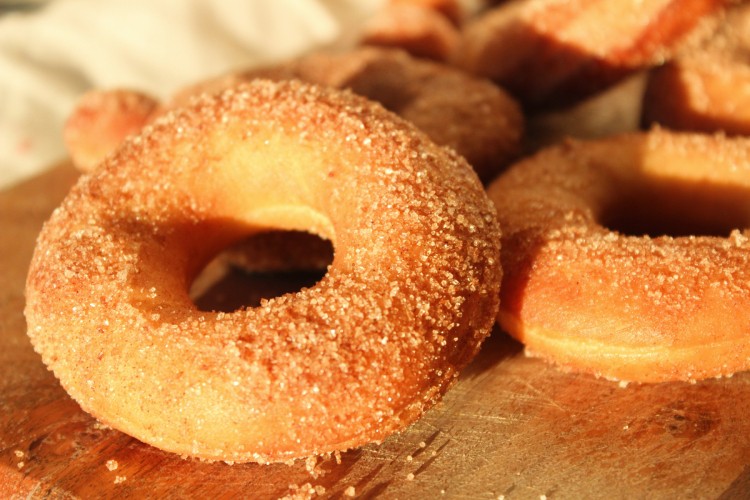
These donuts use baking powder and baking soda rather than yeast, so there is no proofing time. Their interior resembles a soft, spiced cake baked in a ring. They are a different dessert from a fried yeast donut, not an exact oven-made copy.
Three details control the result: stop mixing once the flour disappears, fill each well close to the rim, and remove the donuts as soon as the top springs back from a light touch.
Recipe at a glance
- Yield: 12 standard baked donuts
- Active time: 15–20 minutes
- Bake time: 10–12 minutes
- Oven: 375°F / 190°C
- Pan: two 6-well donut pans, or bake in two batches
How are they different from yeast donuts?
These baked donuts have a cake-like crumb, rise with chemical leaveners, and require no proofing.
Classic yeast donuts have a stretchy, airy center and a delicate fried shell. For that style, use The LINES recipe for fried yeast donuts.
Ingredients
- 4 tbsp (57 g) unsalted butter, softened
- 1/4 cup (50 g) neutral vegetable oil
- 1/2 cup (100 g) granulated sugar
- 1/3 cup packed (70 g) light or dark brown sugar
- 2 large eggs
- 1 1/2 tsp baking powder
- 1/4 tsp baking soda
- 1/2 tsp ground nutmeg
- 3/4 tsp fine salt
- 1 tsp vanilla extract
- 2 2/3 cups (320 g) all-purpose flour
- 1 cup (227 g) milk
If brown sugar is unavailable, use 170 g granulated sugar. The flavor will be simpler and the crust slightly paler, but the recipe will still work.
Allergens: wheat, milk, and eggs.
Mix the batter
- Prepare the pans. Heat the oven to 375°F / 190°C. Lightly grease every well, even if the pan is nonstick.
- Combine fats and sugars. Beat the softened butter, oil, and both sugars until smooth, about 1–2 minutes. The mixture does not need to become highly aerated.
- Add the eggs. Beat them in one at a time. Mix in the baking powder, baking soda, nutmeg, salt, and vanilla.
- Alternate flour and milk. Stir in one-third of the flour, half the milk, another third of flour, the remaining milk, and the final flour. Use a spatula or the mixer's lowest speed and stop as soon as no dry patches remain.
The finished batter is thick enough to hold a spatula trail for a few seconds. If it pours like pancake batter, recheck the flour and milk measurements before adding anything else.
Fill the donut pan cleanly
Transfer the batter to a piping bag or sturdy food-storage bag and cut a 1/2-inch / 1.5 cm opening. Pipe each ring, leaving about 1/4 inch / 5–7 mm below the rim. Smooth the join with a damp fingertip.
If you have one 6-well pan, leave the remaining batter at room temperature and bake the second batch immediately. Let the empty pan cool for a few minutes and grease it again; do not pipe batter into a hot pan.
Bake without drying them out
Bake for 10–12 minutes. The edge should show a little color and the top should spring back after a gentle touch. A tester may carry a few moist crumbs, but it should not have a streak of raw batter.
Rest in the pan for 5 minutes, then loosen with a thin silicone spatula and move to a wire rack. A much longer pan rest traps steam and dampens the bottom.
Three finishes
1. Powdered sugar
After 5–7 minutes, place the still-warm donuts in a bag with 1/2–2/3 cup confectioners' sugar and shake gently. Ordinary confectioners' sugar absorbs moisture and may fade, so add a fresh dusting before serving if needed.
2. Cinnamon sugar
Combine 1/4 cup (50 g) superfine sugar with 1–2 teaspoons cinnamon. Brush the warm donuts lightly with melted butter before coating; dry sugar does not adhere well on its own.
3. Chocolate glaze
Melt 3 1/2 oz (100 g) chocolate with 3 tablespoons (40 ml) cream or milk in short bursts, stirring between each. Dip completely cooled donuts so the glaze stays thick. Add sprinkles or nuts before it sets.
Baked donut troubleshooting
How to use this guide: select a row or its arrow to expand the recommendation.
The donuts are dry and crumbly
Too much flour or extra baking time is the usual cause. Weigh the flour, begin checking at 9 minutes, and remove the pan when the top is springy rather than firm.
The rings are dense and barely rose
Check the dates on the baking powder and baking soda. Avoid prolonged mixing after the flour goes in; overmixing tightens a cake-style crumb.
The center hole closed
The wells were overfilled. Leave 1/4 inch / 5–7 mm below the rim. Bake any extra batter in a small muffin cup instead of forcing it into the rings.
The donuts stuck to the pan
Grease even a nonstick pan and do not turn the donuts out immediately. Five minutes lets the crumb set, but a much longer rest encourages condensation.
The coating melted or slid off
Apply powdered or cinnamon sugar while the donuts are warm, but use chocolate only after they are cool. A warm, sealed storage container also creates condensation that dissolves coatings.
Storage
Baked donuts are best the day they are made. Store fully cooled leftovers in an airtight container at room temperature for up to 2 days. Freeze them without a coating, thaw at room temperature, and finish just before serving.
Sources and editorial note
The formula is based on King Arthur Baking, but this The LINES version explains the cake-donut style, a one-pan workflow, exact filling level, timing for three coatings, and original troubleshooting. It does not call the dessert healthier merely because it is baked.