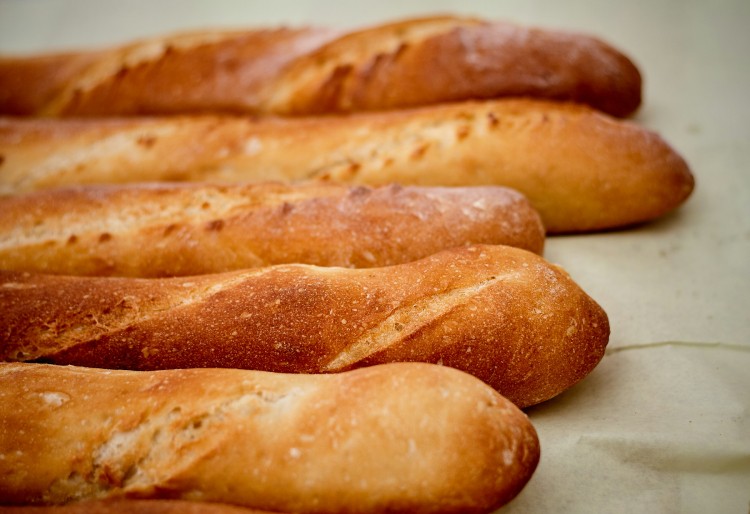
A baguette pan has a more modest — and more useful — job than the packaging may suggest. It supports soft dough at the sides, helps three loaves keep a similar diameter, and removes the most delicate step: transferring fully proofed baguettes from cloth to a hot baking surface.
The pan does not create an airy crumb. If the dough is underfermented, the seam is weak, or the loaves have overproofed, the molded channels will simply hold that result neatly in place. This recipe begins with a poolish, but the method is built around the pan itself.
- Yield
3 baguettes - Active time
about 40 minutes - Total time
about 15–27 hours - Bake
20–25 minutes at 450°F / 230°C
This recipe uses a liquid preferment made with flour, water, and a few grains of commercial yeast. It matures overnight and all of it goes into the final dough. A sourdough starter cultivates wild yeast over several days and requires regular feedings. If that is the method you want, use The LINES' separate guide to making a sourdough starter from scratch.
Supports soft dough, simplifies loading, keeps the loaves more even, and lets hot air reach the bottoms when the surface is perforated.
Weak fermentation, dry dough, overproofing, dragging scores, or an oven that was not given enough time to preheat.
Ingredients
Ingredients are calculated for 3 baguettes.
Poolish
- 180 g unbleached all-purpose flour
- 170 g cool water
- a small pinch instant yeast
Final dough
- all of the mature poolish
- 300 g unbleached all-purpose flour
- 170 g cool water
- 1 tsp instant yeast
- 12 g fine salt
If your pan has three channels, a four- or six-loaf batch will need two rounds in the oven. For the poolish, use only a few grains of yeast for one or two baguettes, a small pinch for three or four, or two pinches for six.
This dough is slightly wetter than the one in The LINES' classic baguette guide, so the molded support earns its place. Flour around 11–12.5% protein is a good starting point. If your flour is noticeably soft and the dough still cannot hold itself after folding, hold back 1 tablespoon (15 g) of water next time rather than burying the sticky dough in more flour.
Allergen: wheat and gluten.
Day 1: make the poolish
Stir together the scaled poolish flour, water, and yeast until evenly combined. Cover and leave in a cool part of the kitchen for 12–24 hours. The warmer the room, the closer you should stay to the shorter end of that range.
How to know the poolish is ready
It should be webbed with bubbles, slightly domed, and not yet visibly sinking. Its condition — not the maximum 24-hour mark — determines when it is ready.
Day 2: mix the final dough
Loosen the poolish with the water, then add the flour, yeast, and salt. Mix until no dry patches remain and let the dough rest for 10 minutes. Knead with a dough hook for 6–7 minutes on low, or knead by hand in the bowl, dampening your fingers as needed.
Bulk fermentation and one fold
The finished dough should be soft and tacky but gather into one mass and pull away from the sides of the bowl. Transfer it to a lightly greased container, cover, and leave for 2 hours. After the first hour, pull four sides toward the center and turn the dough over.
By the end, it should feel stronger, look aerated, and be visibly larger. If it remains dense and has barely changed, give it another 20–30 minutes.
Prepare the pan while the dough rises
Baguette pans differ in length, number of channels, coating, and maximum oven temperature. Before dividing the dough, check:
- Usable channel length. Measure the surface that will actually hold dough, not the outside rim. Each shaped loaf should be 3/4 to 1 inch / 2–3 cm shorter.
- Perforations. The holes let moisture escape and encourage browning underneath. A full sheet of parchment blocks that advantage.
- Coating. Some pans need a very thin film of oil; manufacturers recommend using others dry. Follow the directions for your model.
- Oven position. The pan should sit horizontally on the middle rack. If it will not fit, make shorter loaves or choose a more compact pan.
Divide and rest the dough
Divide the dough into 3 equal pieces of about 9 3/4 ounces / 275–280 g. Gather each into a short cylinder, cover, and rest for 20 minutes.
Avoid covering an entire perforated pan with parchment; it defeats the holes. If sticking makes you nervous, test one channel with minimal oil or place only a narrow strip of parchment beneath the center of each loaf.
Shape the loaves to fit the channels
- Gently pat one rested piece into a small rectangle.
- Fold the top third toward the middle and seal with the heel of your hand.
- Fold the dough lengthwise and close the long seam firmly.
- Roll from the center toward the ends until the loaf is 3/4 to 1 inch (2–3 cm) shorter than the channel. If it springs back, wait five minutes before finishing.
Set the loaves in the channels seam-side down. Straighten them once; repeated lifting and adjusting presses out gas and makes the damp surface more likely to stick.
Proof the loaves in the pan
Cover the pan with a light cloth or a roomy cover that does not touch the dough. Proof for about 30–45 minutes. The loaves are ready when they look rounder and puffy, and a light fingertip indentation returns slowly.
This is where the pan is most useful: once proofed, the loaves do not have to be rolled or moved again. Begin heating the oven to 450°F (230°C) in time for it to be fully hot when the dough is ready.
Score and bake
Make three or four quick, slightly overlapping cuts that run almost along each loaf. Hold the blade at a shallow angle to the surface. Mist the dough lightly with water.
Set the pan on the middle rack and bake for 20–25 minutes, until the loaves are a rich golden brown. Do not judge the top alone: near the end, lift one baguette carefully with a spatula and look underneath.
If the top is browned but the bottom is still pale, remove the baguettes from the pan after 20 minutes and finish them directly on the oven rack for 3–5 minutes. Move them to a cooling rack as soon as they leave the oven.
What went wrong: check the bottom crust
How to use this guide: select a problem or its arrow to reveal the likely cause and the most useful adjustment.
The bottom is pale and soft, with damp stripes
Parchment may be blocking the perforations, the pan may be sitting on a cold solid sheet, or the bread may simply be underbaked.
Next time, place the baguette pan directly on the oven rack, skip a full liner, and check the color underneath near the end. If the top is ready first, finish the loaves outside the pan for 3–5 minutes.
Dough pushed through the holes and stuck
A faint perforated pattern is normal. Heavy sticking more often points to the wrong preparation for the coating or an overlong final proof.
Check the manufacturer's directions for greasing and bake while the dough is still resilient, before it begins to sag deeply into the holes.
The bottom is white and floury
A nonstick perforated pan rarely needs a thick bed of flour. Flour collects in the grooves and interferes with even browning.
Shake off the excess before proofing, or use a very thin film of neutral oil if the manufacturer's directions allow it.
The bottom darkens before the top
The pan may be too low in the oven or sitting directly on a strongly preheated steel or stone.
Move it to the middle rack. Use a stone or steel under the baguette pan only when its manufacturer permits it.
Who will actually use a baguette pan
It earns its storage space if you bake three baguettes regularly, prefer softer dough, or find transferring proofed loaves to be the most stressful part. For one or two batches a year, it is optional. Our guide to classic poolish baguettes shows how to support dough with cloth folds and bake it on an ordinary sheet pan.
Storage
Baguettes are best on the day they are baked. Keep them overnight in a paper bag or a clean towel. For longer storage, freeze the fully cooled bread, then refresh it for 5–7 minutes at 400°F / 200°C after thawing.
Sources
The recipe formula is based on King Arthur Baking's Baguette Pan Baguettes. The LINES rebuilt the article around choosing and preparing the pan, sizing the dough, proofing in the channels, and diagnosing the bottom crust.