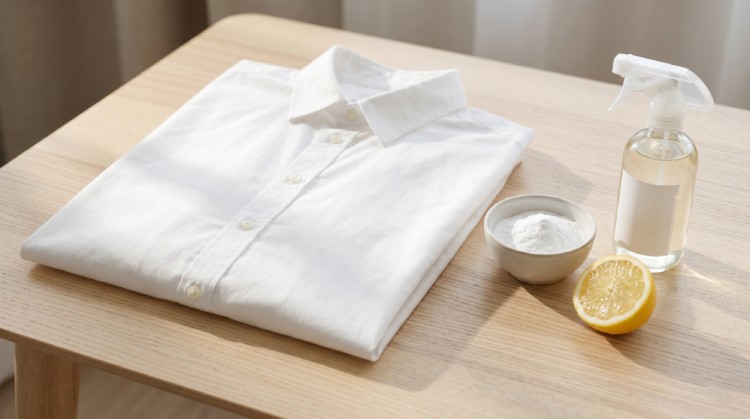
A yellow underarm mark and an odor that returns as soon as a T-shirt warms against the body call for slightly different solutions. The first is a visible buildup of perspiration, body oils, and antiperspirant residue. In the second case, soil may remain within the fibers even when the garment looks clean.
The right starting point is not the strongest remedy in the kitchen cupboard. It is the care label, the fabric, and a straightforward pretreatment. That approach is less theatrical than a three-ingredient paste, but it is far more predictable for both color and fiber.
The short method
- Read the care symbols and test the treatment in a hidden area.
- Turn the garment inside out and rinse the affected area with cool water.
- Apply liquid laundry detergent or a labeled prewash stain remover.
- Wash at the warmest temperature permitted by the care label.
- Air-dry, inspect the area, and only then use a tumble dryer or iron.
First, the rule that matters more than any laundry hack
Do not mix stain treatments
Never combine chlorine bleach with vinegar, citric acid, ammonia, or another cleaner. These mixtures can release dangerous fumes. Do not layer several household treatments on the same mark or try to strengthen a commercial product with an extra ingredient.
- Use one treatment at a time.
- Follow the package directions instead of increasing the dose.
- Rinse the garment thoroughly before switching to another product.
- Use gloves and ventilation whenever the product label calls for them.
The CDC advises never mixing household bleach with other cleaners or disinfectants. The same caution belongs in the laundry room: an internet recipe does not override a product safety label.
Identify the problem before choosing a treatment
Choose what you are dealing with
How to use this guide: select a row or its arrow to expand the recommendation.
The mark is fresh and the fabric is still damp
Turn the garment inside out and flush the area from the reverse with cool running water. Apply liquid laundry detergent, then wash the item rather than leaving it damp in a gym bag or hamper.
A white shirt has developed a yellow underarm mark
Start with an enzyme-containing prewash product. If the care label permits bleaching, follow with an oxygen bleach used exactly as directed. Chlorine bleach is not automatically the right choice simply because the garment is white.
The stain is on a colored garment
Use liquid laundry detergent or a stain remover labeled for colors, then test it on an inside seam. Lemon juice and hydrogen peroxide should not be described as universally color-safe.
The odor returns when the garment warms up
Pretreat the underarm area with an enzyme laundry product, leave it for the time stated on the package, and avoid overloading the washer. Check the care label on activewear because excessive heat can damage elastic fibers.
The garment is wool, silk, or marked dry-clean only
Do not reach for a standard enzyme stain remover, bleach, or household acid unless the garment or product manufacturer permits it. Wool and silk need a cleaner designed for those fibers. Take a dry-clean-only item to a professional and point out the affected area.
How to remove the mark from a washable garment
1. Read the care label and run a patch test
Check the permitted wash temperature, drying method, and bleach symbol. Apply a small amount of the chosen product to an inside seam or fabric allowance, wait for the stated time, and rinse. If the color shifts or the texture changes, stop and choose another method.
2. Work from the reverse
Turn the shirt inside out and rinse the area with cool water. Flushing from the reverse helps move residue back out instead of driving it through the face of the fabric. Do not scrub a fine knit with a hard brush; fingers or a soft brush are sufficient for most washable garments.
3. Apply a laundry pretreatment
Liquid laundry detergent is the simplest first step. For an older mark or persistent odor, an enzyme-containing product can be useful. Different enzymes target different types of soil, so the product's stated purpose and directions matter more than the word “enzyme” on its own.
Do not leave a stain remover overnight when its label specifies 10 or 15 minutes. More time is not necessarily more effective: the treatment may dry on the fabric, affect the dye, or damage a finish.
4. Wash the whole garment
Choose the warmest water permitted by the garment label and a cycle suited to the fabric. Cool water makes sense for the initial rinse, but the main wash does not have to be cold in every case. At the same time, do not raise the temperature for activewear, wool, or garments containing elastane unless the label allows it.
Use the detergent dose recommended for the load and water conditions, and leave enough room for the garments to move. Excess detergent and an overfilled drum can both interfere with rinsing.
5. Delay the dryer and iron
Let the garment air-dry, then inspect the area in daylight. High heat can make remaining soil more difficult to remove. If the mark is still visible, repeat the pretreatment rather than trying to cover it with a heavily fragranced product.
What to use on different fabrics
White cotton and linen
After pretreating with laundry detergent, use oxygen bleach if the care label permits it. A labeled product is more predictable than an improvised mixture because it supplies a dose, contact time, and list of compatible fabrics. Follow the directions for both soaking time and water temperature.
Three percent hydrogen peroxide is sometimes used on white garments, but it is not a universal solution: it can also alter dyes and finishes. If you choose it, patch-test first and never combine it with vinegar, chlorine bleach, or another treatment.
Colored everyday clothing
The safest sequence is a product labeled for colors, a test on an inside seam, washing according to the care label, and air-drying until you have checked the result. “Oxygen” does not automatically mean suitable for every colored item; look for an explicit color-safe statement on the product.
Lemon juice should not be applied to a bright shirt with the promise that it cannot affect the dye. Acid, sunlight, an unstable color, and a long contact time can produce an unpredictable result.
Activewear and synthetic fabrics
Do not leave damp kit sealed in a gym bag. If you cannot wash it promptly, let it dry fully before placing it in the hamper. Turn activewear inside out for washing because most body soil collects on the surface closest to the skin.
Use the cycle and temperature on the care label, measure detergent instead of adding extra, and select an additional rinse when residue is a recurring problem. Use fabric conditioner only when the garment manufacturer allows it.
Wool, silk, and embellished garments
A standard stain remover may be incompatible with the fiber, dye, lining, print, or bonded decoration. Use a cleaner made for the delicate fabric and do not scrub wet wool or silk. If home washing is prohibited, an improvised paste can cost more than professional cleaning.
How to remove odor when the visible mark is gone
Pretreat the underarm area instead of simply adding more fragrance to the washer. For garments that may be soaked, use an enzyme presoak or labeled laundry odor treatment as directed. Wash in a small enough load for proper movement and rinse thoroughly.
🧺 Does the whole load smell?
The shirt may not be the source. Check for trapped water around the door seal, residue in the dispenser, a dirty filter, or a drum that never dries between cycles. Use The LINES' separate guide to washing machine maintenance for that diagnosis.
Why aspirin and complicated homemade pastes are not our first choice
Aspirin, baking soda, lemon, vinegar, and peroxide are often presented as interchangeable “natural” stain removers. They have different pH levels, affect dyes differently, and do not come with fabric-specific directions. Aspirin is not a laundry product, while combining baking soda and vinegar largely neutralizes both ingredients and creates impressive foam without guaranteeing better cleaning.
This does not mean that no household ingredient can ever work. It means that a general guide should begin with a product made for laundry, with a defined dose, compatible-fabric guidance, and safety warnings.
How to reduce new underarm marks
- Let antiperspirant dry before getting dressed.
- Rinse or wash sweaty clothing as soon as practical.
- Do not leave damp shirts sealed in a gym bag or hamper.
- Do not use more detergent than the manufacturer recommends.
- Check a treated mark before exposing the garment to high dryer or iron heat.
Sources and further reading
- CDC: safe use of household bleach and the warning against mixing cleaners.
- University of Georgia Extension: perspiration stain care for textiles.
- American Cleaning Institute: how enzymes are used in cleaning products.
- International Hyperhidrosis Society: laundry guidance for perspiration marks.
- US Federal Trade Commission: what garment care labels cover.
Conclusion
A dependable method rarely looks like a spectacular hack. Reading the label, flushing the mark, allowing a laundry product time to work, washing at a permitted temperature, and checking the result before applying heat is simpler and safer than cycling through vinegar, lemon, peroxide, and bleach.