Keeping vitamins in the bathroom feels convenient: they are easy to see and fit neatly into a morning routine. Yet the bathroom is often one of the worst places for them. Humidity rises after every shower, the temperature fluctuates, and steam finds its way into cabinets that appear closed.
There is no single storage spot that suits every supplement. Some probiotics need refrigeration, while others are designed to remain at room temperature. A bottle of fish oil may have special directions after opening, and a powdered supplement is especially vulnerable to moisture. The most reliable rule is simple: read the label before choosing a permanent place for the container.
Start with the label
Look beyond the serving directions and find the storage instructions. The manufacturer may tell you to:
- store the product at room temperature;
- keep it in a cool, dry place away from light;
- refrigerate it after opening;
- protect it from freezing;
- use it within a stated period after opening.
Those directions matter more than a general tip online. Formulations, nutrient forms, capsule shells, and packaging differ, so two products that look similar may have different storage requirements.
If you move tablets into an organizer, photograph the label or keep the original box. You will still have the product name, ingredients, lot number, date, and manufacturer contact details if you need them.
What changes a supplement over time
Supplements do not all deteriorate in the same way, but heat, moisture, light, and oxygen are common influences. A scientific report on dietary-supplement quality notes that stability also depends on the nutrient form, the full formulation, and the packaging—not merely the name of the vitamin on the front of the bottle.
Moisture
Shower steam, damp fingers, or a wet scoop can affect powders, soften capsules, and make tablets stick together. Products that readily absorb moisture from the air are particularly vulnerable.
Do not reach into a bottle with wet hands or leave it open while preparing breakfast or mixing a drink.
Heat
Heat can accelerate changes in certain vitamins and other ingredients. Avoid shelves above the stove or oven, spaces beside a radiator, and the top of a refrigerator that becomes warm while the appliance is running.
Light and air
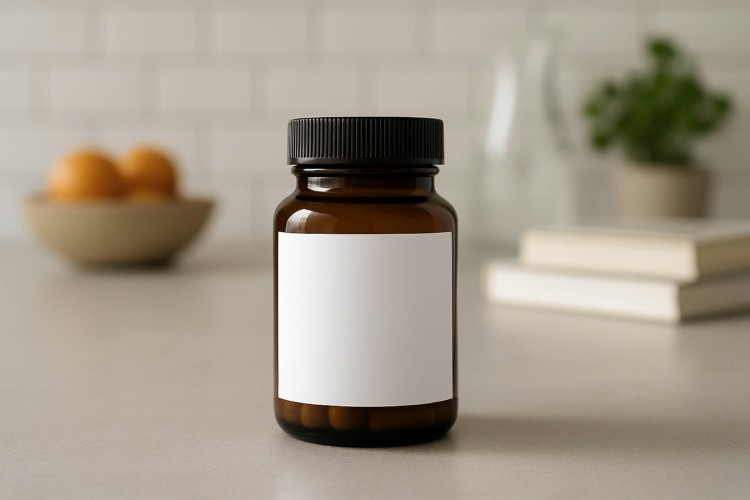
Some ingredients are sensitive to light or oxidation. That is why manufacturers use dark or opaque bottles, tight lids, and individually sealed blister packs.
A clear decorative jar may look tidier, but use one only if the manufacturer permits repackaging. In most cases, the original container offers better protection.
Choose one suitable place at home
For most dry tablets and capsules, a closed cabinet in a bedroom, hallway, or pantry is a practical choice. It should be dry, away from direct sunlight, and separated from heat sources.
Places that commonly cause problems include:
- the bathroom;
- a shelf above the stove or oven;
- a cabinet next to the sink;
- a sunny windowsill;
- a spot beside a radiator;
- the top of the refrigerator.
A kitchen cabinet can work if it stays dry and does not warm up during cooking. When in doubt, check the shelf after the kitchen has been in use for a while. If it feels noticeably warm or develops condensation, choose another location.
Quick guide
Where should this supplement go?
Choose the product form for a basic starting point. The directions on its label always take priority.
Keep the product in its original bottle or blister pack, away from steam, sunlight, and sources of heat.
Some probiotics need refrigeration; others belong in a dry place at room temperature. The category name alone cannot tell you which applies.
Close the container promptly, use a completely dry scoop, and do not hold the open powder over steam.
Follow any separate directions for an opened bottle; some liquid products require refrigeration after opening.
Warm conditions can change texture and shape, but refrigeration is not a universal solution unless the label calls for it.
Not every probiotic belongs in the refrigerator
The blanket advice to refrigerate every probiotic is inaccurate. According to the National Institutes of Health Office of Dietary Supplements, some probiotic products need refrigeration while others can be stored at room temperature. The correct answer should appear on the label of the specific product.
If the manufacturer requires refrigeration:
- keep the product tightly closed in its original packaging;
- avoid the refrigerator door, where temperatures fluctuate more often;
- do not press the container against the back wall, where it could freeze;
- remove only the amount you need and return the container promptly;
- avoid leaving the cold bottle open in a humid room.
You cannot assess the viability of probiotic cultures by sight or smell. If the recommended conditions were not maintained, check the manufacturer’s guidance for that particular product.
Storage notes for different supplement forms
Tablets and dry capsules
A dry, closed cabinet usually works unless the label says otherwise. Keep the lid tightly closed, and do not cut blister packs in a way that removes the product name or date.
If the manufacturer placed a desiccant packet or canister in the bottle, leave it there unless the instructions say otherwise. Do not open the desiccant.
Powders
Powdered supplements are particularly vulnerable to moisture. Use a completely dry scoop, do not hold the open container over a steaming drink, and close it as soon as you have measured the serving.
Clumps do not automatically prove that a product is unusable, but they can indicate moisture exposure. If clumping appears with an unusual smell, a color change, or visible mold, discard the product.
Gummies and softgels
Gummies can melt, stick together, or change texture in warm conditions. Softgels may deform or leak. Keep them away from sunlight and heat, but do not refrigerate them unless directed: excess moisture can also affect the product.
Omega-3s and other oils
Liquid oils and omega-3 softgels can oxidize when exposed to light, heat, and air. Close the bottle tightly and follow any separate directions for storage after opening. Some liquid products are meant to be refrigerated once opened.
A sharp rancid or distinctly unusual odor is a reason not to use an oil. A normal smell, however, cannot confirm that the original composition and potency remain unchanged.
Drops and other liquid supplements
Avoid touching the dropper to your mouth, fingers, or other surfaces. Close the bottle immediately after use. If the manufacturer gives a period for use after opening, write the opening date on the label.
Should supplements go into a pill organizer?
An organizer is convenient, but it does not necessarily protect against moisture, light, and oxygen as well as the original bottle or blister pack. Take particular care with softgels, probiotics, gummies, and tablets supplied in protective packaging.
Move only a modest amount at a time, and only if the label does not require the product to remain in its original container. Avoid placing look-alike tablets together if you may not be able to identify them later.
What the date on the package can—and cannot—tell you
An expiration or best-by date applies to a product stored under the conditions specified by its manufacturer. If a bottle has spent a long time in an excessively warm or humid place, the printed date no longer confirms that it retains its stated quality.
Do not assume that an expired supplement is safe simply because it looks normal. Appearance cannot show how much of an active ingredient remains or whether invisible changes have occurred.
Do not use the product if:
- the protective seal was damaged before the first opening;
- there is moisture or visible mold inside;
- capsules leak, swell, or become badly distorted;
- tablets crumble or change color;
- gummies have melted into a single mass;
- a liquid becomes cloudy, separates contrary to its directions, or develops an unusual odor;
- the label is unreadable and the product cannot be identified reliably.
The absence of visible damage does not prove that the original quality remains intact. If storage directions were substantially breached, the manufacturer is best placed to answer questions about the particular formulation.
A five-minute cabinet check
- Check the name and date on every package.
- Reread the storage directions, especially for opened products.
- Set aside anything whose label requires refrigeration.
- Make sure containers are dry and close properly.
- Remove damaged or unidentified tablets.
- Place products with the nearest dates at the front.
The takeaway: the most reliable storage instruction is the one printed on the specific product. A cool, dry cabinet is suitable for many dry supplements, but refrigeration, pill organizers, and replacement containers are not universal solutions.
Sources
- NIH Office of Dietary Supplements: Probiotics — Fact Sheet for Consumers
- A Quality Dietary Supplement: Before You Start and After It’s Marketed
- FDA: Dietary Supplement Labeling Guide
- FDA: Current Good Manufacturing Practice for Dietary Supplements