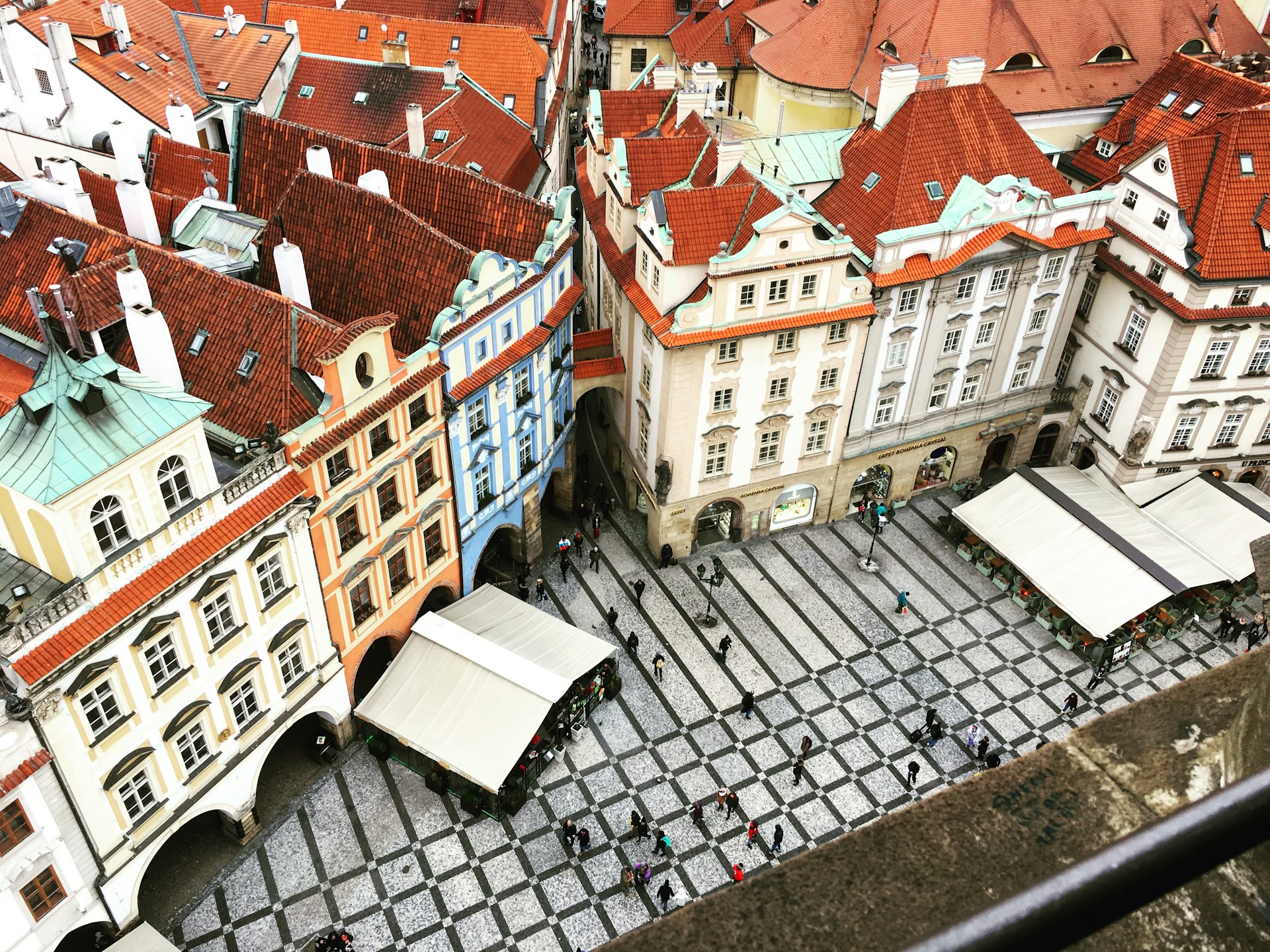
Old Town Square is more than somewhere you cross on the way to Charles Bridge. Within a few hundred metres, it brings together a medieval astronomical clock, Gothic churches, a Baroque church, a Rococo palace and traces of events that shaped Czech history.
The square began as a market at the meeting point of European trade routes. Nearby stood Týn, or Ungelt, a fortified courtyard where foreign merchants stored their goods, spent the night and paid customs duties. A town hall, churches and wealthy townhouses gradually grew around the market, turning the square into both the commercial and political centre of the Old Town.
See the principal sights from outside.
Add the tower, historic rooms and one gallery.
Prices and opening hours were checked in August 2026. Review each attraction’s official page before visiting because services, public events and seasonal markets can alter access.
Where to begin
Arrive at the Prague Astronomical Clock five to ten minutes before the hour. After the brief display, visit Old Town Hall and continue clockwise around the square.
- 01Astronomical Clock and Old Town Hall
Begin with the apostles and the view from the tower.
- 02Memorial crosses
Look down beside the town hall.
- 03Jan Hus Monument
The square’s focal point and a key chapter of Czech history.
- 04Marian Column and Prague Meridian
Another detail that is easy to walk past.
- 05Church of Our Lady before Týn
The Gothic skyline and its concealed entrance.
- 06Kinský Palace and the Stone Bell
Rococo beside restored Gothic architecture.
- 07St Nicholas Church
A Baroque finish to the circuit.
This route avoids repeatedly crossing the square and leaves time to notice details that disappear easily in the crowd.
What the Astronomical Clock shows
The Prague Astronomical Clock, or Orloj, is mounted on the southern wall of Old Town Hall. Mikuláš of Kadaň created its main mechanism in 1410. It is the oldest astronomical clock of its kind that is still operating.
It has three principal sections. The astronomical dial displays several systems of time, the positions of the Sun and Moon and their movement through the zodiac. The calendar dial sits below it, while windows for the figures of the apostles appear above.
The skeleton representing Death pulls a cord and rings a bell. The twelve apostles then appear in two windows before the cockerel calls and the clock strikes the hour.
The display is brief. Standing immediately below the clock gives you a good view of the apostles but makes it harder to take in the whole façade. Step towards the centre of the square for a better overall view.
There is little point trying to decode every mark on the dial from the street. Inside the town hall, visitors can see the mechanism and the chamber from which the apostle figures move.
Old Town Hall: tower, historic rooms and underground passages
Old Town Hall was founded in 1338. Rather than a single purpose-built structure, it is a group of buildings from different periods that were gradually joined as the town administration expanded.
The 69.5-metre tower was completed in the 14th century. Stairs and lifts lead to its viewing gallery, where the panorama includes Týn Church, the tiled roofs of the Old Town, Prague Castle and the shape of the square itself.
Beyond the tower, the visitor route may cover the chapel, ceremonial rooms and Romanesque-Gothic underground spaces. Some former ground floors ended up below street level after Prague raised its streets in the 13th century to protect the city from flooding.
The town hall’s eastern wing was destroyed during the Prague Uprising in May 1945 and never rebuilt. This is why one side of the complex appears incomplete today.
Opening hours and tickets
- April–December
- Daily, 09:00–20:00
- January–March
- Daily, 10:00–19:00
- Standard adult ticket
- CZK 350
- Lift supplement
- CZK 100
A good time to visit: standard admission is 50% cheaper during the first hour after opening, when the viewing gallery is also generally quieter.
Online tickets marked Skip the Line have different prices and may cover only the tower, so check what is included before buying.
The crosses beside the town hall
A row of white crosses is set into the paving beside Old Town Hall. They commemorate leaders of the Bohemian Estates’ uprising against the Habsburgs who were executed in the square on 21 June 1621.
The memorial is traditionally associated with 27 executed men, yet 28 crosses are visible today. The additional cross appeared in 2011 in memory of Martin Fruwein of Podolí, who died before the execution but whose body was also beheaded.
The memorial is easy to miss when everyone is looking up at the tower or the clock. It sits directly in the paving without a high barrier or large information panel.
Jan Hus Monument
The monument in the middle of the square honours the Czech preacher and church reformer Jan Hus. He criticised abuses within the Church, argued for reform and preached in Czech. Hus was condemned and burned at the Council of Constance in 1415.
Ladislav Šaloun’s monument was unveiled in 1915, five hundred years after Hus’s death. The composition includes not only Hus himself but also his followers and people forced into exile after the defeat of Czech Protestants.
This is more than a convenient meeting point. The monument helps explain why Hus holds such an important place in Czech historical memory.
Marian Column and the Prague Meridian
The Marian Column stands nearby. Its original was erected in 1650 in thanks for Prague’s defence against Swedish troops at the end of the Thirty Years’ War.
The column was pulled down in 1918, when it was regarded as a symbol of Habsburg and Austro-Hungarian rule. The present reconstruction was installed on the historic site in June 2020.
The Prague Meridian is marked in the paving beside it. The column’s shadow once acted as a solar indicator: when it aligned with the meridian, residents knew that noon had arrived.
It is one of the square’s most interesting details, yet most people pass over it without noticing the inscription beneath their feet.
Church of Our Lady before Týn
The two dark Gothic towers of the Church of Our Lady before Týn form Old Town Square’s most recognisable silhouette. Construction of the present church began in the mid-14th century on the site of earlier buildings associated with the Ungelt merchants’ courtyard.
Both towers rise to roughly 80 metres. The northern tower is known as Eve and the southern one as Adam; Adam is about a metre taller. This is more accurate than the popular claim that their different proportions represent a universal symbolic rule of Gothic architecture.
Inside is the tomb of Danish astronomer Tycho Brahe, who worked at the court of Emperor Rudolf II. The church also contains an organ dating from 1673, the oldest in Prague.
The entrance is less obvious than the view from the square suggests. Other buildings stand in front of the façade, so visitors enter through an arched passage. Sightseeing hours depend on services, and tourist access may be restricted during worship.
Kinský Palace: admire the façade, but do not plan an exhibition
The pink-and-white Kinský Palace is an example of Prague Rococo. It was built between 1755 and 1765 on the site of several older houses.
The palace belongs to the National Gallery Prague, but it has been closed to exhibition visitors since 1 June 2025. Older recommendations to visit a gallery here are therefore no longer current.
The façade is still worth a look. It contrasts sharply with the neighbouring Gothic architecture and shows how the square changed over the centuries. Check the National Gallery website before travelling because the building’s status may change in future.
House at the Stone Bell
To the left of Kinský Palace stands the House at the Stone Bell. Its austere Gothic façade can look like a later imitation, but the building is medieval. Its present appearance followed a long restoration that removed a later Baroque façade and recovered the Gothic form.
Prague City Gallery now uses the house for temporary exhibitions and concerts. Its Gothic cellar is free to enter, while exhibitions require a ticket.
Opening hoursTuesday–Sunday, 10:00–20:00; closed Monday.
Standard ticketCZK 200.
If you want to enter one gallery directly on the square, this is currently a more practical choice than the closed Kinský Palace.
St Nicholas Church
The white St Nicholas Church on the opposite side of the square is a fine example of Prague Baroque. The present building was constructed between 1732 and 1737 to a design by Kilian Ignaz Dientzenhofer.
One of the interior’s most striking details is a large crown-shaped crystal chandelier made at the Harrachov glassworks. The church is also known for its acoustics and an organ decorated with figures of angels.
It is normally open daily from 10:00 to 17:00 and is free to visit outside services. Paid classical and organ concerts are held regularly from April to November.
Do not confuse them: St Nicholas Church on Old Town Square and St Nicholas Church in Malá Strana are separate buildings in different parts of Prague.
Sources
- Prague City Tourism — Old Town Square and its history
- Prague City Tourism — Old Town Hall and the Astronomical Clock
- Prague City Tourism — Church of Our Lady before Týn
- Prague City Tourism — the memorial crosses
- Prague City Tourism — Marian Column
- Prague City Tourism — St Nicholas Church in the Old Town
- National Gallery Prague — Kinský Palace status
- Prague City Gallery — House at the Stone Bell