Once the harvest is over, vegetable beds do not have to remain bare until spring. Fall is a useful time to stop weeds from setting seed, weaken perennial species and protect the soil through winter. There is no single method for every garden, however, so the first step is to identify the kind of problem you have.
What to do immediately after harvest
Start by cutting and removing any weeds that already carry mature seed. Healthy young weeds without seed heads can usually be composted, but rhizomes from aggressive perennial species should not go into a cool compost pile: they may survive and return to the garden.
Avoid automatically digging the entire bed deeply. This can bring a new supply of buried weed seed to the surface. Shallow cultivation is often enough for small seedlings, while a garden fork makes it easier to lift perennial roots without chopping them into many pieces.
Should you use a herbicide in fall?
Harvesting the vegetables reduces the risk of accidentally hitting the crop, but it does not make every herbicide safe. The use site, weed species, temperature, condition of the foliage, time before the next planting and the directions on the specific product label still matter.
Systemic post-emergence herbicides can work against certain perennial weeds while their leaves are green and actively growing. In fall, plants move carbohydrates into underground storage organs, and the active ingredient may move toward the roots as well. Uptake is often poorer after a hard frost, drought stress or recent mowing.
Use only a product approved for the exact site and purpose. Follow the labelled rate, weather limits, protective-equipment requirements, planting interval and every other direction. Protect nearby plants from spray drift, and never assume that “post-harvest” automatically means risk-free.
Why pre-emergence herbicides are not a universal answer
Pre-emergence products do not “destroy every seed in the soil.” They interfere with susceptible weeds during germination or very early growth. Some remain active in the soil and restrict what can safely be planted next spring. They should not be used in a home vegetable garden as a precaution: the label must specifically list the site, target weeds and allowed crop rotation.
Cardboard and mulch: where they work best
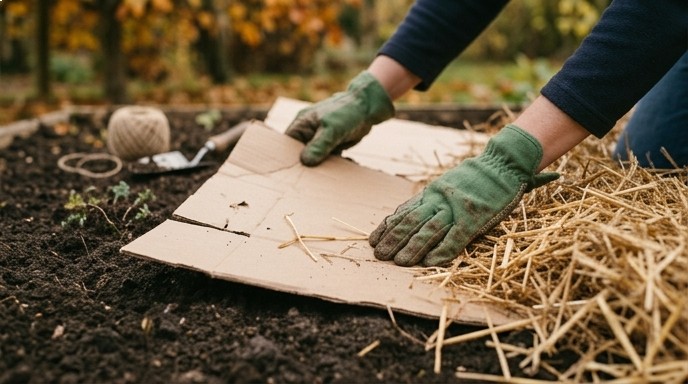
Sheet mulching excludes light and is most useful on paths, new beds and areas that will not immediately be sown with small seeds. It can sharply reduce annual weeds, but it may not defeat quackgrass, bindweed or other deeply rooted perennials in a single season.
- Remove seed heads and as much of the persistent rhizomes as practical.
- Overlap one layer of plain brown, non-glossy cardboard with all tape and staples removed, or use several layers of black-and-white newspaper.
- Soak the paper, then cover it with compost, leaves, straw or wood chips so it stays moist and does not blow away.
- Check water and air movement in spring. If the cardboard is still dense, do not sow small seeds directly above it.
Solarization and dark tarping are not the same
Prepared, moist soil is tightly covered with clear plastic for roughly four to six weeks during the hottest, sunniest part of the year. Trapped solar heat suppresses some weed seeds, pests and soilborne pathogens. It does not work equally well on every species and should not be described as complete soil sterilization.
An opaque black tarp or sheet blocks light. Weeds are gradually depleted, but the soil usually does not heat the same way it does under clear plastic, so the covering may need to remain longer. Although the two methods look similar, this is not solarization.
In cooler climates, late fall is generally too cold for effective solarization. Plan it for the hottest weeks of late spring or summer instead. In autumn, mulch, a cover crop or an opaque tarp is usually more practical when the bed does not need to be planted.
Plant a cover crop instead of leaving bare soil
If enough growing time remains after harvest, a cover crop can protect against erosion, capture some excess nutrients and slow new weeds. Oats establish quickly and often winterkill in cold climates. Winter rye can be sown later, but it must be terminated on time in spring or it may compete with vegetables. Match the species and sowing date to your local climate and the crop that will follow.
A cover crop will not eliminate established perennial rhizomes. Remove or weaken those weeds first, then seed the newly opened space.
A quick way to choose
The main rule of fall weed control
The goal is not to make the soil “sterile” in a day. A more realistic plan is to stop new seed, weaken perennial weeds and avoid leaving the ground bare. The best results usually come from combining methods chosen for the particular weed and the next crop.