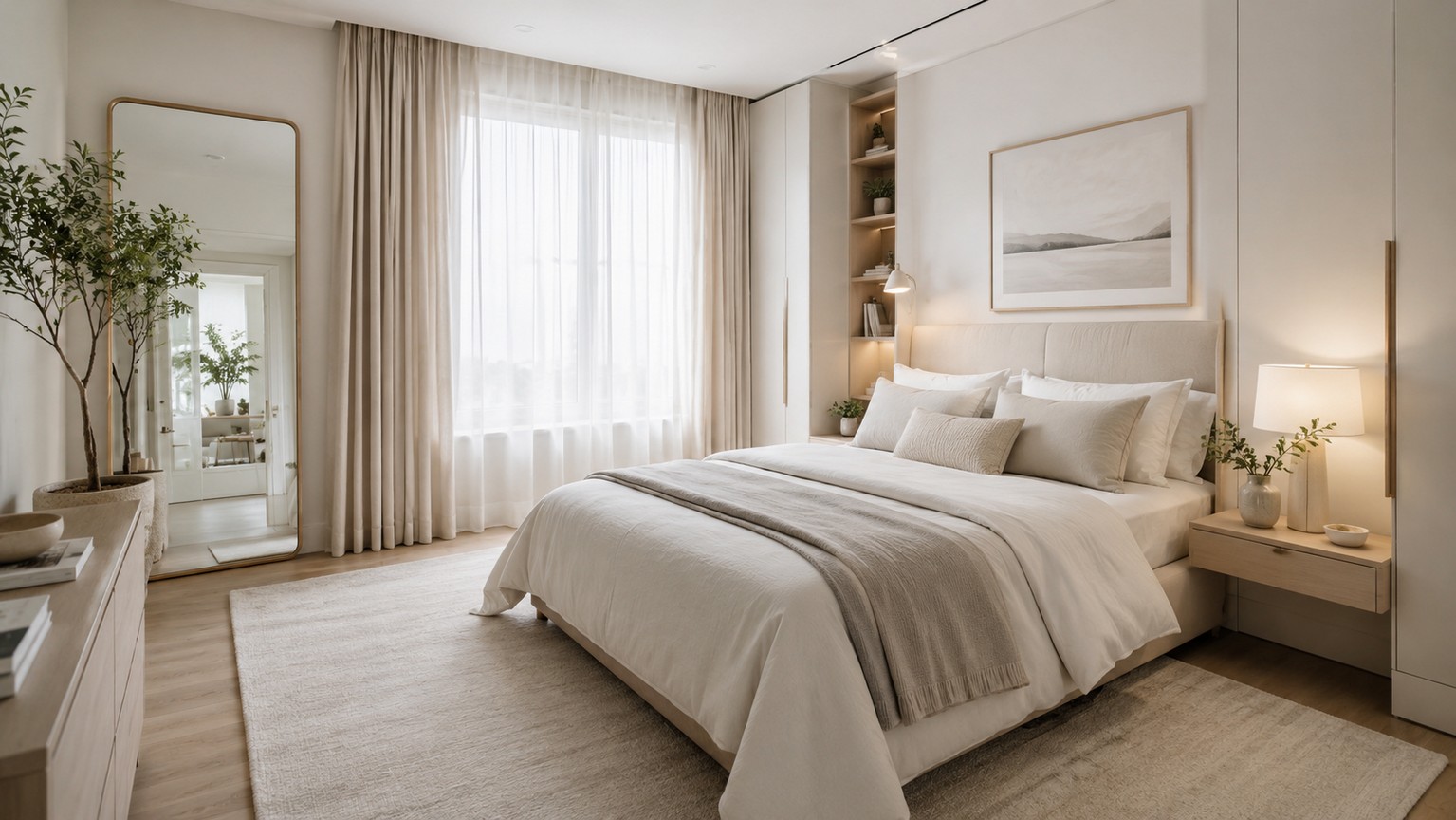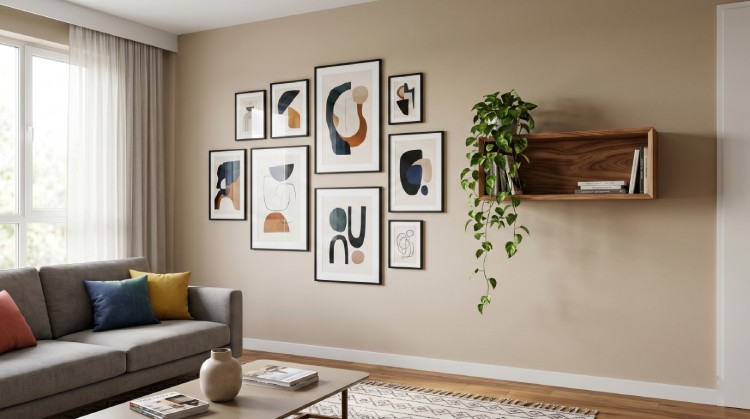
A blank wall often makes us want to buy everything at once: three prints, a shelf, a mirror, and a tin of fashionable paint. The room ends up with more objects, but not necessarily more character.
Before choosing the decor, decide what the wall is missing: color, a focal point, useful storage, or a personal story. The strongest result usually comes from one leading idea rather than five competing accents. If the real problem is an awkward floor plan rather than a blank wall, start with the separate guide to designing a functional small bedroom.
What to check before making the first hole
- Plan around the furniture. Account for the sofa, bed, desk, or console beneath the arrangement.
- Check the scale. Lay the decor on the floor or mark each piece with paper templates and painter’s tape.
- Assess the light. Look at the wall in the morning, evening, and under artificial light; color and shadows will change.
- Identify the wall construction. Check the substrate and look for concealed wiring or pipes before drilling.
1. Paint: change the composition, not only the color
A new color can refresh a room quickly, but the familiar rule that “warm colors energize and cool colors calm” is too simple to design by. Daylight, light bulbs, flooring, furniture, and even the view outside affect how a shade reads. A color that looks soft in the store may turn gray on a north-facing wall or yellow beneath a warm bulb.
Instead of judging a small swatch, paint a large sample board or a discreet test area and move it around the room during the day. If you do not want to repaint the whole room, consider one of three clear approaches:
- one accent wall when the room already has a natural focus, such as a bed or sofa;
- a painted block to visually connect a desk, console, or group of artwork;
- a darker lower section when you want color while keeping the upper wall lighter.
Choose the shade beside something that will remain in the room: the floor, sofa, curtains, or rug. If you are working with a beige bedroom, The LINES has a separate guide to pairing beige walls with bedding and textiles, so there is no need to repeat the entire palette here.
2. Wallpaper: give the pattern a specific job
Wallpaper does not have to cover an entire room. It can define an alcove, sit behind a headboard, line the back of open shelving, or become a large framed panel. This brings in pattern without making it surround you on every wall.
A large print does not automatically make a small room look bigger. Tape up a full-size sample and view it from the doorway. Consider not only the colors but also how many times the motif will repeat across the actual wall.
Peel-and-stick wallpaper is useful for temporary changes, but “removable” does not guarantee a damage-free result on every painted surface. Test it in an inconspicuous place and follow the manufacturer’s instructions. In a home you own, traditional wallpaper may be the better long-term option when the wall has been prepared correctly.
3. Build a gallery wall with a personal point of view
A coordinated pack of generic prints is easy to find, but a personal edit is what keeps the wall from resembling thousands of other rooms. Consider family photographs, children’s drawings, exhibition posters, work by local illustrators, vintage maps, small pieces bought from independent makers, or your own travel photography.
First decide whether the furniture needs one substantial work above it or a group of smaller pieces. For a gallery arrangement, trace the frames onto paper, cut out the templates, and attach them with painter’s tape. You can adjust the spacing and height without leaving a trail of unused holes.
The layout does not have to be symmetrical. One repeated element—a frame color, consistent matting, a limited palette, or a shared subject—can hold different images together. Leave some open wall around the arrangement; negative space is part of the composition.
4. Add shelves or picture ledges that serve a purpose
A picture ledge or shallow shelf lets you rotate prints, books, and small objects without drilling a new hole for every change. It is often more useful than a complicated arrangement of staggered shelves when your goal is a flexible display rather than serious storage.
Before installation, identify whether the wall is drywall, plaster, brick, or masonry and use fixings rated for that construction and for the combined weight of the shelf and its contents. Check for wiring and pipes, and follow the shelf manufacturer’s instructions. Avoid placing heavy shelves or metal objects above pillows or a seat used every day.
Use flameless candles on narrow shelves, inside wooden display boxes, or near textiles. The London Fire Brigade advises keeping naked flames away from furnishings and other combustible materials and never leaving candles unattended.
5. Bring in texture with a wall hanging
A tapestry, rug, woven panel, or macramé piece can soften a broad blank surface and introduce a material quality that framed prints cannot. Dense textiles may reduce a little room echo, but they will not soundproof a wall against neighbors. For that problem, see the separate guide to improving room acoustics and reducing noise without renovating.
A modern, replaceable textile can hang from a sewn sleeve, a properly supported hook-and-loop strip, or a purpose-made rail. Its weight should be supported evenly across the width to prevent distortion. Do not glue or staple a vintage embroidery, heirloom textile, or fragile fabric to ordinary board. The Canadian Conservation Institute recommends even support and display methods that limit distortion; a valuable piece is a good candidate for conservation framing.
Also consider sunlight, dust, and cleaning. A bright or historic textile should not hang where direct sun reaches it every day.
What should you choose for your wall?
Start with the problem, not the style label
How to use this guide: select a row or its arrow to expand the recommendation.
The room feels impersonal
Create a gallery from personal photographs, local art, or objects with a story. Repeat one frame finish or a limited palette so different subjects still feel connected.
You need a little more storage
Choose one picture ledge or shallow shelf instead of several decorative constructions. Identify the wall material and calculate the total load before choosing the fixings.
You rent and cannot drill
Start with lightweight frames, an existing picture rail, a replaceable textile, or an adhesive product tested on a hidden area. Do not trust a heavy or valuable object to temporary adhesive simply because drilling is not allowed.
You want color but cannot choose a shade
Do not buy paint for the whole room yet. Test a large sample beside the floor, furniture, and curtains at different times of day. If you still hesitate, introduce the color through a print or textile that is easier to replace.
Common wall-decor mistakes
- designing the wall for an empty room and then buying furniture at a different scale;
- hanging a small group of art too high and too far from the sofa or console below;
- turning every wall into a separate focal point;
- drilling before checking the substrate, wiring, and pipes;
- trusting heavy or valuable objects to temporary adhesive;
- combining bold wallpaper, a gallery, shelves, and textiles on one compact wall.
Conclusion
You do not need to turn every wall into an exhibition to refresh a room. Choose one surface, decide what it needs to do, and test the composition with a paper mock-up. That will tell you whether paint, wallpaper, art, shelving, or textiles is the right move.
Good wall decor does more than cover an empty area. It connects the wall to the furniture, the light, and the objects that already mean something to you.