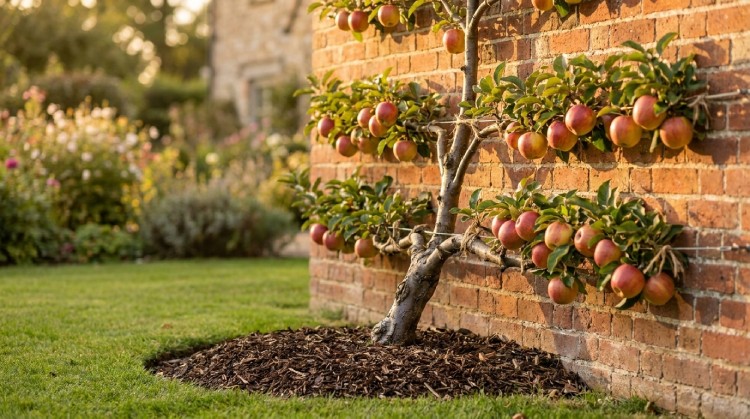
Espalier is the ancient European art of training fruit trees to grow perfectly flat in a single plane. It is an ideal solution for owners of small gardens, as these apple trees can grow flat against a house wall, along a fence, or act as living space dividers, completely replacing traditional hedges.
📋 Quick Facts About Espalier Apple Trees
- Planting Location: A well-lit sunny wall, a solid fence, or a specially constructed sturdy wire trellis system.
- Soil: Fertile, loose, and well-draining. Intensive feeding is mandatory.
- Hardiness: High. Furthermore, a south or west-facing wall provides the tree with additional protection against harsh winter winds.
- Spacing: The distance between trees along the same trellis line should be at least 10–12 feet (3–3.5 meters).
Planting Espalier Apple Trees: Choosing Saplings and Installing Supports
To create an espalier, purchase young, one-year-old apple whips grafted onto dwarf or semi-dwarf rootstocks (such as M9 or MM106). You can plant the tree from late autumn to early spring while it is completely dormant.
If you are planting the tree near a wall or a solid fence, leave a gap of about 12–16 inches (30–40 cm) from the structure. This gives the roots room to develop and ensures proper air circulation around the trunk. Mount sturdy horizontal wires to heavy-duty posts, spacing the wires about 16–20 inches (40–50 cm) apart vertically. You will tie the future structural branches of your tree to these wires using soft garden twine.
Important: When planting, ensure the graft union (the bump on the lower trunk) remains 2–3 inches (5–7 cm) above the soil level. After planting, water thoroughly and mulch the root zone with compost or shredded bark.
Pros and Cons of an Espalier Garden
The espalier method looks incredibly striking but requires the gardener to clearly understand the rules of the game:
- Space-saving: The tree occupies a minimal footprint in the yard.
- Fruit quality: Every apple receives 100% direct sunlight, so the fruits grow huge and extremely sweet.
- Decorative value: In spring, the wall turns into a blooming canvas, and in autumn, into a living display of apples.
- Constant attention: You cannot skip pruning; you will have to shape the tree several times a season.
- Fertilizer dependency: Due to dense fruiting and regular branch removal, the tree requires consistent mineral feeding.
- Support costs: Building a reliable wire trellis system requires initial financial investments.
✂️ How to Prune Espalier Apple Trees: Summer and Winter Pruning
To keep the tree flat and stimulate it to produce fruit rather than useless foliage, a two-step pruning system is used:
- Summer Pruning (July – August): This is the most crucial stage for an espalier. All young vertical shoots of the current year that have grown from the horizontal branches and reached over 8 inches (20 cm) in length are cut back, leaving only 3 leaves (buds) above the basal cluster. This stunts the tree's vigorous growth and forces these buds to develop into short fruiting spurs.
- Winter Pruning (January – February): Carried out during the plant's full dormancy. The gardener inspects the tree's skeletal shape, completely removes any diseased, damaged, or frozen branches, and ties new extension shoots to the wire to continue forming the desired pattern (fan, horizontal cordon, or palmette).
Fertilizing Espalier Apple Trees: Nutrient Rules
Because an espalier apple tree directs all its energy into forming fruit within a highly restricted canopy area, its soil is depleted several times faster than in a regular orchard. In early spring (March-April), be sure to apply well-rotted manure or a complex nitrogen fertilizer around the base. In summer, during fruit development, feed the tree with potassium sulfate, and in autumn, mulch the root zone with compost to protect the shallow roots from freezing.
Pest and Disease Control for Flat Orchards
A huge advantage of a flat canopy is that it is incredibly easy to inspect and spray. In most temperate climates, the main threats to the harvest are the codling moth (worms in the apples) and apple scab (a fungal disease).
To prevent scab, apply a dormant spray of Bordeaux mixture in early spring. Against the codling moth, use a simple eco-friendly method: always collect all worm-infested windfall apples, put them in thick black plastic bags, and leave them in the scorching sun for a week. The solar heat will destroy the larvae inside and halt their life cycle.
Harvest your espalier apples carefully when the fruits have fully developed their varietal color and the stem separates easily from the branch. Thanks to ideal sun exposure, your espalier apples will store much better and boast an unbeatable, market-perfect appearance!