If you’ve suddenly noticed massive, unsightly, cobweb-like structures enveloping the tips of the branches in your yard during late summer or early fall, your trees are under attack by the Fall Webworm (Hyphantria cunea). While native to North America, this aggressive and hungry pest is a true nightmare for gardeners and orchard owners alike.
Although their populations are somewhat kept in check by natural predators in their native habitats, during outbreak years, these pests are fully capable of defoliating an entire tree in a matter of weeks. Let's break down how to properly identify this pest, understand its behavior, and learn how to safely and effectively clear their webs out of your garden.
How to Identify the Pest: Webs on Tree Branches
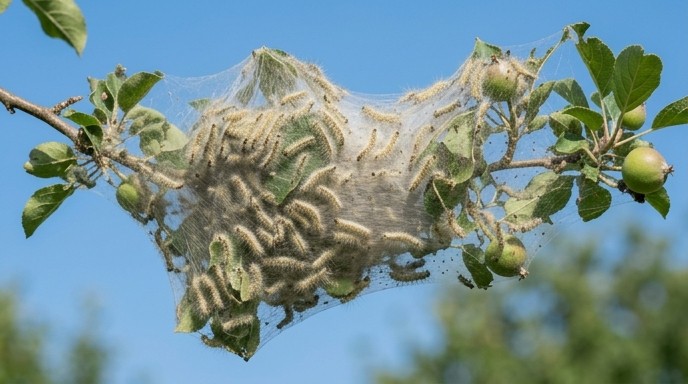
More often than not, you will spot the devastating aftermath of their work long before you notice the caterpillars themselves. Giant, dense, light-gray webs stretch over and completely encapsulate the tips of tree branches. As the autumn foliage naturally begins to drop, these bizarre, spooky nests become very conspicuous, even from a great distance.

The mature caterpillar reaches about 1 to 1.5 inches in length and is covered in long, irritating bristles.
The caterpillars themselves are rather unpleasant to look at: they are covered in long, tufty gray-white or yellowish hairs. Entomologists recognize two primary morphological types of these pests:
- Black-headed webworms: Feature a pale yellowish-green body with two distinct rows of black spots running down their backs.
- Red-headed webworms: Possess a darker, more brownish-tawny hue with orange or reddish tubercles (bumps).
Fun Fact: If you disturb their nest (for example, by sharply tapping the branch with a stick), all the caterpillars inside will begin to rhythmically and violently twitch in good unison. This is an evolutionary defense mechanism designed to startle and deter hungry birds and wasps.
The adult insect is a nocturnal moth with a wingspan of about 1 to 1.5 inches (3-4 cm). It is a brilliant, blinding white color, occasionally speckled with tiny dark spots on its wings.
What Do Fall Webworms Eat?
This pest is highly unpicky when it comes to its diet. Fall Webworms are known to feed on the foliage of over 250 different species of deciduous trees and shrubs. However, in residential landscapes, their absolute favorite "meals" consistently include:
- Walnut and Pecan trees (often the hardest hit);
- Mulberry trees;
- Apples, cherries, plums, and other fruit trees;
- Maples, ashes, and weeping willows.
Life Cycle of the Fall Webworm
The white moth lays hundreds of tiny eggs in dense clusters on the undersides of leaves. About a week later, minuscule, ravenous caterpillars hatch and immediately begin spinning a communal silken web over the foliage they intend to eat. The main difference between Fall Webworms and other species is that these caterpillars live, grow, and feed exclusively inside the protection of their expanding web.
As they rapidly grow, they continuously expand the web, enveloping more and more branches. In severe infestations, an entire young tree can be completely shrouded in a solid gray cocoon. After about 6 weeks of non-stop feeding, the fattened caterpillars drop to the ground, hide in deep bark crevices or under leaf litter, and pupate to survive the winter. In warmer southern climates, this pest easily produces 2 to 3 full generations in a single growing season.

Mechanical pruning and immediately destroying the nests is the simplest and most effective localized control method.
How to Get Rid of Fall Webworms Safely
Because the caterpillar colony is so well-protected by their water-repellent silk web, simply spraying the outside of the canopy with traditional insecticides is often entirely ineffective—the toxic droplets just roll right off the cocoon. The most effective and commonly used methods include:
- Mechanical Removal (Pruning): The easiest and most eco-friendly method is to grab a pole pruner or long-handled loppers, snip off the affected branch tips, and immediately crush, bag, or burn the nests. You must do this late in the evening or early in the morning when the entire colony is resting inside the web.
- Organic Biological Sprays (Bt): Sprays containing the specific soil bacterium Bacillus thuringiensis (Bt) are lethal to the digestive tracts of caterpillars but are 100% safe for humans, pets, bees, and birds. For the Bt spray to actually work, use a long stick to tear open the web first, then spray the foliage directly inside and around the nest so the caterpillars ingest the bacteria while feeding.
- Encourage Natural Predators: Create a welcoming environment for birds and paper wasps in your garden. Wasps, in particular, are very aggressive hunters that naturally regulate webworm populations.
Don't Confuse Them: Fall Webworms vs. Tent Caterpillars
Large silken tree nests are frequently confused with the equally destructive Eastern Tent Caterpillar. The main difference lies in timing and location: Tent Caterpillars are active in the early spring, and they build their thick, tent-like webs in the crotches (forks) of main branches. In contrast, Fall Webworms are most active in late summer and autumn, and they construct their webs exclusively over the very tips of the branches.
Despite the terrifying, apocalyptic appearance of these massive webs, mature, established trees very rarely die from late-season defoliation. However, this pest multiplies aggressively. Never ignore these "Halloween decorations" hanging in your trees—prune and destroy the nests as soon as you spot them to protect your garden's health for the following year!
A key qualification
Fall webworm nests look dramatic, but late-season defoliation on a mature healthy tree can have less impact than it appears. Young trees and repeated heavy infestations deserve more attention.
A practical checklist before you use the advice
- identify the pest, weed, or disease as accurately as possible before treating;
- judge severity: a few damaged leaves do not always justify treating the entire garden;
- start with sanitation, physical removal, irrigation changes, airflow, and other non-chemical measures where practical;
- if a pesticide is needed, use only a product whose label covers the crop/site and the target problem;
- do not mix products or concentrated homemade remedies without confirmed compatibility and label directions.
What to adapt to your own garden
Integrated pest management does not aim for a sterile garden with no insects or blemishes. The goal is an acceptable level of damage while minimizing risk to plants, people, and beneficial organisms.
Additional verified references: University of Minnesota Extension — Managing Plant Diseases in the Home Garden; University of Minnesota Extension — Yard and Garden Insects.