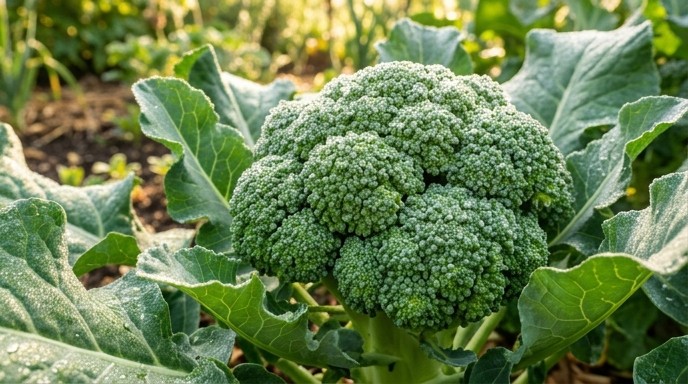
A head of broccoli consists of hundreds of flower buds that must be harvested just before they open. It is easy to miss the moment: a head that was compact yesterday may loosen and show yellow petals after several warm days. Success therefore depends not only on care but on finding a suitably cool weather window for head development.
First, which kind of broccoli are we growing?
In North American and many other sources, “broccoli” usually means the crop with one large central green head. British gardening guides often call it calabrese, reserving “broccoli” for sprouting types that produce many smaller purple or white shoots.
This article is mainly about heading broccoli, or calabrese. Many cultivars produce smaller side shoots after the central head has been removed.
Important: side-shoot production depends on cultivar, weather and plant health. A second crop is possible, not guaranteed.
Broccoli needs cool conditions, not necessarily cold
Broccoli is a cool-season crop. Its leaves can grow normally during warm weather, but prolonged heat as the head initiates and expands reduces quality: the head may remain small, become loose or flower prematurely.
There is no single magical threshold of exactly 25 °C beyond which every head fails. The response depends on cultivar, duration of heat, night temperature, moisture and plant age. The practical aim is to time the crop so heads form before intense summer heat or during cooler autumn conditions.
Spring and autumn crops require different calculations
For an early harvest, sow in modules approximately four to six weeks before transplanting. Harden seedlings off and move them into the garden once they have a healthy root system and several true leaves. A temporary cover protects young plants from wind, cold and insects, but its edges must be secured.
Do not automatically sow autumn broccoli in May or early June in every region. Count backwards from the expected arrival of cool autumn weather using the cultivar’s stated days to maturity, then add time for germination and possible slower growth. Sowing may be later in warm regions and earlier in cool ones.
Direct sowing is possible, but young seedlings are particularly vulnerable to heat, drought and flea beetles. Transplants provide more control, although they do not make plants inherently pest-proof.
Soil and spacing: a large head needs room
Broccoli grows best in fertile, well-drained soil that retains moisture. A pH of approximately 6.0–7.0 is generally suitable. Very acidic soil encourages clubroot, but lime should be applied according to a pH test rather than by guesswork.
Gently firm the soil around transplants and water thoroughly to establish root contact. There is no need to tread heavily across the entire bed: excessive compaction impairs drainage and aeration.
For many heading cultivars, about 30–45 cm between plants and 45–60 cm between rows is adequate. Closer spacing generally produces smaller heads, while vigorous cultivars may need more room. Follow the seed supplier’s recommendation.
Watering without abrupt checks in growth
Water young plants regularly until established. Afterwards, keep the soil evenly moist, especially during head development. Prolonged drought followed by heavy watering stresses the crop and may hasten premature flowering.
Water the root zone rather than relying on overhead irrigation as a flea-beetle treatment. Persistently wet leaves do not guarantee control and may favour some diseases. Mulch with compost, straw or another clean material to retain moisture and suppress weeds.
Fertilizer: examine the soil before making a schedule
Broccoli needs a steady nutrient supply, but a fixed list of three mandatory feeds does not suit every garden. Compost or well-rotted manure can be incorporated during bed preparation. Fresh manure is undesirable because it may contain pathogens and weed seeds and supplies an unpredictable amount of nitrogen.
Moderate nitrogen may help plants in poor soil or those growing slowly. Apply phosphorus and potassium according to soil-test results; many garden soils already contain sufficient phosphorus.
Mesh is more reliable than ash
Fine mesh installed over hoops immediately after sowing or transplanting physically excludes cabbage white butterflies and some other pests. Secure the edges against the ground and keep the material from resting directly on the leaves.
Inspect leaf undersides regularly and remove egg clusters and young caterpillars. Mesh with sufficiently small openings, early detection and healthy growth also help manage flea beetles. Dusting with ash gives inconsistent control, washes away and may alter soil pH.
Avoid returning broccoli and related brassicas to the same bed every year. A rotation break of about four years reduces the buildup of soil-borne diseases, including clubroot.
The right moment to harvest
A head is ready once it has reached a useful size for the cultivar, remains compact and evenly coloured, and its individual buds have not begun to open. Yellow petals mean the optimum moment is passing, although the broccoli can still be used if it remains sound.
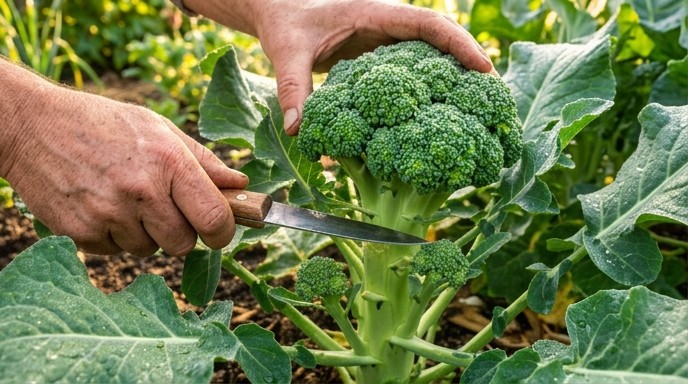
Cut the central head with a clean, sharp knife and a short length of stalk. An angled cut may help water drain, but avoiding a split stem and protecting the axillary buds below are more important.
Leave healthy foliage and the lower plant in the ground. Continue watering and, where soil fertility indicates a need, apply a modest feed. Harvest side heads by the same rule: compact and before the buds open.
After cutting
Broccoli loses quality quickly at room temperature. Cool it promptly, keep it out of direct sun and refrigerate it. For longer storage, the florets can be blanched and frozen.
A large broccoli head does not begin with a large dose of fertilizer. Match the cultivar and sowing date so the crop develops in cool weather, provide steady moisture, protect plants with mesh and do not miss the brief window of ideal maturity.