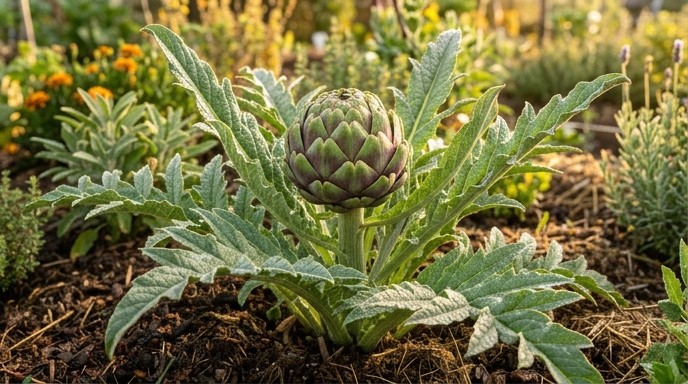
A globe artichoke is part vegetable, part giant thistle and part garden sculpture. Its edible portion is an unopened flower bud; leave it on the plant and it becomes a large purple bloom attractive to bees. Artichokes can be grown in cool climates, but first decide whether you expect a crop in one season or intend to overwinter the plant as a perennial.
Annual or perennial: the choice that determines everything
Growing for one season
This suits regions with cold winters. Choose an early cultivar capable of producing buds in its first year and sow it very early indoors.
Main risk: a conventional perennial cultivar may produce beautiful foliage without having enough time to crop.
Growing for several years
This is possible in milder climates or with reliable winter protection. The plant mainly builds a strong crown in its first season, with the main crop expected later.
Main risk: cold combined with wet soil can kill the crown even under a cover.
Under favourable conditions, globe artichokes live for several years, but “four or five years” cannot be guaranteed in every garden. Hardiness varies by cultivar, while survival depends on minimum temperature, drainage, snow cover and the frequency of winter thaws.
Which cultivar to choose
For an annual crop, look for a cultivar explicitly described as capable of flowering in its first year. Imperial Star is one familiar example, although local availability varies. Green Globe types and other locally suitable cultivars are often used for perennial growing.
Seed-grown plants may vary in vigour, bud shape and eating quality. Offsets and divisions are clones of the parent, so these methods preserve the characteristics of a named cultivar more reliably.
Growing globe artichokes from seed
For an early start, sow indoors in late winter or early spring, individually in small pots or modules. Sow about 2 cm deep and maintain warmth and even moisture. Once seedlings emerge, provide bright light.
If the plant must form buds in its first season, some cultivars require a period of cool temperatures known as vernalisation. The precise temperature and duration vary, so do not improvise by severely chilling the seedlings. Follow the seed supplier’s directions.
Harden plants off gradually before moving them outside after severe frost risk has passed and the soil is workable. A young perennial benefits from establishing a strong crown in its first year. The RHS recommends removing flower stalks during the first summer and beginning the full harvest in the second.
Propagation by offsets and division
Young rosettes emerge around the base of an established plant in spring. Once a vigorous offset is approximately 20–30 cm tall, detach it with a clean, sharp knife and a section of root, then plant it promptly.
Old clumps gradually lose vigour. Divide them in spring about every four or five years, or once cropping noticeably declines. Division rejuvenates the planting and produces new plants with predictable traits.
Room for a plant almost a metre wide
Choose a warm, sunny site sheltered from strong winds. A mature globe artichoke may reach 1–1.5 m tall and about a metre wide, so allow roughly 75–100 cm of space. Crowding makes maintenance harder and reduces air movement.
The soil should be fertile and free-draining. A globe artichoke will not die “instantly” after one heavy rain, but persistent waterlogging is genuinely dangerous, especially in winter. Use a raised bed or another drainage improvement on heavy sites.
Water and nutrients without extremes
Water new plants regularly throughout their first season. An established artichoke tolerates short dry periods better, but lack of water while buds form reduces their size and number. Water deeply as the soil begins to dry rather than keeping the roots permanently wet.
Compost or another organic mulch helps retain moisture and gradually improves the soil. Keep damp mulch away from the centre of the crown.
Regular feeding every three weeks is not essential in fertile ground. Apply compost in spring and, where growth is poor or the plant is container-grown, use a suitable balanced fertilizer. The RHS suggests an organic high-potassium feed to support bud production. Excess nitrogen can produce abundant leaves without a proportional increase in crop.
The bracts determine harvest time
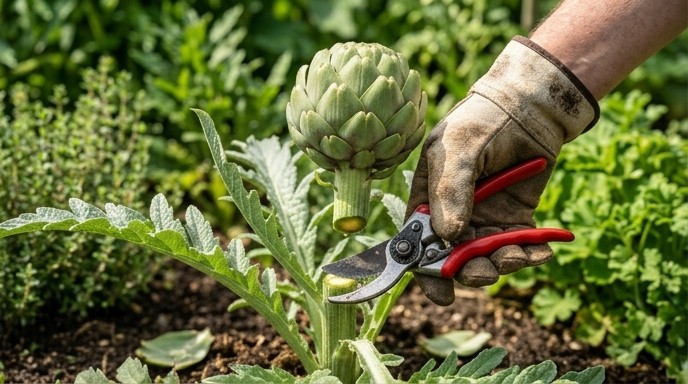
Harvest a globe artichoke before it flowers. The bud should have reached the size typical of its cultivar, while the bracts — the overlapping “scales” — remain tightly pressed together. Buds can open quickly in warm weather, so inspect plants regularly.
Cut the largest central bud first, followed later by the smaller side buds. Use pruning shears and retain about 5–8 cm of stem. Its tender interior may also be edible after peeling, although toughness depends on the age of the shoot.
Once a bud opens to reveal purple florets, it is generally too fibrous for ordinary cooking. It then becomes a striking garden flower and a source of nectar and pollen.
Overwintering: protect against moisture as well as cold
- After cropping Remove old flower stems and dead foliage. Healthy dry leaves can form the first protective layer over the crown.
- Insulate the root zone Cover it with a thick layer of dry straw, leaves, bracken or compost. Young plants are particularly vulnerable in their first winter.
- Do not create a sealed wet cocoon Protection should insulate without trapping water around the crown. Ventilation may be necessary during frequent thaws.
- Keep a backup plan In cold regions, grow some plants as annuals or keep young offsets in a cool, protected place.
Why the plant produced no buds
Common reasons include a cultivar not intended to crop in its first year, late sowing, lack of the required cool period, insufficient sun, drought during bud development or excessive nitrogen. A young perennial crown may simply not be mature enough yet.
Think of the globe artichoke not as a difficult exotic plant but as a crop with two distinct strategies. For quick results, choose an early annual cultivar. For a perennial planting, provide free-draining sheltered ground, patience and winter protection adapted to your climate.