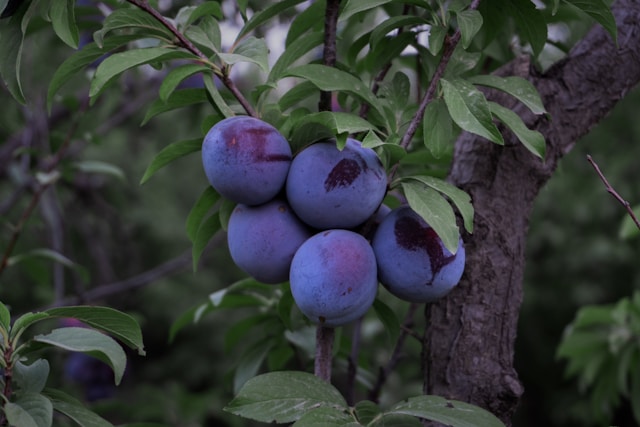
A plum tree can produce generous crops for many years, but much of its future is decided before planting. The cultivar name tells you about the fruit; the rootstock determines the tree’s eventual size, pollination compatibility influences fruit set, and the planting site and timing of pruning affect long-term health.
Five questions to ask before buying a plum tree
The rootstock is the hidden half of the tree
A named plum cultivar is usually grafted onto another plant called a rootstock. The same cultivar on a less vigorous rootstock may form a relatively compact tree, while a vigorous rootstock can produce a much larger crown requiring wider spacing.
There is therefore no universal planting distance for every plum. Before purchase, learn the predicted mature size and allow room for the full crown, sunlight and maintenance. Even a semi-dwarf plum will not necessarily remain small without training.
One plum tree may crop alone — but not always
Many cultivars are self-fertile and can set fruit without another plum. Others are partly self-fertile or self-incompatible and require a compatible pollination partner whose flowering period overlaps.
Any neighbouring plum does not guarantee pollination: the trees may flower at different times or be biologically incompatible. Check the pollination group in a specialist nursery catalogue. A suitable tree may already grow in a nearby urban garden, but relying on that without checking is risky.
Where a plum has the best chance
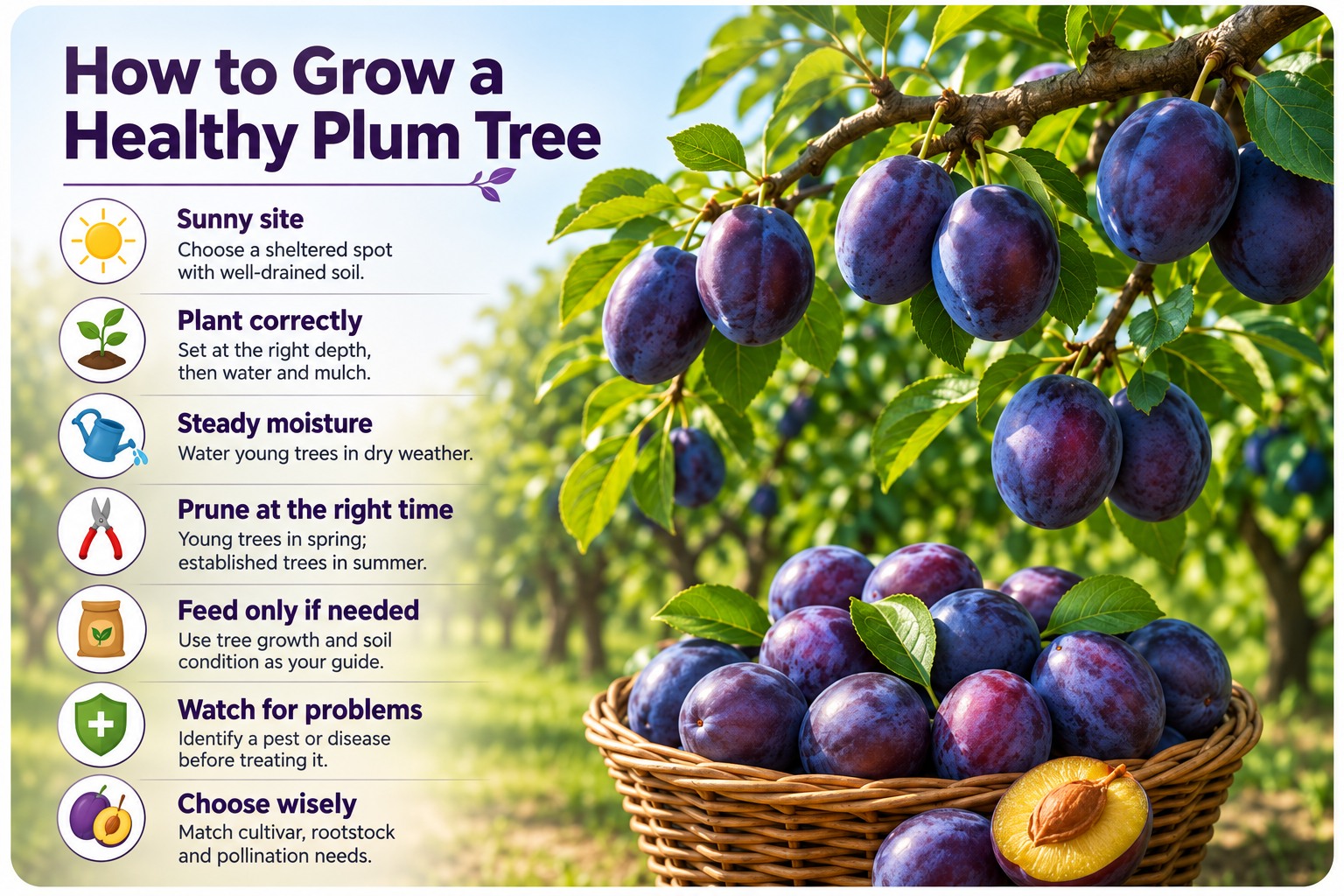
Choose a sunny position sheltered from strong wind. Plums blossom early, so a low frost pocket where cold air collects is dangerous even for a hardy tree: the trunk may survive the cold while the flowers do not.
Fertile, moisture-retentive but well-drained soil is ideal. Plums can grow well in loam or clay provided water does not stagnate. An approximate pH of 6.0–6.5 is favourable, although the tolerable range is broader.
Do not plant where water remains after rain. Correct the drainage or choose another site rather than trying to compensate for waterlogging with fertilizer.
A planting hole without a “nutrient pot”
Bare-root trees are planted while dormant, from late autumn to early spring, when soil is neither frozen nor waterlogged. Spring planting often gives a tree in a cold region more time to establish before its first winter. Container-grown trees have a longer planting season but need closer attention to watering in hot weather.
- Moisten the roots. Water a container thoroughly, or place bare roots in water briefly before planting without soaking them for an entire day.
- Dig a broad hole. It should accommodate spread roots without bending and should not be substantially deeper than the root system.
- Do not place concentrated fertilizer beneath the roots. Where needed, mix compost with the excavated soil. Ash is unnecessary without a pH test and may make the soil too alkaline.
- Check the planting height. Keep the root flare at its natural level and the graft union above the soil.
- Water and mulch. The amount of water depends on tree size and soil moisture rather than a universal number of buckets. Keep mulch away from the trunk.
Water young trees more often and mature trees when needed
A young tree has a limited root system, so check it regularly and water during dry periods. Mature plums need supplemental water mainly during prolonged drought, particularly while young fruit is enlarging.
A rule of three or four irrigations per season ignores rainfall and soil type. Nor should watering automatically cease exactly two weeks before harvest. Abrupt drought may cause fruit drop or poor quality, while excessive water after a long dry period may lead to splitting. Aim for moderate, relatively stable moisture.
Pruning plums: do not copy an apple-tree calendar
Sanitary pruning removes dead, diseased, broken and rubbing branches. Do not rejuvenate a neglected tree all at once: removing a large proportion of the crown triggers many upright shoots and creates major wounds. Spread the work over several summers.
Feed only where there is evidence of need
A healthy tree in normal garden soil does not necessarily need a yearly programme of nitrogen in spring and phosphorus plus potassium in autumn. Excess nitrogen produces excessive shoots, shades the crown and may delay wood maturity.
Assess shoot growth, leaf colour and cropping and, where possible, test the soil. Compost can be spread thinly over the root zone without burying the trunk. Large late applications of nitrogen are indeed undesirable, but phosphorus, potassium and ash should not be applied automatically either.
Tree protection begins before spraying
Plums may be affected by aphids, plum moth, brown rot, bacterial canker and silver leaf. A universal Bordeaux-mixture spray every spring and autumn is not the right solution for every garden.
Collect mummified and rotting fruit, remove affected branches at an appropriate dry time, clear badly damaged fruit from beneath the crown and maintain good air movement. If a problem recurs, identify the pest or pathogen first. Use only a product registered for plums, at the permitted timing and exactly as its label directs.
Whitewashing the trunk is not a universal disease treatment either. Where winter sunscald is a concern, protect a young trunk with a light-coloured tree guard or suitable material that does not trap moisture or constrict the bark.
Damsons and greengages are groups, not single cultivars
Names such as damson and greengage refer to groups of plum-like fruits with shared characteristics, not one universal cultivar. Individual selections differ in flowering time, hardiness, self-fertility and disease response.
Stanley, President and other familiar cultivars cannot be declared the best everywhere. Choose with advice from a reliable local nursery, taking account of rootstock, pollination, climate and intended use.
Harvest without losing flavour
Plums ripen unevenly and are normally picked in several rounds. For fresh eating, fruit should have developed its characteristic colour and yield slightly to gentle pressure. Fruit intended for transport or processing may be picked a little earlier.
Plums bruise easily, so avoid squeezing them or piling them deeply into containers. Use damaged and overripe fruit promptly. Sound fruit can be chilled, frozen after pitting, or made into preserves, sauces and dried products.
A plum can indeed be generous, but its low-maintenance future begins with the right purchase. A suitable rootstock, compatible pollinator and safe planting site will save more work than any universal fertilizer or preventive-spray calendar.