Fruit trees do not necessarily need to be fertilized every year. If a tree grows well, has healthy foliage and produces a steady crop, the soil may already provide everything it needs. Fertilizer should be used when the tree actually lacks nutrients, not simply because spring has arrived.
Before applying fertilizer, look at shoot growth, leaf color, fruit production and soil condition. Slow growth or yellowing leaves can indicate a nutrient deficiency, but the same symptoms may be caused by waterlogged soil, damaged roots, unsuitable soil pH or disease.
Check new shoot growth, canopy density, leaf color and the amount of fruit produced in recent years.
A soil test can reveal pH and the available levels of phosphorus, potassium and other nutrients.
Compost, manure and blended fertilizers all provide nutrients and must be included in your calculations.
What the N-P-K numbers mean
Fertilizer labels usually show three numbers representing nitrogen, phosphorus and potassium. These numbers describe the product; they are not a universal feeding recommendation for every tree.
- Nitrogen (N) supports leaf and shoot growth. Too much can produce excessive soft growth and delay the hardening of new wood.
- Phosphorus (P) is involved in root development, flowering and energy transfer within the plant. It should not be added without a reason because it can accumulate in the soil.
- Potassium (K) contributes to water regulation, fruit development and the tree's ability to tolerate stress.
When to apply fertilizer
This is the main period for nitrogen when a tree genuinely needs it. Consider the weather, soil condition and product instructions.
A modest second application may be useful for a weak-growing tree or one carrying a particularly heavy fruit crop.
Nitrogen is generally avoided because it may stimulate late growth that will not harden before freezing weather.
The exact timing depends on climate, tree species, age and the fertilizer being used. Granular fertilizer should not be left on dry soil without water. During severe heat or drought, delay feeding until the tree has received enough moisture.
Organic or mineral fertilizer?
Compost and aged manure
These materials gradually add nutrients and organic matter while improving soil structure and water-holding capacity.
Their nutrient content varies, so excessive amounts can still add too much nitrogen, phosphorus or salt. Fresh manure should not be placed around fruit trees.
Mineral fertilizers
They make it easier to supply a specific nutrient and usually work more quickly. This is useful when a deficiency is supported by testing or the tree's condition.
The main risk is overapplication. Always consider the N-P-K concentration, the area being treated and the manufacturer's instructions.
The two approaches do not have to compete. Compost can support the soil, while a mineral fertilizer can correct a particular deficiency more precisely.
Where and how to spread fertilizer
- Do not pile fertilizer against the trunk. It will not improve nutrient uptake and may damage bark or roots.
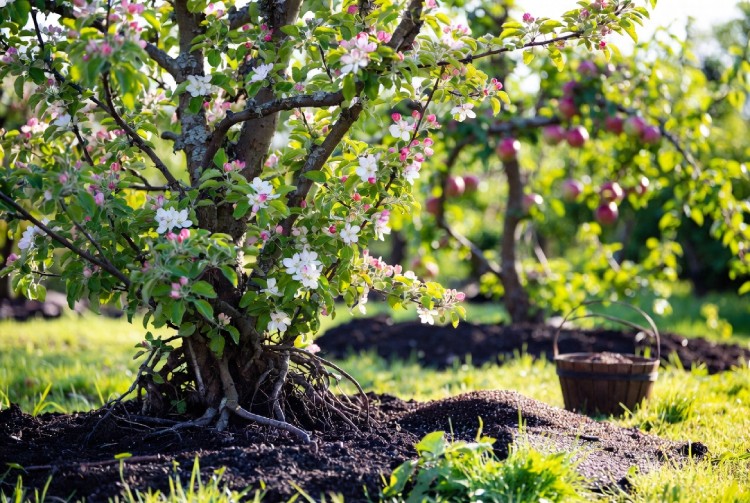
- Spread it evenly beneath the canopy. For a mature tree, begin away from the trunk and cover the area toward the canopy edge and slightly beyond it.
- Avoid concentrated piles or narrow rings. These are especially risky around young trees.
- Water after application. Follow the instructions for the particular product and consider recent or expected rainfall.
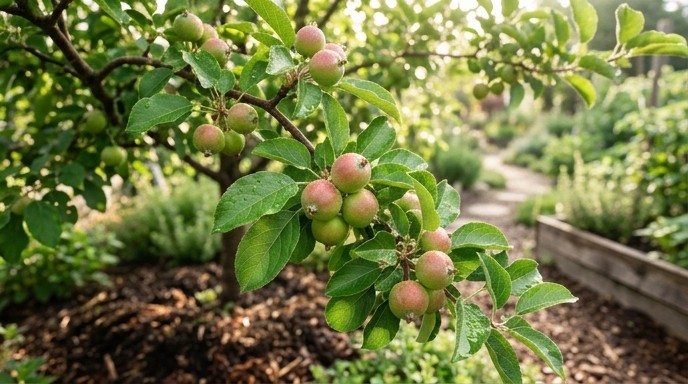
- Add mulch if appropriate. Compost, shredded bark or grass clippings help conserve moisture, but mulch should not touch the trunk.
Young and mature trees need different care
Fertilizer should not be placed directly in the planting hole because concentrated nutrients may injure tender roots. A newly planted tree first needs correct watering, suitable soil and time to establish.
If a young tree is growing well, there is no need to rush into fertilizing it. When feeding is necessary, use a modest amount on the soil surface and keep it away from the trunk.
An established tree should be judged by annual shoot growth, foliage and crop production. Very strong growth combined with poor fruiting can sometimes indicate too much nitrogen rather than too little.
A simple conclusion
Good fertilizing begins not with choosing an attractive bag, but with observing the tree and its soil. If the tree is growing and producing well, unnecessary fertilizer may only upset the existing balance.
When a need has been identified, apply the appropriate nutrient at the right time, spread it evenly beneath the canopy and stay within the recommended rate. For fruit trees, moderation is almost always more helpful than generosity.