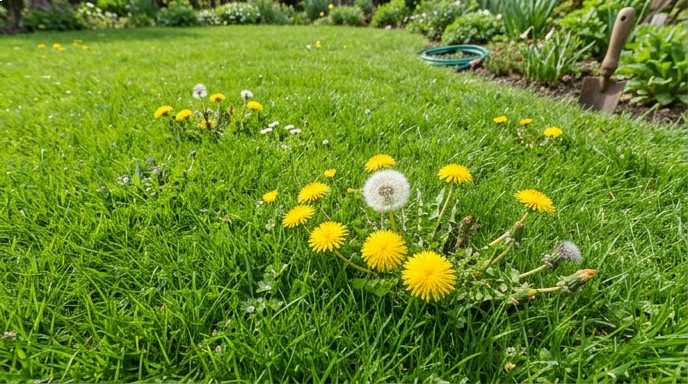
A dandelion may be a welcome spring flower in one yard and a persistent perennial weed in another. Its taproot stores enough energy to produce new leaves after the top is mowed off. The right response, however, depends on location: a treatment used between pavers can damage turf or a garden bed.
A few plants are usually easiest to dig. A thin lawn needs both weed removal and turf repair, while a garden bed benefits from mulch after weeding. The realistic goal is not a promise of permanent, total eradication. It is to reduce the population over time and leave fewer open sites where new seedlings can establish.
- A few plants
Dig after rain or a thorough watering. - In a lawn
Remove the root and reseed the opening. - In a garden bed
Weed before seed set and cover bare soil with mulch. - Between pavers
Work precisely and prevent runoff toward plants.
Why the taproot matters
Dandelions form a leaf rosette above a long taproot. When only the foliage is cut, reserves in the root can often support another flush of leaves. Removing more of the root lowers the chance of rapid regrowth.
Even careful digging cannot stop seeds arriving from nearby properties or germinating from the soil. After removal, fill the opening with turf, mulch, or desired plants rather than leaving bare ground.

Where are the dandelions growing?
Choose the closest situation to open a practical plan.
One or two plants in the lawn
After rain, dig them with a narrow trowel or dandelion tool, refill the hole with soil, and reseed with the same turfgrass. Check the spot for new leaves during the following weeks.
Dandelions are scattered across the lawn
Do not rely on endless digging alone. Look at why the turf is thin: scalping, heavy traffic, bare patches, or mismatched care can leave room for seedlings. Repair the lawn first and reserve a selective herbicide for a population too large to manage by hand.
Dandelions are in a vegetable or flower bed
Dig by hand without disturbing the roots of desired plants. Remove flower stalks before seeds mature and cover open soil with mulch suitable for that bed. Never use a lawn broadleaf herbicide around vegetables or flowers unless its label specifically permits that site.
Plants are growing in paver joints or along a curb
Start with a narrow scraper or hand tool. Boiling water can injure a weed on a hard surface away from turf, trees, and ornamentals, but the root may recover. Refill washed-out joints after cleanup when appropriate.
How to dig a dandelion
- Wait for moist soil. Work after rain or water the area thoroughly beforehand. Taproots are more likely to snap in hard, dry soil.
- Choose a narrow tool. A dandelion digger or long trowel disturbs less turf than a wide shovel.
- Insert it beside the center of the rosette. Loosen the soil along the root from more than one side instead of pulling only on the leaves.
- Lever gently rather than jerking. Remove as much of the taproot as practical. If it breaks, mark the location for another inspection.
- Repair the surface immediately. Fill and reseed a lawn opening or replace mulch in a bed.
What to do with the plant
A plant without mature seed can go into local yard-waste collection or a properly managed compost system. Separate mature fluffy seed heads rather than dropping them into an open or cool compost pile where seeds may survive.
How to reduce dandelions in a lawn
Dense turf shades the soil surface and leaves fewer open sites for seeds to establish. It is not an instant fix, but it addresses the conditions that allow repeated invasion.
- Do not mow below the recommended height for your turf species. Scalping weakens grass and exposes soil.
- Reseed bare patches. Do not leave a circle of exposed soil after digging.
- Address compaction and traffic. If water infiltrates poorly and grass thins along walking routes, repair those areas.
- Water and fertilize according to turf needs. Extra fertilizer does not replace proper mowing and reseeding.
- Mow flower stalks before seed set. This limits new seed but does not kill the existing taproot.

Does vinegar kill dandelions?
Household vinegar can burn the foliage of a small young weed, but it acts mainly on the green tissue it contacts. The established taproot of a perennial dandelion often survives, so rapid browning can be followed by regrowth.
Concentrated acetic-acid herbicides are not simply stronger kitchen vinegar. They can burn skin and cause serious eye injury. Do not make weed killer from vinegar concentrate or mix vinegar with salt and dish detergent. If you choose an acetic-acid product, use only an EPA-registered herbicide and follow its label for the site, concentration, protective equipment, and reentry period.
Rapidly injure the contacted leaves of a small, young weed.
Taproot death, selectivity in turf, or safe handling at high concentrations.
Where boiling water fits
Boiling water can be used on an isolated weed in a hardscape joint when no turf, tree roots, or desirable plants are nearby. It injures any living tissue it reaches and cannot distinguish a dandelion from a wanted plant.
Pour from a low height and avoid splashing; a burn to the person carrying the kettle is the most immediate hazard. Skip this method on slopes and near lawn edges where hot water can run. If leaves return, the taproot survived and digging is the better next step.
Skip salt and homemade acid mixtures
Salt is not a good choice even between pavers. Rain can carry it toward turf, tree roots, and soil, and salty runoff can damage nearby materials. Adding salt and dish detergent to vinegar does not make the mixture selective or reliably effective against a taproot.
Natural does not mean harmless
Boiling water scalds, concentrated acetic acid is corrosive, and salt accumulates in soil. Judge a method by what it does and where it will travel—not by whether its ingredients are found in a kitchen.
When to consider a lawn herbicide
If dandelions occupy a large part of the lawn and hand removal is no longer practical, a selective broadleaf herbicide may be reasonable. Choose an EPA-registered product labeled for your turf species, application site, and dandelions.
Do not move the same product into a vegetable or flower bed. Herbicides that spare turfgrasses can still damage vegetables, flowers, shrubs, and young trees. Never increase the rate, prevent spray drift, and follow every label restriction for children, pets, mowing, irrigation, and weather.
Late-summer and fall treatment is often more effective for perennial broadleaf weeds than spraying during the spring flower show because the plant is moving reserves toward its roots. The product label and local Extension guidance should determine the exact timing, temperature, and need for repeat treatment.
A realistic plan that does not become endless weeding
- Remove flowering plants first. Dig small patches and prevent new seed heads from maturing.
- Check the same spots one or two weeks later. New leaves reveal where a root survived.
- Close the gaps. Reseed turf or replace mulch so bare soil is not left open.
- Reassess late in the season. Continue spot removal if the lawn is recovering. If dandelions still dominate, choose a correctly labeled selective product or consult a lawn professional.
The bottom line
For a handful of dandelions, careful taproot removal in moist soil is the most practical method. In a lawn, success also depends on repairing turf; in a bed, it depends on mulch; and on pavers, treatment must stay precise. Vinegar and boiling water can damage foliage but do not guarantee control of a deep root. A realistic goal is to reduce dandelions steadily and leave fewer open sites for new seedlings.