White cottony clumps in leaf joints, brown bumps along a stem, and fine webbing call for different responses. Before reaching for a spray bottle, move the plant away from the rest of your collection and identify the pest. A treatment that works well on aphids may do little to an adult scale insect protected by its waxy covering.
Most small infestations are best approached with a shower, a damp cloth, or removal of individual pests before using a pesticide. If those steps are not enough, choose a ready-made product whose label lists both indoor houseplants and the pest you are trying to control.
- Isolate
Move the affected plant away from other pots. - Identify
Inspect leaf undersides, joints, and new growth. - Start gently
Rinse or remove the pests you can see. - Check again
One treatment may miss eggs and young stages.
Move the plant away from the collection first
Place the pot in a well-lit area away from other plants. If the infestation is heavy, loosely cover the foliage with a large bag while moving it so the leaves do not brush against neighboring plants. Remove the bag immediately afterward; the plant should not remain enclosed.
Look beyond the top leaves. Check leaf undersides, joints, tender shoots, petioles, the rim of the pot, the saucer, and the surface where the pot stood. Wash your hands after the inspection and clean scissors or other tools before using them on a healthy plant.

What do you see on the plant?
Select the closest description to check the signs and open the first step.
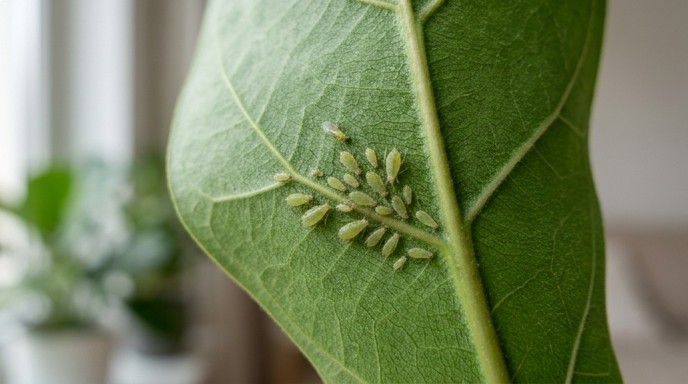
Clusters of small insects on tender new growth
These are probably aphids. They may be green, black, gray, or pale and often gather around buds and young leaves. Curled growth, sticky honeydew, and pale shed skins are additional clues. Begin by rinsing the insects away and removing the most heavily infested weak shoot if the plant tolerates pruning.
White cottony clumps in leaf joints
This is the classic appearance of mealybugs. They hide where leaves meet stems, beneath foliage, and near the base of shoots; sticky residue may be present too. Remove visible insects with a cotton swab or soft cloth and inspect every tight crevice.
Brown or tan bumps that do not move
These may be scale insects. They settle along stems, veins, and leaf undersides, and some species produce sticky honeydew. Adults are protected by a waxy covering, so physical removal is useful; the mobile young stage is generally more vulnerable to contact treatments.
Fine pale stippling and delicate webbing
Spider mites may be responsible. They are tiny relatives of spiders, not insects. Leaves often look dusty or finely speckled before webbing becomes obvious. Tap a leaf over a sheet of white paper and look for very small moving dots to support the identification.
Sticky residue is a clue, not a diagnosis
Aphids, mealybugs, and soft scales can all produce honeydew. Shine on the leaf is not enough by itself; look for insect clusters, cottony material, or immobile scales.
Start with a shower and physical removal
A thorough rinse can reduce a small population of aphids or spider mites. Cover the soil surface, place the pot in a sink or shower, and wash the foliage with room-temperature water, paying close attention to leaf undersides. Use enough pressure to dislodge pests without breaking tender stems, then allow excess water to drain.
Wipe large, smooth leaves with a soft damp cloth. Lift scale insects and mealybugs individually with a cotton swab or cloth. If the plant tolerates pruning, remove a badly damaged leaf or shoot and seal the debris in a bag before discarding it.
A single shower will not necessarily remove eggs or pests hidden in leaf joints. Inspect the plant every few days for the next several weeks. Repeat a pesticide only at the interval stated on its label.
When insecticidal soap makes sense
Commercial insecticidal soap contains potassium salts of fatty acids and works only when it directly contacts the pest. It can help control aphids, mealybugs, young scale insects, and some mites, but it has little or no residual effect after it dries.
Choose an EPA-registered product whose label permits use on indoor houseplants and lists the target pest. Test it on one leaf and wait 24 to 48 hours. If no damage appears, treat the stems and both sides of the foliage exactly as directed.
It has a known formulation, tested concentration, and directions for plants and target pests.
Fragrances, degreasers, and other additives can injure foliage. There is no universal safe recipe for every plant.
Horticultural oil and neem-based products
Horticultural oils coat pests and work primarily through direct contact. They can be useful against scale, mealybugs, and spider mites. Some registered products contain clarified neem extract or neem seed oil, but a natural origin does not make an improvised mixture safe for every houseplant.
Do not combine raw neem oil and household soap using an online recipe. Use a formulated product labeled for the plant and pest. Do not apply oil to a drought-stressed plant, in direct sun, or at a temperature prohibited by the manufacturer. A patch test is especially important on tender, young, or fuzzy foliage.
Reserve rubbing alcohol for spot treatment
Individual mealybugs or scale insects can sometimes be lifted with a cotton swab lightly moistened with isopropyl alcohol. Test a hidden area first. Do not spray the entire plant with a strong alcohol solution; sensitive foliage can develop burns.
Do not stack treatments
A stronger concentration or a mixture of soap, oil, alcohol, and other products will not make the plant recover faster. It does increase the chance of leaf damage. Use one product at a time, follow its label, provide the required ventilation, and keep children and pets away for as long as the manufacturer directs.
A practical plan for each pest
Rinse the plant, remove the most crowded shoots, and recheck new growth. If colonies return, use an insecticidal soap whose label lists aphids.
Remove visible insects, spot-treat them with alcohol after a patch test, and use a labeled insecticidal soap or horticultural oil if needed. Check leaf joints, the pot rim, and the saucer.
Gently remove adults and prune heavily infested growth. Target the mobile young stages with horticultural oil or another product whose label specifically lists scale.
Wash leaf undersides repeatedly. If that is not enough, choose a product that specifically lists mites; an ordinary insecticide may not control them. Thorough coverage and label-directed repeat treatments matter.
When it is better to discard the plant
A severely infested pot can remain a source of pests for the entire collection for months. Disposal may be the more practical choice when most foliage is damaged, mealybugs are established around the roots, scale densely covers the stems, or mite webbing has spread to neighboring plants.
Cover the plant with a bag before carrying it through the home and do not place infested material in an indoor compost bin. For a rare or valuable plant, ask a local Extension office, plant clinic, or reputable nursery to confirm the identification before escalating treatment.
How to avoid bringing pests home again
- Inspect before buying. Check leaf undersides, joints, new growth, and the potting mix surface.
- Quarantine a new plant for at least three weeks. Inspect it several times, not just on the day it arrives.
- Check the collection while watering. Sticky residue, pale stippling, webbing, and cottony clumps are easier to manage early.
- Clean tools and work surfaces. Do not move from an infested plant to a healthy one with the same uncleaned scissors.
- Match care to the plant. Poor light, inappropriate watering, or excess fertilizer can weaken growth, but a universal instruction to water less will not treat foliage pests.

What if tiny flies rise from the soil?
They are likely fungus gnats rather than one of the four pests above. Their larvae develop in moist potting mix, so this problem does call for adjusting watering and treating the growing medium. Spraying the leaves with alcohol or oil will not solve it.
The bottom line
The best treatment begins with correct identification. Isolate the pot, rinse or remove the pests you can see, and then evaluate the result. If a pesticide is needed, choose it by the target pest and the permitted use on its label—not by a universal DIY recipe.
Sources
- Colorado State University Extension — identification and management of houseplant pests
- Colorado State University Extension — insecticidal soap and the risks of household detergents
- University of Minnesota Extension — identifying and controlling spider mites
- US EPA — selecting and using pesticide products according to the label