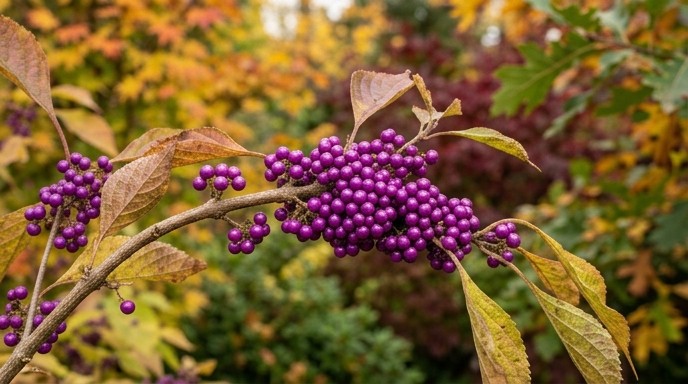
When most plants lose their colors in autumn and the garden turns gray, the Beautyberry (Callicarpa) is just beginning its main show. This unusual ornamental shrub is famous for its dense clusters of brilliant, neon-purple (and occasionally white) berries that heavily coat the branches and remain long after the leaves have completely fallen.

The neon-purple berries of Callicarpa look so bright they almost seem artificial.
In the wild, the Beautyberry grows in moist woodlands and along the banks of streams. But thanks to its phenomenal hardiness and low-maintenance nature, it has become an absolute favorite among landscape designers. Here is everything you need to know to successfully grow this cosmic beauty in your garden.
Ideal Conditions: Sun, Soil, and Climate
Callicarpa is a fairly tough plant, but to achieve the brightest and most abundant fruiting, you need to provide conditions that mimic its native environment.
- Sunlight: The plant thrives best in full sun or light, dappled shade. The golden rule is: the more sun the bush receives during the day, the more abundant and vibrant the berry harvest will be in the fall.
- Soil: Moist but well-drained soil, generously enriched with compost or other organic matter, is ideal. The plant absolutely cannot tolerate stagnant water (boggy conditions) around its roots, especially in winter.
- Hardiness: Beautyberry handles moderate winters well. However, at temperatures below -18°C (0°F), the upper branches may suffer frostbite. In colder regions, it is highly recommended to mound soil high around the base and mulch the root zone heavily for winter.
Planting and Propagation
You can introduce a beautyberry to your garden in several ways: buy a potted seedling, grow it from seed (a lengthy process), or root a summer cutting. Thanks to closed root systems, container-grown plants can be planted almost anytime during the warm season, but there are optimal agronomic windows.

Thick mulching helps retain the moisture that this plant loves so much.
The Secret to a Bountiful Harvest: Proper Pruning and Feeding
For Callicarpa to maintain a neat, compact shape and produce the maximum number of berries, it requires simple but regular care. The most important rule involves spring pruning.
The fact is that the beautyberry flowers and produces berries exclusively on new wood (the current year's growth). Therefore, in late winter or very early spring (March), do not hesitate to cut the entire bush back, leaving only "stumps" about 15-35 cm (6-14 inches) above the ground. Don't worry, this won't kill the plant! On the contrary, such a radical haircut stimulates the vigorous growth of young, thick branches, which will be covered in a solid carpet of berries by autumn.
As for feeding, the plant does not require expensive chemical fertilizers. It is sufficient to mulch the root zone with well-rotted manure or good homemade compost in late winter. This gives the shrub the perfect nitrogen boost for its spring growth.
💡 Interesting Facts About Beautyberry
- Natural Repellent: Callicarpa leaves contain chemical compounds (specifically callicarpenal) that effectively repel mosquitoes, ticks, and ants. If you crush a fresh green leaf in your hands and rub it on your skin, you will notice a distinct, spicy aroma.
- A Joy for the Eco-Garden: The bright berries are a favorite treat for many garden birds and small mammals, helping to support biodiversity in your yard during the winter months.
- Are They Edible for Humans? The berries are not toxic, but raw, they are almost tasteless and are considered culinarily inedible (astringent, small, and mealy). However, some enthusiasts boil them down to make an exotic jelly with an incredible ruby color.
Problems and Pests
One of the biggest advantages of the beautyberry is its phenomenal resilience. It almost never suffers from typical fungal infections and absolutely does not attract traditional garden pests (like aphids, caterpillars, or spider mites). The only real threat, if you live in a rural area or near a forest, is wild deer and rabbits, which love to nibble on its tender young foliage in the spring.
In autumn, when other shrubs look dull and sad, beautyberry branches can be boldly cut to create striking floral arrangements for your home. Plant it in your garden, and it is guaranteed to become the main, unforgettable centerpiece of your autumn landscape!