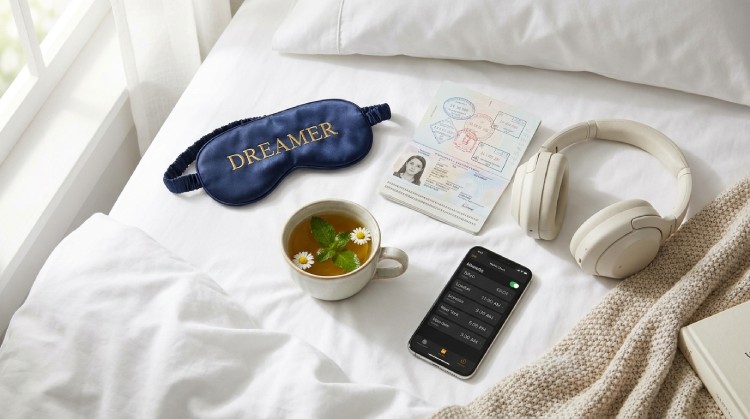
The first morning in a new country may begin nothing like you planned. Daylight fills the room and the city is already moving, yet your body is convinced it is the middle of the night. By evening, the pattern reverses: after feeling sleepy all day, you get into bed and suddenly cannot fall asleep.
This is jet lag—a temporary mismatch between the body’s internal clock and local time. A bottle of water, a large breakfast, or a special travel pillow cannot erase it. Well-timed sleep, light, and caffeine can, however, make the first few days easier.
Jet lag is not simply post-flight fatigue
A long journey can leave you exhausted even when you have not crossed a time zone. An uncomfortable seat, noise, an early trip to the airport, and several hours without proper sleep all contribute to ordinary travel fatigue.
Jet lag has a different cause. It appears when you cross several time zones quickly and your circadian rhythm cannot adjust at the same speed. Your internal clock is still following the schedule at home, even though the light-dark cycle around you has changed.
Symptoms can include:
- insomnia or waking much too early;
- strong daytime sleepiness;
- difficulty concentrating;
- irritability or changes in mood;
- feeling mentally slowed down;
- headache;
- temporary digestive discomfort.
Severity depends on the number of time zones crossed, the direction of travel, sleep loss, age, and individual susceptibility.
Why eastbound travel is usually harder
Traveling east requires you to fall asleep and wake earlier than your body expects. After a flight from New York to London, for example, the destination may be ready for bed while your internal clock is still set to late afternoon.
Westbound travel does the opposite: the day feels longer and bedtime moves later. Most people find it easier to delay sleep a little than to make themselves fall asleep several hours early.
The CDC gives rough average adjustment rates of about one time zone per day when traveling east and one and a half when traveling west. These are estimates rather than promises; some travelers adjust faster and others need more time.
Before departure: should you shift your schedule?
If an important meeting, competition, or event is scheduled soon after arrival, preparation can begin two or three days before the flight.
For eastbound travel, try moving bedtime and wake time 30–60 minutes earlier each day. For westbound travel, move them slightly later. Meal times and light exposure can shift in the same direction.
Do not do this by sacrificing sleep. A drastic one-night change may simply add sleep deprivation to jet lag. If the schedule cannot be adjusted, arriving well rested is more useful.
Once you board, set your watch or phone to destination time. That simple step makes it easier to decide whether it is a sensible time to sleep or to remain awake.
Light matters more than travel gadgets
Light is one of the strongest signals for the internal clock. It can move the circadian rhythm earlier or later, which means timing matters as much as brightness.
After eastbound travel, morning light at the destination is often helpful, while evening light should usually be reduced. This gradually encourages earlier sleep and waking.
After westbound travel, light in the late afternoon or early evening is often more useful. It signals that the body should remain active longer and go to sleep later.
This simple rule can break down after very large time-zone changes. Light at the wrong biological time can move the body clock in an unhelpful direction. If you are crossing many time zones or must perform on a critical schedule, use a science-based jet-lag calculator or plan the timing with a sleep clinician.
Most leisure travelers do not need a special lamp. Going outside at the appropriate time and reducing bright indoor light and screens in the evening is often enough.
Trip planner
Which way are you traveling?
Choose a direction or a short trip to see a basic plan. Crossing eight or more time zones calls for more precise light timing.
Your body needs to sleep earlier
- Two or three days before
Move bedtime and wake time 30–60 minutes earlier each day, provided this does not shorten your overall sleep.
- On the plane
Switch to destination time and try to sleep if it is already nighttime there.
- After arrival
Morning light is often useful; reduce bright evening light. For a large time shift, confirm the precise timing with a jet-lag calculator.
- Caffeine and naps
Keep caffeine to the earlier part of the local day and limit a necessary nap to roughly 20–30 minutes.
Your body needs to sleep later
- Two or three days before
Gradually move bedtime and wake time 30–60 minutes later without creating a sleep deficit.
- On the plane
Begin timing sleep and meals according to the destination clock.
- After arrival
Late-afternoon or early-evening light is often helpful when you need to stay awake later.
- Local evening
Try not to fall asleep too early. If you use caffeine, stop at least six hours before bedtime.
Fully adjusting may not be worthwhile
- Before the trip
Check whether you can keep part of your home sleep schedule without disrupting the purpose of the visit.
- Plan important tasks
When possible, schedule demanding meetings for hours when your internal clock would normally expect you to be alert.
- Daytime sleep
A short nap may help if sleepiness is overwhelming; a long nap can make the next night more difficult.
- Before returning
Do not force a complete shift for one night when your home schedule is reasonably compatible with the trip.
Your first day at the destination
After arrival, try to live according to local time even if your body has not caught up.
Morning or daytime
Go outside when daylight suits the direction in which you need to adjust. A gentle walk can help you remain alert, although exercise itself does not cure jet lag.
Eat on the local schedule. Meals are a practical cue that can help establish a new routine, but convincing clinical evidence that a large breakfast speeds recovery is still lacking. The frequently cited study about a substantial morning meal used a mathematical model rather than a trial in travelers.
When you can barely stay awake
A short nap of roughly 20–30 minutes may improve alertness. A long daytime sleep can leave you groggy and reduce sleep pressure in the evening, making it harder to fall asleep at the local bedtime.
If you can do so safely, remain awake until a normal local bedtime. Do not drive or perform hazardous work when you are struggling to keep your eyes open.
Evening
Dim the lights, set work aside, and allow yourself a normal wind-down period. An eye mask and earplugs can make sleep more comfortable, but their role is straightforward: they block light and noise. They do not reset the body clock on their own.
Caffeine promotes alertness, but it does not reset the clock
Caffeine can temporarily reduce daytime sleepiness. In a small randomized trial after eastbound travel, it improved alertness but also tended to interfere with nighttime sleep.
It therefore makes more sense earlier in the local day. The CDC recommends stopping caffeine at least six hours before the intended bedtime.
Trying to sustain yourself with several large coffees until late evening may get you through one day, but it can also postpone sleep and prolong the adjustment.
Melatonin: timing matters as much as the product
Melatonin is a hormone the body naturally produces in darkness. Melatonin products may improve sleep and reduce some symptoms of jet lag, particularly after crossing five or more time zones.
A systematic review of randomized trials found that melatonin was more likely to help when taken close to the intended bedtime at the destination. It is not simply a sleeping pill that works the same way at any hour: poor timing can move the internal clock in the wrong direction.
Studies have used different doses. The CDC notes that 0.5–1 mg is often enough to produce a circadian shift and advises against high doses above 5 mg. More is not necessarily better, and the amount in a product may not always match its label.
Ask a physician or pharmacist about timing and dose, particularly if you take regular medication, are pregnant or breastfeeding, or have a chronic condition. Do not try melatonin for the first time immediately before an important trip without knowing how it affects you.
What about sleeping pills?
Prescription sleeping medication can make it easier to fall asleep, but it does not necessarily reduce daytime symptoms or accelerate circadian adjustment. Some medicines can cause next-day sedation, dizziness, memory problems, and impaired coordination.
Sedating antihistamines are not a neutral substitute. They can impair attention and increase fall risk, particularly in older adults.
Do not use prescription sleep medication without medical guidance, and never combine sedatives with alcohol. This is especially risky on a plane, where movement is limited and you may need to respond quickly to an unexpected situation.
Water helps, but it does not treat jet lag
It is sensible to drink enough during a flight because dry cabin air and alcohol can worsen headache, dry mouth, and general discomfort.
Dehydration is not the main cause of jet lag, however, and an extra bottle of water will not synchronize the body clock. Hydration can make the journey easier; sleep, well-timed light, and the local schedule remain the main tools for circadian adjustment.
Travel pillows, footrests, headphones, and eye masks can also improve comfort. They are useful accessories, not scientific treatments for jet lag—and no particular brand is required.
Should you adjust for a very short trip?
For a stay of only one or two days, a complete shift may not be worthwhile. When practical, you can keep part of your home schedule and arrange important tasks for times when your internal clock would normally expect you to be alert.
This approach will not suit every meeting, tour, or early return flight. The best choice depends on the itinerary as well as the time difference.
How long does jet lag last?
Jet lag usually fades gradually as the internal clock synchronizes with the new cycle of day and night. Crossing several time zones may require several days of adjustment; a larger shift can take longer.
Not every persistent sleep problem after travel is jet lag. If your sleep does not recover, symptoms become worse, or sleep regularly causes difficulty even when you have not traveled, discuss it with a clinician.
What is worth remembering
You do not need to follow every tip at once. A practical plan for most trips comes down to five steps:
- Arrive rested and, when time allows, shift your schedule gradually toward destination time.
- After boarding, begin eating, moving, and sleeping according to the destination clock.
- Use daylight strategically: morning light is often useful after eastbound travel, while later light more often helps after westbound travel.
- If you are struggling to stay awake, keep a daytime nap to roughly 20–30 minutes.
- Reserve caffeine for earlier in the day, and use melatonin only with carefully considered timing.
The bottom line: jet lag cannot always be avoided, especially after a large time shift. The realistic goal is not to defeat it in one night, but to stop getting in the way while the body gradually settles into a new rhythm.
Sources
- CDC Yellow Book 2026 — Jet Lag Disorder
- Herxheimer and Petrie — systematic review of melatonin for preventing and treating jet lag
- Choy and Salbu — systematic review of non-pharmacological interventions for jet lag
- Beaumont et al. — randomized trial of caffeine and melatonin after eastbound travel
- American Academy of Sleep Medicine — practice parameters for circadian rhythm sleep disorders and jet lag
- Huang, Zhang and Braun — mathematical model of meal timing and circadian re-entrainment