When a plant turns yellow, grows poorly or fails to crop, it is tempting to reach for a bag of fertiliser. The real cause may be dry or waterlogged soil, cold weather, too little light, damaged roots or unsuitable pH. Fertiliser helps only when the plant genuinely lacks nutrients.
Good feeding therefore begins not with the most impressive product on the shelf, but with a simple question: what is already in the soil, and what does this particular crop need? The answer may be nitrogen, compost or, quite often, no additional fertiliser at all.
What do the three numbers on the bag mean?
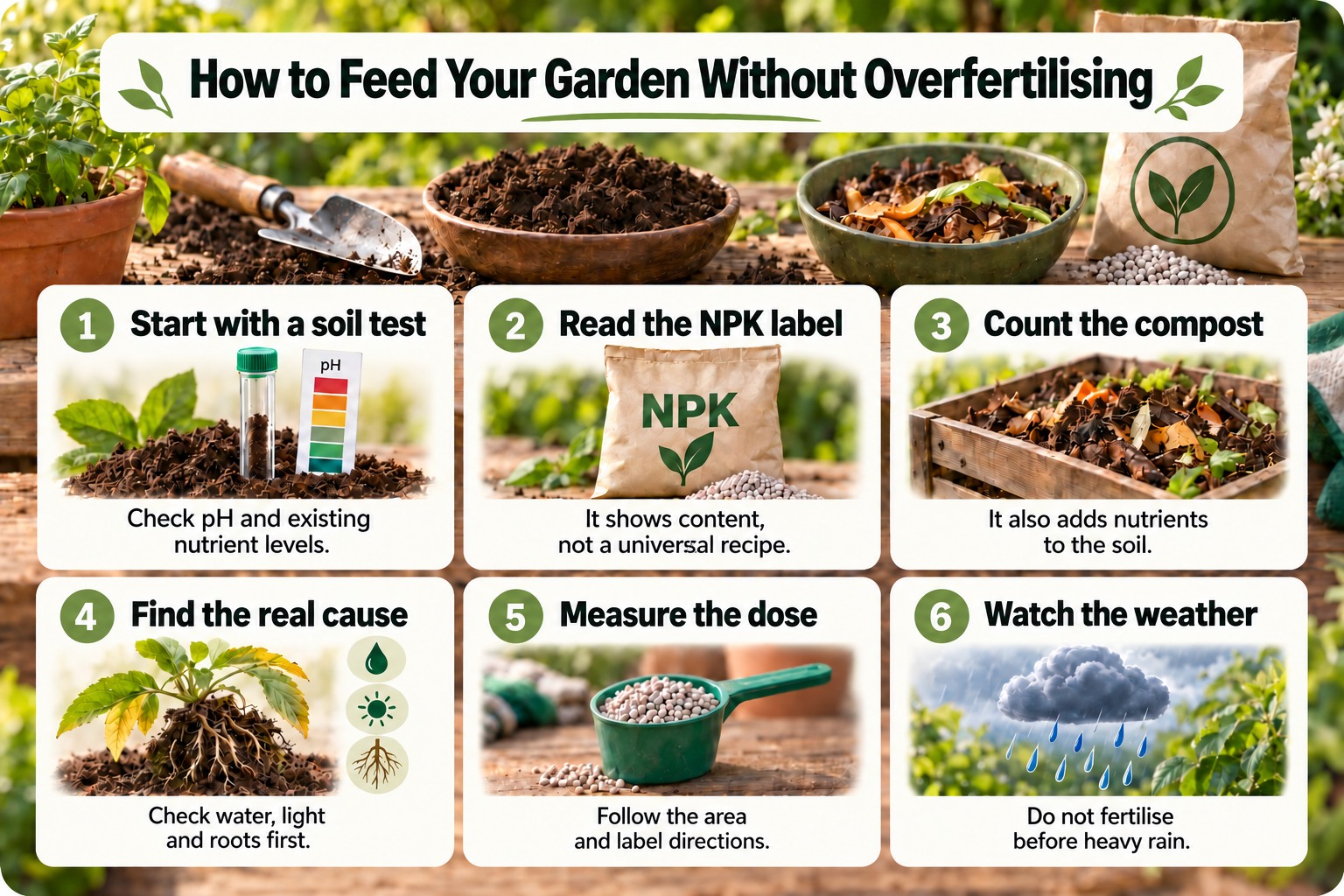
NPK describes the fertiliser’s nutrient analysis. The letters always appear in the same order: nitrogen, phosphorus and potassium. A grade of 10-10-10 has equal declared proportions of the three primary components, while 20-10-10 contains twice the proportion of nitrogen shown for either of the next two figures.
There is a detail that simplified explanations often miss. In many countries, the first number is the percentage of nitrogen, while phosphorus and potassium are declared as phosphate and potash equivalents — P2O5 and K2O. Labelling rules vary, so use the explanation printed on the product sold in your country.
NPK is not the whole of plant nutrition. Calcium, magnesium, sulphur and small amounts of other elements are also essential. A nutrient may be present in the soil yet remain difficult for roots to absorb when pH is unsuitable.
Why a soil test saves money
A laboratory test can report pH, available phosphorus and potassium, organic matter and other measurements depending on the service. A good laboratory also provides recommendations for the crop you intend to grow. This allows you to buy what the soil needs rather than simply choosing the strongest product.
Take small samples from several points at the same depth and combine them. Test vegetable beds, lawn and orchard areas separately because their history differs. For useful comparisons over time, repeat the test in roughly the same season.
Compost counts as a nutrient source
Compost improves structure, helps soil retain water and supports soil organisms. It is not, however, a nutrient-free “safe” material. Compost — especially composted manure — adds nitrogen, phosphorus, potassium and salts.
Applying generous amounts of manure every year and following it with a complete mineral fertiliser can cause phosphorus and potassium to accumulate. Ground receiving regular organic additions should still be tested. A thin layer of mature plant-based compost is often enough for soil improvement, while manure should also be counted as fertiliser.
When a plant does not need feeding
Do not rush to fertilise cold or saturated soil, a newly transplanted plant with damaged roots, sun-scorched foliage or a crop struggling in deep shade. Roots function poorly under these conditions, and additional salts may intensify the stress.
Yellow leaves are not a diagnosis either. Notice whether old or young leaves changed first, whether spots are present, how quickly the problem developed and what happened with weather and watering. Only then should nutrient deficiency move higher on the list of likely causes.
Is there one feeding calendar for the whole garden?
No. A lawn, tomato plant, apple tree and perennial flower do not share the same needs. Apply nutrients during active growth and when the particular crop can use them. Timing depends on climate, plant, product formulation and the soil-test recommendation.
Large, late applications of nitrogen can indeed delay the hardening of young shoots before winter. It does not follow that every plant automatically needs phosphorus and potassium in autumn. If the soil already contains enough, adding more provides no benefit.
A vegetable bed and an apple tree feed differently
Annual vegetables build leaves, roots or fruit within a few months, so their nutrients are often planned for a single season. Even tomatoes, cucumbers and cabbages differ in their needs, and concentrated solutions can easily injure young plants.
A mature tree explores a large volume of soil and may grow normally for years without annual mineral fertiliser. Do not pour a heap of product beside the trunk. Spread it evenly through the active root zone, following the label and accounting for the actual size of the plant.
How to avoid getting the dose wrong
The NPK grade shows the proportion of nutrients in a product, not how much product your bed requires. The calculation also needs the recommended nutrient rate, the area being treated and the fertiliser concentration. A spoonful “by eye” or one handful per plant is a poor measuring system.
- Measure the area you intend to treat.
- Match the soil-test recommendation to the analysis of the chosen product.
- Measure the product with scales or a dedicated garden measure.
- Distribute it evenly and follow the label’s watering directions.
- Do not exceed the rate or mix products unless the manufacturer explicitly permits it.
The weather matters too
Do not spread fertiliser before heavy rain. Runoff can carry nutrients into drains, ponds and rivers. Keep granules off leaves unless the label instructs otherwise, and do not feed a dry, wilted plant with a concentrated solution.
Some products should be watered in after application, while others are used differently. The rule “always water heavily afterwards” is not universal; follow the directions for the actual product.
Signs that the garden may have had too much
- dry or scorched-looking leaf margins appearing after feeding;
- a white salt crust on soil or potting mix;
- very long, soft shoots with few flowers;
- growth becoming worse immediately after an application;
- consistently excessive phosphorus or potassium in soil-test results.
In a container, excess soluble salts can sometimes be leached with several slow, thorough waterings, provided the plant tolerates this and drainage works properly. In open ground, do not try to “balance” one excess nutrient by adding another.
Good feeding is almost invisible: plants grow steadily, salts do not accumulate and the gardener does not buy products just in case. Check the soil and growing conditions, identify a genuine need and only then measure the fertiliser. That sequence works better than any universal calendar.