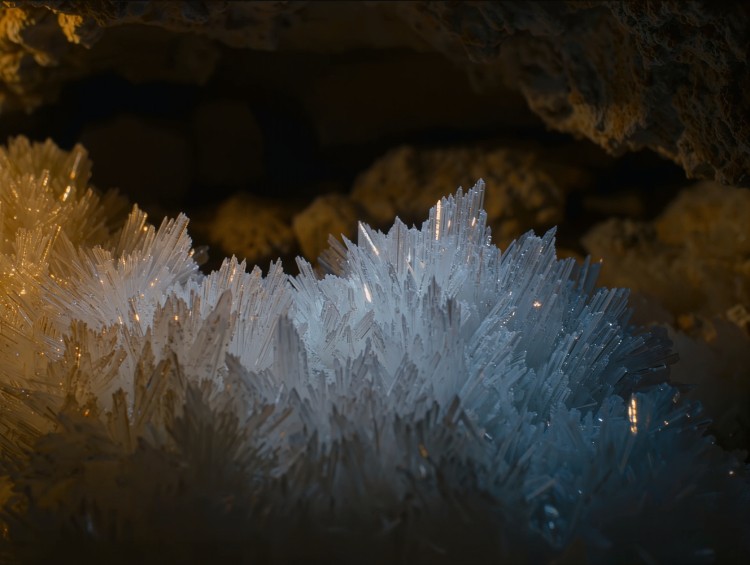
Kryshtaleva Cave in the village of Kryvche offers a rare chance to enter a vast gypsum labyrinth without sporting equipment or crawls through tight passages. Its visitor section is illuminated, yet it still feels genuinely underground: a long entrance corridor first carries you away from daylight, then white, cream, and amber crystals emerge in the lamps.
- Mapped passages
Approximately 23 km. - Visitor route
Approximately 2.5 km. - Tour duration
Up to 1 hour 20 minutes. - Temperature
About 10.6 °C (51 °F) throughout the year.
Kryshtaleva is a gypsum cave, not a quartz cavern
The name can be misleading: the walls are not made of rock crystal. The cave developed within thick gypsum, and its galleries carry crystalline aggregates in white, yellow, pink, and amber-brown shades. Under directional light, their small faces reflect and turn an ordinary-looking wall into a shimmering surface.
Its mapped passages extend for roughly 23 km, but visitors see only the developed section. Off-route galleries are closed not because they hide a secret “better cave,” but to protect the fragile environment and the crystals themselves.

What the tour feels like
The first roughly 500 metres follow the Entrance Corridor. It acts as a gradual transition from the surface to the main cave: daylight disappears, the temperature settles, and crystals begin to emerge on the walls.
The route continues through the Hall of Rocks, Corridor of Stone Icicles, Zoological Hall, and Hall of Rubble. Many names come from visual associations, with guides pointing out shapes that resemble animals and familiar objects. The most distinctive stretch is the Crystal Corridor, where pale and amber formations cover broad areas of wall. Near the exit, visitors meet the formation known as the Stone Buffalo.
This is not a walk across a level museum floor. The visitor route is more manageable than a sporting cave, but the ground remains naturally uneven and can be damp or slippery. Allow up to 1 hour 20 minutes for the full tour.

A cave with a human history as well
Written references to Kryshtaleva date to 1721. Its entrance was destroyed after the Second World War and restored in the 1970s. The galleries were later equipped with electric lighting and developed for tours. Since 1963, Kryshtaleva has held national status as a geological natural monument.
This history helps explain why the site feels like both a natural feature and part of the region’s cultural memory. It is more than an attractive backdrop: it belongs to the long history of exploring Podillia’s gypsum karst.
Does the cave air really provide medical treatment?
Tourist descriptions of Kryshtaleva often mention air ionization and the potential for speleotherapy. An ordinary tour lasting a little over an hour, however, is not a therapeutic course and should not be presented as treatment for asthma or any other disease.
Speleotherapy has been studied in dedicated underground centres where participants completed repeated, lengthy, supervised sessions. Those findings cannot simply be transferred to every cave or a brief tourist visit. Kryshtaleva is worth visiting for its geology, history, and underground atmosphere.
You feel the cool air within minutes
The cave remains near 10.6 °C (51 °F) even during summer heat. A T-shirt that felt comfortable at the car park quickly becomes insufficient underground.
What to wear and bring
- A warm outer layer. A fleece, sweatshirt, or light jacket is useful even in July.
- Closed footwear. Trainers or light hiking shoes with reliable tread are suitable.
- Your own flashlight. The official centre asks visitors to carry backup lighting because electricity interruptions are possible.
- A small backpack. A bulky bag gets in the way in corridors, while free hands make movement easier.
- A charged phone. Do not expect a stable mobile signal underground.
If you experience severe claustrophobia, have balance difficulties, or cannot comfortably walk 2.5 km over uneven ground, ask staff about the route before travelling. “Developed” does not mean fully step-free or accessible.
Opening hours and tickets in 2026
According to the Ternopil Regional Tourism Centre, visitors join tours in a live queue at the entrance. The final group enters one hour before the guides finish work.
Closed.
10:00 a.m.–5:00 p.m.
10:00 a.m.–6:00 p.m.
UAH 140.
UAH 100.
Up to 15 people; the minimum tour charge is UAH 1,000.
These prices took effect on 1 January 2026. Hours, route access, and tariffs can change, so open the official page or use the telephone numbers listed there before setting out. This matters particularly for a small party: the minimum tour charge may exceed the sum of individual tickets.
Getting to Kryvche
By car. From Ternopil, drive south through Chortkiv and Borshchiv. Kryvche lies roughly 19 km from Borshchiv in the direction of Melnytsia-Podilska. Turn toward the cave after passing Kryvche Castle. Use a current navigation app rather than relying entirely on regional road numbers.
By public transport. The simplest approach is to reach Borshchiv first, then continue to Kryvche by a local bus or taxi. Frequencies change, so confirm the return journey before beginning the tour.
What else to see nearby
Two towers of the seventeenth-century Kryvche Castle remain on a hill near the cave. They can be added without rushing or making a long detour. With a full day and a car, continue to Borshchiv or toward the Dniester Canyon, but leave spare time for the queue at the cave entrance.
Kryshtaleva or Mlynky?
Kryshtaleva suits a first underground experience: it has lighting, a defined visitor route, and requires no specialist equipment. Mlynky is a more active adventure with narrow passages, gypsum dust, and much closer contact with the cave. The choice is not about which is “better,” but about the level of difficulty you want.
The LINES’ guide to Mlynky Cave explains route styles, equipment, and preparation for a genuine caving excursion.
Photography without damaging the cave
Low light makes phones lengthen exposure time, so blurred photographs are normal. Brace your elbows against your body, pause your breathing for the shot, and avoid flash if the guide does not allow it. Never step off the route for an angle or touch crystal surfaces: oils and dirt from hands leave marks on formations that developed extremely slowly.
Who will enjoy the trip?
Kryshtaleva works best for travellers who want to see a genuine gypsum cave without committing to sporting caving. It is not a staged attraction, but a natural labyrinth into which visitors have been allowed a carefully managed glimpse.
Visiting in 2026
Ternopil Regional Tourism Centre: route, hours, tickets, and contacts
Geology and history
Encyclopedia of Modern Ukraine: Kryshtaleva · Wikimedia Commons: photographs of the cave
Speleotherapy
Cochrane Review: speleotherapy for asthma