Mlynky Cave is nothing like a show cave with illuminated paths and stairways. Visitors may need to duck, crawl, squeeze between walls, and use their hands and feet for support. A visit is best understood as a guided caving trip whose difficulty should be matched to the abilities of the group, rather than as an ordinary sightseeing tour.
That does not mean a first visit must include the tightest passages. Mlynky offers different route options, and an experienced guide can adjust the trip to the group’s fitness and confidence underground.
Mlynky Cave at a glance
Mlynky lies near the village of Zalissia in the Zavodske community of Chortkiv Raion, Ternopil Oblast. It is a subhorizontal maze cave formed in gypsum.
According to the Ukrainian Cave Cadastre, 53,160 metres—about 33 miles—of passages have been mapped. Exploration continues, which is why older sources often give much smaller figures.
The cave remains close to 10 °C (50 °F) throughout the year and has high humidity. It is also a geological natural monument of national importance. Its crystals and other formations should never be broken, removed, or used as handholds unless necessary for safety.
This is not a walk through an underground gallery
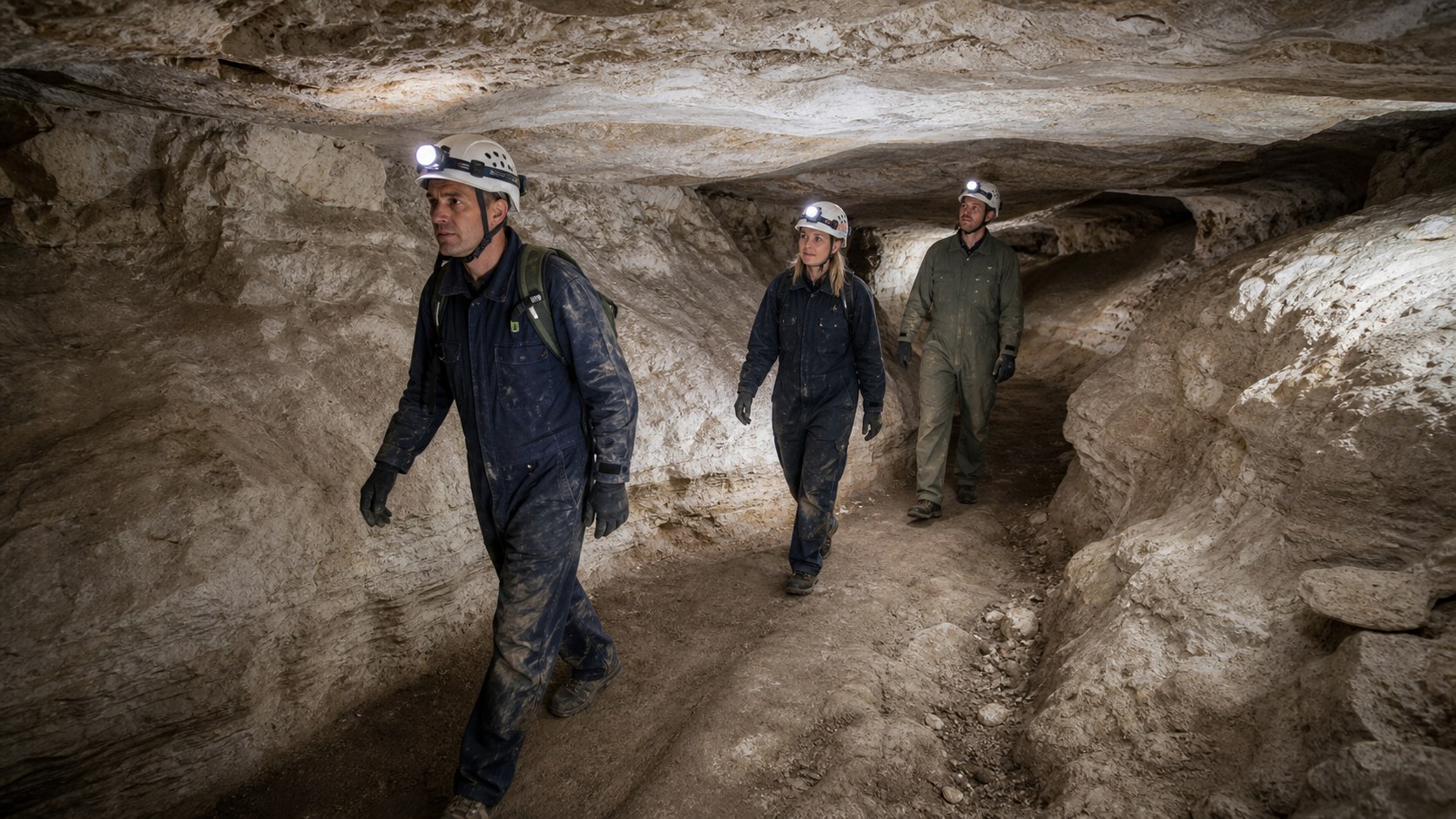
Mlynky has no permanent lighting, level floor, or handrails. Natural passages range from roomier chambers to low cracks where visitors move on their knees or stomachs. Some sections involve stemming: supporting the body between opposing walls with the legs and back.
Even a short route can take several hours and demand continuous attention. The distance is not usually the hardest part. The unfamiliar movement—crouching, crawling, climbing over rocks, and remaining bent for long periods—can be more tiring.
This is an important contrast with fitted Kryshtaleva Cave, where the visit is closer to a conventional underground tour. If you would prefer to see a gypsum cave without sporting obstacles, read our guide to Kryshtaleva Cave.
Why go underground?
The most memorable feature of Mlynky is not one supposedly “extreme” squeeze but the labyrinth itself. Its walls contain gypsum of different structures and, in places, crystalline draperies and druse formations. A headlamp reveals surfaces in white, muted yellow, gray, and darker mineral tones.

Different areas of the cave have different characters. A passage may narrow into a crack and then open only a few metres later into a space where the whole group can stand. That contrast creates the feeling of genuine exploration, even though the guide already knows the route.
Cave crystals grow extremely slowly. Dirty hands can leave permanent marks, while one careless movement can break a fragile formation. Take photographs only where the group can stop safely without touching the walls or blocking the route.
How to choose a route for your first visit
Route names and durations vary between clubs. Instead of relying only on labels such as “easy” or “extreme,” ask the organiser to describe the actual obstacles.
For a first descent
A two- to three-hour route on which the tightest and most difficult sections can be bypassed is a sensible starting point. It may still include crawling, crouching, and several straightforward stemming sections.
If you want a more physical route
More active routes include longer low passages, harder climbs, and sections where participants must support their own body weight confidently. Choose one only after an honest conversation with the guide about the fitness of everyone in the group.
For experienced cavers
Longer or more technical trips should be arranged separately. They may require specialist equipment, previous experience, and substantially more endurance. Duration alone does not determine difficulty: a short trip through confined passages can be psychologically harder than a longer but roomier route.

What to ask before booking
A reliable organiser should explain clearly what the group will encounter. Before paying, ask:
- How much time will the group spend underground?
- Will the route include squeezes, stemming, climbs, or descents?
- Which difficult sections can be bypassed?
- How many participants and guides will be in the group?
- What equipment is included in the price?
- Are a protective helmet, primary and backup headlamps, coveralls, gloves, and knee pads provided?
- What footwear should participants bring?
- Can the trip be shortened if someone feels unwell or uncomfortable?
- How is contact with the surface maintained, and what is the emergency procedure?
Ask for the current price directly before travelling. Equipment hire, transfers, accommodation, and meals may be charged separately, so a single “tour price” does not always show the real cost of the trip.
Current travel advice for international visitors
Government travel advice for Ukraine remains restrictive and can change quickly. As of August 2026, the UK Foreign, Commonwealth & Development Office advises against all but essential travel to Ternopil Oblast, while the U.S. Department of State advises against travel to Ukraine. Travelling against official advice may also affect insurance cover. Check the guidance issued for your nationality before considering a trip.
What to wear
Clothing needs to protect against cool temperatures, high humidity, dust, and repeated contact with rock.
A synthetic or wool base layer works well beneath coveralls because it does not remain wet for as long as cotton. Although the cave feels cool at first, active movement quickly generates heat, and an excessively thick sweater can become uncomfortable.
Footwear should fit securely and have a well-defined tread. Worn trainers with smooth soles are a poor choice on damp rock. Gloves protect the hands, while soft knee pads make crawling considerably more comfortable.
Tie back long hair, remove jewellery, and secure laces and loose straps so that they cannot catch on the rock.

After the trip, you will want:
- a complete set of dry clothes;
- spare footwear;
- a bag for dirty clothing;
- water and a small snack;
- a towel or wet wipes.
Take a phone only in a robust protective case and a securely fastened pocket. A smartphone is not a substitute for a primary or backup light.
Mlynky without the bravado
Mlynky Cave does not need inflated promises of “maximum adrenaline.” Its real value lies in seeing a natural gypsum maze, experiencing the scale of the underground environment, and following a route that demands attention to yourself, your team, and the cave.
A successful trip is not defined by a daring photograph in a squeeze. It depends on choosing the right route, travelling with a reliable guide, and returning to the surface without leaving a trace behind.
Sources
- Ukrainian Cave Cadastre: the longest karst caves in Ukraine
- Encyclopedia of Modern Ukraine: Mlynky
- Ternopil regional environmental authority: protected natural sites in the Zavodske community
- Tour Club Ternopil: practical information about guided trips in Mlynky Cave
- National Speleological Society: Minimum-Impact Caving
- UK FCDO: Ukraine travel advice
- U.S. Department of State: Ukraine Travel Advisory