Powdery mildew is a group of related fungal diseases that affect roses, phlox, gooseberries, cucumbers, squash, apples, and many other plants. Its white or gray coating most often appears on leaves and tender shoots. A severe infection can weaken a plant or reduce flowering and yield, but the outcome depends on the host, weather, and how early management begins.
The first job is not to find a miracle spray but to confirm the diagnosis. The second is to judge severity. A few spots on a mature ornamental late in the season do not call for the same response as an early infection on a young cucumber vine.
- Typical sign
White or gray powdery patches on green tissue. - Spread
Spores travel through the air to susceptible plants. - Best timing
The first spots or preventive treatment after a history of severe disease. - Treatment limit
Old damaged foliage will not become healthy again.
What powdery mildew looks like
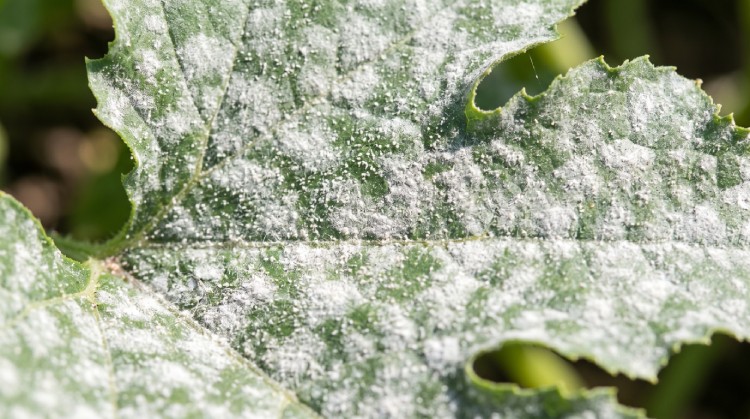
Early infections appear as separate pale patches that look as though the leaf has been dusted with flour. The patches expand and may merge across the upper or lower leaf surface, stem, bud, or young fruit. Infected foliage may yellow, curl, become distorted, or drop early.
The coating may partly rub away, but that is not a reliable diagnosis by itself. Fungal growth and injured tissue remain, and the white film can return. Consider the plant species, the pattern of the spots, and how they change over several days.
Irregular white powdery patches expand and appear on new leaves, shoots, or buds.
The mark follows the edge of a dried droplet, washes away, and does not spread to new tissue.
Yellow, purple, or brown spots are often bounded by veins, with gray growth more noticeable on the leaf underside.
Uniform wax or hairs look the same on healthy leaves and do not expand over time.
Compare them with The LINES “Visual Guide to Common Fungal Diseases in Plants”. A fungicide for powdery mildew will not necessarily control bacterial leaf spot, rust, or downy mildew.
Why powdery mildew can appear without rain
Most powdery mildew fungi grow largely on the plant surface and do not require a lasting film of water on the leaf to infect. Moderate temperatures, shade, high humidity within a dense canopy, and poor air movement often encourage disease. Lush young growth produced by excess nitrogen can be especially susceptible.
That does not mean the plant should be kept dry. Prolonged drought adds stress. Water according to the crop’s needs, preferably in the morning and into the root zone. This approach can reduce other foliar diseases, but it will not control powdery mildew by itself.
What to do after the first spots appear
1. Check how much healthy foliage remains
A few affected lower leaves on a mature ornamental late in the season may require only monitoring and limited cleanup. Act sooner when spots appear early, move rapidly onto new growth, or affect a crop where yield is at risk.
Remove a few of the worst leaves, improve growing conditions, and inspect new growth twice a week.
A fungicide will not restore old leaves. Preserve enough green tissue, support the plant, and decide whether keeping it is practical.
2. Prune selectively
Remove the most heavily infected leaves or shoots with clean pruners when the plant tolerates that type of pruning. Do not strip every leaf with a pale spot. Losing a large amount of healthy foliage can weaken the plant more than a moderate infection.

Clean the tool afterward. Send heavily infected debris to municipal green-waste collection or dispose of it according to local rules. A properly managed hot compost pile can destroy many pathogens, but if you do not monitor temperature and process, keep heavily diseased material out. Burning is not a necessary universal recommendation.
3. Bring more light and air into the canopy
- Reduce overlapping growth. Thin only excess or weak shoots rather than opening the plant abruptly.
- Allow adequate spacing. Base it on the mature size of the cultivar.
- Move container plants when appropriate. Choose a brighter position if the species tolerates more sun.
- Avoid excess nitrogen. Fertilize for the crop’s needs rather than forcing fast, tender growth.
- Prevent prolonged drought stress. A weakened plant is less able to tolerate loss of foliage.
When a fungicide can still help
Fungicides work best preventively or very early, protecting healthy tissue. They do not restore a leaf that is already yellow, distorted, or covered with fungal growth. When a high-value plant has a history of severe infection, treatment may begin before visible symptoms—but only according to the product label and local guidance.
Choose an EPA-registered fungicide whose label specifically lists both the plant and powdery mildew. Permission for roses does not automatically permit use on cucumbers or gooseberries.
- Sulfur: primarily a protectant used early. It can injure sensitive crops, should not be applied in high heat, and must be separated from horticultural oil as directed by the label.
- Horticultural oils: some labeled products can suppress a mild to moderate infection. Do not use them on drought-stressed plants, in prohibited temperatures, or too close to a sulfur application.
- Potassium bicarbonate: this is an active ingredient in formulated fungicides, not simply another name for household baking soda. Even a registered product can injure sensitive or severely infected foliage, so crop, rate, and a preliminary test matter.
- Other fungicides: select by host plant, disease, and permitted site rather than a general “fungus control” claim.

Do not improvise combinations
Some products can burn foliage when mixed or applied too close together, particularly sulfur and oils. Use one labeled product at a time unless the label explicitly permits a combination. On an edible crop, check the preharvest interval as well.
What about household baking soda?
DIY baking-soda sprays are often presented as guaranteed fungicides. Bicarbonates have been studied and used in powdery mildew management, but performance depends on the active ingredient, rate, additives, plant, and timing. An improvised mixture can spot or burn foliage, while repeated sodium applications can add salts.
Do not combine baking soda and household soap using a universal recipe or treat it as equivalent to a formulated potassium-bicarbonate product. If a bicarbonate treatment is appropriate, a registered fungicide labeled for the plant is the more predictable option.
How to tell whether management is working
Do not expect old white patches to disappear and the leaf to look new. Judge the fresh growth. When new leaves open without coating and spots on older leaves stop expanding, the disease is becoming stable. Continue inspecting and repeat a fungicide only as its label directs.
If fresh foliage develops new patches, reassess the diagnosis, spray coverage, and canopy conditions. For a severely infected annual near the end of its season, replacement may be more practical than repeated treatment.
Prevention for the next growing season
- Choose resistant or less susceptible cultivars. This is especially useful for phlox, roses, cucumbers, squash, and apples where disease returns every year.
- Plant for mature size. Neighboring plants should not form a permanently shaded, tightly packed wall of foliage.
- Scout plants with a history of disease. Check new leaves weekly before the time mildew usually appears.
- Remove heavily infected residue. Do not leave it in a dense mat beneath a susceptible plant.
- Avoid forcing tender growth. Excess nitrogen produces more susceptible tissue.
- Use early protection only when justified. On a crop with repeated severe disease, a labeled fungicide is more useful before widespread infection than afterward.
The bottom line
Powdery mildew rarely disappears after one magic spray. Confirm the diagnosis first and avoid removing too much healthy foliage. Improve light and air movement, correct excessive feeding, and watch the new growth. If disease keeps progressing or repeatedly threatens a crop, use early treatment with a fungicide labeled for that specific plant.