L-arginine is an amino acid the body uses to make nitric oxide, a signaling molecule that helps blood vessels relax. That mechanism sounds like a ready-made formula for better circulation and stronger workouts. Yet there is a considerable gap between raising an amino acid level in the blood and producing a meaningful result—and studies give different answers depending on the goal.
The one-minute summary
Arginine is necessary, but most healthy people do not need it as a supplement. A normal protein-containing diet provides it, and the body also makes its own. Evidence is weakest for improving exercise performance; there are more cautious signals of benefit for certain blood-pressure outcomes and mild to moderate erectile dysfunction.
What is L-arginine?
Arginine is described as a conditionally essential amino acid. A healthy adult can usually synthesize it, but requirements may change during growth, serious illness, injury, or major physiological stress.
It participates in protein synthesis, the urea cycle, ammonia disposal, and the production of other compounds, including creatine and nitric oxide. These are important biological roles, but they do not prove that an extra serving of arginine will automatically enhance every process.
How arginine relates to nitric oxide
Enzymes use arginine as a substrate to produce nitric oxide. Nitric oxide signals smooth muscle in blood vessels to relax, affecting vascular tone and blood flow. This is why L-arginine has been studied in cardiovascular health, sports nutrition, and erectile function.
Oral arginine is also substantially metabolized in the gut and liver before it reaches systemic circulation. The body regulates nitric-oxide production in ways that are more complicated than the simple “arginine → NO” arrow on a supplement label.

L-arginine often appears in pre-workout blends, but its presence does not guarantee a better result.
What the research says for different goals
Results are conflicting, and overall L-arginine produces little to no meaningful improvement in exercise performance in healthy people.
Meta-analyses suggest a modest reduction may occur, but this does not replace treatment and may add to the effect of medication.
Some studies in mild to moderate dysfunction report improvement, although doses, formulations, and combinations vary and the underlying cause still matters.
Arginine is studied in specialized clinical nutrition, but those protocols cannot be transferred directly to an ordinary sports supplement.
Does arginine improve workouts?
According to the NIH Office of Dietary Supplements, research on L-arginine for strength, muscle gain, blood flow, and aerobic endurance is limited and conflicting. Many trials have found little or no practical benefit even when the proposed mechanism sounded convincing.
A muscle “pump” should not be confused with muscle growth. Temporary fullness during a session does not reveal how much new muscle tissue a person will build over weeks of training.
A mechanism is not an outcome
Arginine is a precursor to nitric oxide. What has not been established is that an ordinary supplement reliably increases strength, endurance, muscle mass, or recovery in a healthy athlete.
Progressive training, adequate calories and protein, sleep, and recovery have much stronger evidence. For a practical foundation, see “Pre-Workout Nutrition.”
L-arginine and blood pressure
A meta-analysis of randomized trials found average reductions in systolic and diastolic blood pressure after L-arginine supplementation. However, participants, doses, and trial durations varied. A group average cannot predict how a particular person will respond.
If your blood pressure is already low, or you use antihypertensive medicines, nitrates, or other products that affect blood vessels, an additional blood-pressure reduction may be undesirable. Arginine should never replace prescribed treatment.
What is known about erectile function
Nitric oxide participates in the physiology of an erection, so L-arginine has been studied for erectile dysfunction. A meta-analysis of small trials found improvement in some men with mild to moderate symptoms, but studies used different doses, durations, and combinations.
Erectile dysfunction can be an early sign of vascular or metabolic disease, a medication effect, or the result of another condition. A supplement should not delay evaluation of the cause. Combining it with erectile-dysfunction or blood-pressure medicine should also be discussed with a clinician first.
Arginine or citrulline?
L-citrulline is converted into arginine in the kidneys and often raises blood arginine more effectively because less is lost during first-pass metabolism. This helps explain why citrulline increasingly appears in “pump” formulas.
Better bioavailability still does not guarantee a performance benefit. The NIH describes evidence for citrulline as an exercise enhancer as limited and conflicting. Combining two amino acids does not become effective simply because the formula is more expensive or complex.
Food sources of arginine
Arginine occurs in everyday protein foods, so most people do not need to count it separately.
Poultry, beef, pork, fish, seafood, eggs, and dairy products.
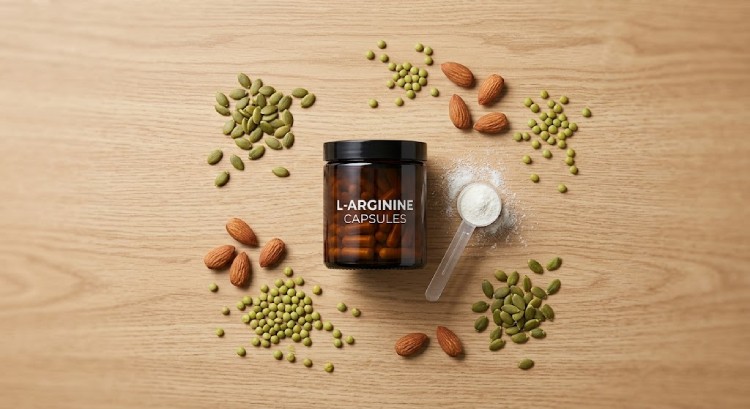
Pumpkin and sesame seeds, peanuts, almonds, soy, chickpeas, lentils, and beans.

A varied protein-containing diet normally provides arginine without a separate powder.
Why there is no single “correct dose”
Trials have used widely different amounts depending on the goal, health status, and duration. This does not create a universal dose “for the heart,” “for vitality,” or “for a pump.” A dose studied in one population is not an automatic recommendation for everyone else.
The NIH reports that amounts up to 9 g per day were generally tolerated in short studies, while larger doses more often caused nausea, diarrhea, other digestive symptoms, and a slight reduction in blood pressure. Long-term safety of high-dose use is less clear.
There is also no universally proven rule that arginine must be taken on an empty stomach exactly 30–90 minutes before exercise. If it is used at all, the goal, product directions, tolerance, and interactions matter more than a ritualized countdown to a workout.
Who should be particularly cautious?
- people with low blood pressure;
- those using blood-pressure medicines, nitrates, or erectile-dysfunction drugs;
- people with kidney or liver disease;
- anyone preparing for surgery, pregnant, or breastfeeding;
- children and adolescents without a specific clinical indication.
After a heart attack, this is not a DIY supplement
In the randomized VINTAGE MI trial, L-arginine did not improve cardiac function after myocardial infarction, and the trial was stopped early because of a potential harm signal. After a recent heart attack, arginine should not be used unless the medical team explicitly recommends it.
Before buying a product, check other supplements and pre-workout blends for duplicate arginine and ingredients that affect blood pressure. A step-by-step review is available in “7 Supplement Mistakes.”
Bottom line
L-arginine performs important functions in the body and remains a useful research subject. For a healthy person, however, it is not an essential supplement or a guaranteed route to a better workout. When the goal involves blood pressure, erectile function, or recovery from illness, understanding the underlying problem, checking medication compatibility, and setting realistic expectations matter more than buying a tub of powder.