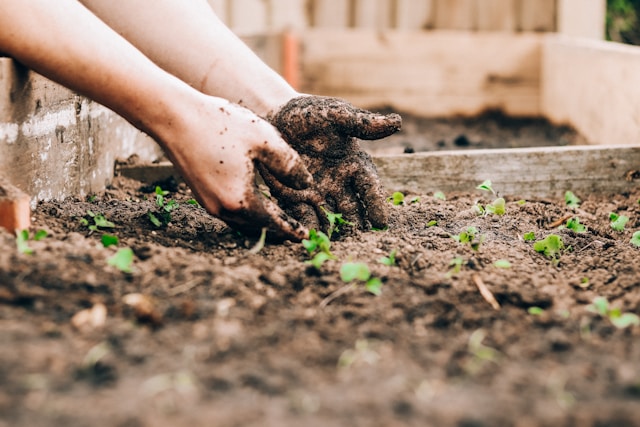
Many home gardeners believe that the main secret to a great harvest is an abundance of fertilizers. In reality, it all starts not with the fertilizers, but with the soil itself. It is its structure, moisture retention, and amount of organic matter that determine how well your plants, trees, and vegetable crops will grow.
Even the best fertilizers will not give the desired result if the soil is depleted, too compacted, or poorly retains moisture. Therefore, proper garden care is a comprehensive approach where soil health, feeding, and regular plant care are equally important.

Why Soil Health is So Important for Your Garden
Soil for plants is not just dirt. Through it, the plant receives:
- water;
- nutrients;
- oxygen for the root system.
If the soil is too hard, the roots develop weakly. If the soil is too sandy, water and fertilizers wash away quickly. And overly clayey soil often retains excess moisture, which can cause the roots to rot.
The best option for most vegetables, fruit trees, and decorative plants is loam — soil that retains moisture well but remains loose and breathable.
Organic Fertilizers and Mulch: The Foundation of Soil Fertility
In modern gardening, more and more attention is paid to organics. Compost, humus, mulch, and plant residues not only feed plants but literally "bring the soil to life." Regular application of organic materials helps to:
- improve soil structure;
- retain moisture longer;
- reduce summer drying;
- stimulate the development of beneficial microorganisms;
- make the soil looser.
This is especially important for a home garden, where crops actively take nutrients from the soil every year.
For mulching, gardeners often use:
- mowed grass;
- straw;
- sawdust;
- shredded leaves;
- compost.
Mulch not only retains moisture but also gradually decomposes, further improving soil fertility.
What is NPK: The Most Important Nutrients for Plants
Most often on fertilizer packages, you can see three letters — NPK. These are the essential elements without which plants cannot develop properly.
Nitrogen (N): Growth of Green Mass and Shoots
Nitrogen is responsible for the active growth of leaves and shoots. It is needed most by plants in spring and early summer. If there is a lack of nitrogen:
- leaves begin to turn yellow;
- the plant grows more slowly;
- shoots become weak.
However, an excess of nitrogen is also dangerous. The plant begins to actively build up green mass, but the yield may decrease. This is especially noticeable on tomatoes, cucumbers, and fruit trees.
Phosphorus (P): Root System Development and Blooming
Phosphorus is very important for the root system. It helps plants take root faster after planting and stimulates blooming. Signs of phosphorus deficiency:
- slow growth;
- darker leaves;
- weak blooming.
Phosphorus is especially important for young fruit trees and seedlings.
Potassium (K): Plant Immunity and Stress Resistance
Potassium is responsible for the overall immunity of plants. It helps crops better endure:
- heat;
- drought;
- temperature fluctuations;
- fungal diseases.
Potassium also affects the taste of fruits and their shelf life.
💡 What the Numbers on Fertilizer Packaging Mean (NPK)
Many people buy fertilizers without even paying attention to the numbers on the packaging. In fact, they are very important. The first number indicates the amount of nitrogen, the second — phosphorus, the third — potassium.
- 10-10-10 — universal complex fertilizer;
- 20-10-10 — high nitrogen content (for building green mass);
- 5-10-5 — milder fertilizer for delicate plants.
Leafy vegetables usually need more nitrogen, while potassium and phosphorus are important for the fruiting of fruit trees and vegetables.
How to Apply Fertilizers Correctly: Why Excess Harms the Harvest
One of the main problems in home gardening is over-fertilizing. Many think that the more feeding, the better the harvest. But it works the other way around. Excess fertilizer can:
- burn roots;
- accumulate salts in the soil;
- impair plant growth;
- make crops more vulnerable to diseases.
That is why it is recommended to conduct a soil test at least occasionally. This allows you to understand which elements are truly lacking, the acidity level of the soil, and the need for organic or mineral fertilizers.

Feeding Calendar: When is the Best Time to Fertilize Plants
The timing of fertilizer application is just as important as the fertilizer itself.
In spring, plants need nitrogen the most, as the active growth of leaves and shoots begins.
In summer, plants spend a lot of energy forming fruits, so potassium and complex feedings become important.
At the end of summer and in autumn, nitrogen fertilizers are used carefully. If the plant begins to grow actively before winter, young shoots can freeze. To prepare the garden for winter, potassium fertilizers, phosphorus feedings, and organics are usually used.
Organic vs. Mineral Fertilizers: Which is Better for Your Garden
There is no single answer here. The best result is usually given by a combination of the two options.
Organic fertilizers: work slower, improve the soil, help retain moisture.
Mineral fertilizers: give a quick effect, allow precise control of nutrition, convenient for quick feeding.
That is why many experienced gardeners use compost or humus as a base, and mineral fertilizers — only as an additional feeding at the right time.
Conclusion: Healthy Soil is the Key to a Bountiful Harvest
Healthy soil is the main secret of strong plants and a good harvest. Fertilizers do help the garden, but only when used correctly and in moderation.
Regular application of organics, proper watering, mulching, and careful observation of plants are much more important than the constant use of large amounts of fertilizers. If you maintain soil fertility and properly feed plants at the right time, your home garden will delight you with healthy crops and a generous harvest every year.
Based on: Washington State University – A Home Gardener's Guide to Soils and Fertilizers