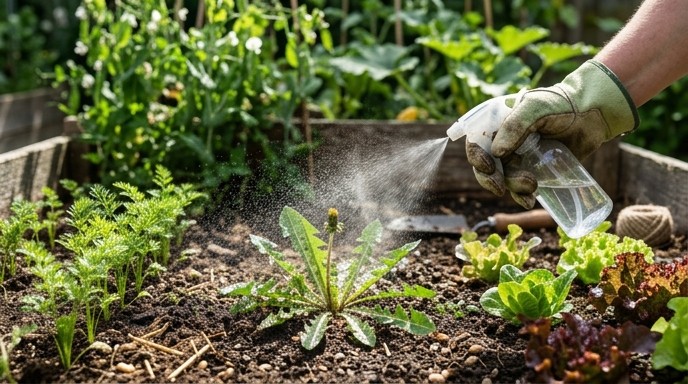
Vinegar is often promoted as a natural weed killer, but its abilities are easy to overstate. Acetic acid damages the leaf tissue it directly contacts, so a young weed may wilt quickly. Fast browning above ground, however, does not prove that the entire plant is dead.
Vinegar acts as a contact treatment rather than a systemic one. It does not travel from the leaf into the root the way some labeled systemic herbicides do. That makes tiny annual seedlings its most plausible target, while dandelions, thistles, bindweed, and other established perennials commonly regrow.
- Action
Injures green tissue through direct contact. - Best target
A very young annual weed with only a few leaves. - Main limitation
Does not guarantee control of a perennial root. - Main risk
Can also injure turf, vegetables, and flowers.
What acetic acid does to a leaf
Acetic acid disrupts cell membranes and dries the treated surface. Tender young foliage can show injury quickly. The effect remains where the spray lands, though: a hidden leaf, underground shoot, or deep root may survive.
Injures the leaves and stems that receive the spray. Acetic-acid herbicides work primarily this way.
Is absorbed and moves within the plant. Household vinegar does not have this behavior.
That is why the same-day appearance can be misleading. If fresh leaves emerge from the crown a week or two later, the foliage was burned back but the root survived.
Household vinegar and acetic-acid herbicide are not the same product
Household vinegar contains a relatively low concentration of acetic acid. It may burn tender foliage on a newly emerged seedling, but large plants and perennial weeds often recover. Performance depends on weed age, coverage, and weather, so a kitchen product should not be presented as a predictable all-purpose herbicide.
Registered acetic-acid herbicides can be much more concentrated. They can burn skin and cause serious eye injury. That is not a reason to dilute industrial or food-grade concentrate at home. A homemade calculation does not replace a tested formulation, pesticide label, and use directions.
Do not judge safety by the word natural
The origin of an active ingredient does not determine its hazard. Concentrated acetic acid is still corrosive, and a labeled product must be used with the protection, application site, and weather restrictions stated by its manufacturer.
When an acetic-acid product may fit
The best-case target is a small annual seedling in a location where an off-target drop cannot land on a desirable plant. Even in that situation, use only a finished product whose label permits the application site.
Young seedlings in paver joints, gravel, or along a path—only when the product label specifically permits that site.
A lawn, vegetable bed, flower border, or area beside a young tree or shrub where droplets can reach foliage or bark.
Dandelions, Canada thistle, quackgrass, bindweed, and other established perennials with underground reserves.
Wind, approaching rain, or any condition prohibited by the label. Fine droplets can readily drift onto nearby plants.
Acid can also damage certain metals, finishes, and masonry. Do not assume that every hardscape joint is automatically a safe application site; read the surface restrictions and protect nearby materials.
Why the vinegar, salt, and soap recipe is a poor choice
Salt remains after the weed is gone
Large amounts of salt can accumulate in soil and interfere with future plant growth. Rain can carry salty water beyond a paver joint or gravel patch and toward turf, tree roots, or a garden bed. Salt does not turn vinegar into a systemic herbicide or guarantee control of a perennial root.
Dish soap does not create a tested herbicide
A surfactant helps liquid spread and remain on waxy foliage. In a registered herbicide, the surfactant type and rate are part of a tested formulation. Household dish detergent contains other ingredients, and an improvised amount can increase injury to desirable plants and runoff.
Lemon juice and essential oils do not fix the main limitation
Another acid or aromatic oil may make a homemade mixture more irritating, but it does not give the spray the ability to move into roots. There is no good reason to recommend those boosters in place of a properly labeled product.
This article leaves out a recipe on purpose
A ratio that burned one young weed is not automatically safe for eyes, skin, turf, soil, or hardscape. If an acetic-acid treatment is appropriate, use a finished registered product rather than recreating one from pantry ingredients.
What works better for different weeds
- Young annual seedlings: hand pulling, shallow hoeing, or a labeled contact product permitted for the surface.
- Weeds in a garden bed: removal before seed set followed by suitable mulch between desired plants.
- Taprooted perennials: a narrow root-removal tool, follow-up inspection, and closing the opening with wanted vegetation.
- Rhizomatous perennials: repeated removal to exhaust new shoots or a herbicide whose label lists the weed and application site.
- Lawn weeds: repair thin turf and, when necessary, use a selective herbicide labeled for the turf species.
See The LINES guide “How to Get Rid of Dandelions in Lawns, Beds, and Pavers” for separate plans for turf, garden beds, and hardscape.
How to choose a product in the United States
- Look for EPA registration. Choose a pesticide product with an EPA registration number rather than an untested pantry recipe.
- Find the application site on the label. Paths, lawns, garden beds, and non-crop areas are not interchangeable uses.
- Check the target weeds. Rapid contact injury does not mean the product controls every perennial species.
- Follow the application directions. Do not increase the concentration, add dish soap or salt, or transfer the product to an unlabeled bottle.
- Observe every safety restriction. The label determines eye and skin protection, wind limits, distance from people and pets, and reentry time.
The bottom line
Acetic acid can quickly injure the foliage of a young weed, but it is not a universally safe substitute for herbicides and does not guarantee root control. Its strongest role is as a finished, labeled contact product for small annual seedlings in an appropriate site. Lawns, garden beds, and perennial weeds usually call for a different strategy.
Sources
- University of Maryland Extension — how acetic acid works, performs, and can cause injury
- Colorado State University Extension — natural contact herbicides in weed management
- US EPA — acetic acid and minimum-risk pesticide eligibility
- US EPA — selecting and using pesticide products according to the label