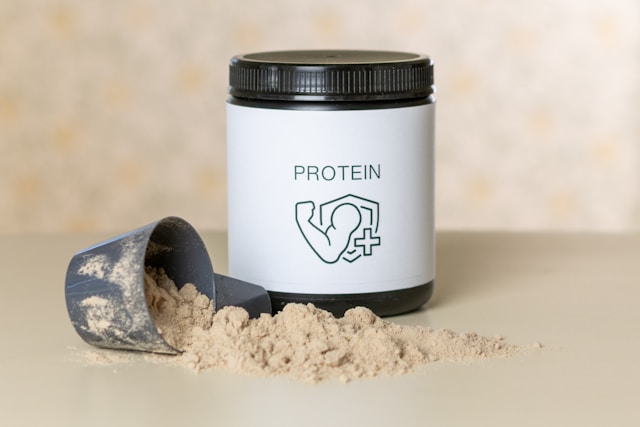
Protein powder does not build muscle on its own, and it is not an essential part of sports nutrition. It is simply a convenient source of protein—much like yoghurt, eggs, fish, or beans, but in a form that is easy to carry and quick to prepare.
A supplement can be useful when getting enough protein from ordinary food is difficult. The best choice, however, is not necessarily the tub with the biggest promise on the front. What matters is the ingredient list, how well you tolerate it, and what you actually need it for.
What protein powder is
Protein powder is concentrated protein made from milk, eggs, soy, peas, rice, or another source. After filtering and drying, manufacturers may add flavourings, sweeteners, thickeners, vitamins, or other ingredients.
“Protein” is not a separate substance invented for sports supplements. The body breaks dietary protein down into amino acids and uses them to maintain muscle, skin, organs, enzymes, and other tissues.
If your diet already provides enough protein, powder has no special advantage over food. Its main benefit is convenience.
Who might find it useful
A protein supplement makes sense when there is a noticeable gap between your needs and your usual diet. For example:
- you cannot have a normal meal after training;
- a busy schedule regularly pushes one meal aside;
- you avoid meat, fish, dairy, or other familiar protein sources;
- a low appetite makes it difficult to get enough protein from food;
- you want to maintain an adequate protein intake while reducing calories;
- a doctor or dietitian has advised you to increase your intake.
Going to the gym is not, by itself, a reason to buy protein powder. If regular meals already cover your needs, another shake may simply add calories.
What protein powder can realistically do
Research suggests that protein supplements can modestly improve gains in muscle mass and strength during regular resistance training. People whose diets were previously short on protein are generally the most likely to benefit.
The important qualifier is that the powder works alongside training. Without an appropriate stimulus, extra protein does not automatically become muscle.
Protein-rich food can also be more filling than the same number of calories from foods dominated by rapidly digested carbohydrate. A protein shake is not a weight-loss treatment, however; the result still depends on the diet as a whole.
Do not expect any protein powder to guarantee a faster metabolism, “stronger immunity,” better skin, or normal blood glucose. Those claims depend on the specific product, the rest of the diet, and a person’s health; they do not describe a universal effect of protein powder.
Whey protein
Whey comes from milk. It contains all essential amino acids and is digested relatively quickly, which is why it has become the most common base for sports protein supplements.
Whey concentrate
Concentrate is usually less expensive and goes through fewer filtration steps. Along with protein, it may retain more lactose, fat, and carbohydrate.
For most people who tolerate dairy, it is a practical everyday option. The exact proportion of protein varies by product, so check the nutrition label rather than relying on the word “concentrate.”
Whey isolate
Isolate is filtered further. It usually supplies a higher proportion of protein and less lactose, fat, and carbohydrate per serving.
It may suit some people with lactose intolerance better, but the word “isolate” does not guarantee that a product is completely lactose-free. Neither concentrate nor isolate is suitable for someone with a milk-protein allergy.
Clear protein is one format of whey isolate. It is not a new category of protein with a different effect, but a lighter, juice-like alternative to a milky shake.
Casein and milk-protein blends
Casein is another protein found in cow’s milk. It tends to produce a thicker drink than whey and is digested more slowly.
People often use it in the evening or when there will be a long gap before the next meal. Studies of pre-sleep casein have found an increase in overnight protein synthesis, although much of this research involved young men who were resistance training.
That does not make casein a compulsory “night protein.” If total protein intake is already adequate, a special serving before bed may add little.
Plant protein
Plant powders are useful for people who avoid dairy or follow a vegan diet.
The idea that plant proteins are completely missing one or more essential amino acids is an oversimplification. Most contain all or nearly all of them, but the proportions and digestibility can differ.
Soy
Soy protein provides all essential amino acids and can support adaptation to training. It is one of the better-studied plant options, although it is unsuitable for anyone with a soy allergy.
Pea
Pea protein contains no dairy ingredients and usually mixes reasonably well. It supplies plenty of lysine but relatively little methionine, so manufacturers often combine it with rice protein.
Rice and plant blends
Rice protein can have a slightly grainy texture. In blends, it is often paired with pea protein to produce a more balanced amino-acid profile.
A longer list of plant sources does not automatically make a powder better. The amount of protein per serving and how well you tolerate the finished product matter more.
Egg-white protein
Egg-white powder contains all essential amino acids and no lactose. It can be an alternative to dairy protein for people who tolerate eggs.
Check the sodium content, flavour, and allergen information. It is not suitable for someone with an egg allergy.
Why collagen is not a substitute for regular protein powder
Collagen peptides are often sold alongside protein powders, but they are not an equivalent replacement for whey, soy, or a balanced plant blend.
Collagen is low in several essential amino acids and does not provide enough leucine to stimulate muscle-protein synthesis as strongly as a complete protein. In studies comparing equal amounts after exercise, whey produced a stronger muscle-protein response than collagen.
Collagen may be used separately for a specific purpose, but it should not be counted as the main protein source for building or maintaining muscle.
Spirulina is not a practical substitute either: a typical serving is too small to provide an amount of protein comparable with an ordinary protein powder.
Quick chooser
What matters most to you?
Choose one priority. This is not a brand ranking—it is a quick way to narrow the field to a suitable protein type.
Start with whey concentrate
- Why
- It is usually the least expensive complete dairy protein.
- Trade-off
- It may contain more lactose, fat, and carbohydrate than isolate.
- Check
- Protein per serving and whether you tolerate dairy comfortably.
Consider whey isolate
- Why
- Extra filtration usually leaves less lactose in each serving.
- Trade-off
- It often costs more and is still a milk-derived product.
- Check
- Lactose and allergen information: isolate is not suitable for a milk-protein allergy.
Try soy or a pea-and-rice blend
- Why
- These are practical dairy-free sources with amino-acid profiles suitable for everyday use.
- Trade-off
- Taste, solubility, and protein concentration vary considerably between products.
- Check
- Protein per serving, allergens, and whether the blend contains unnecessary added sugar.
Try casein
- Why
- It produces a thicker shake and is digested more slowly than whey.
- Trade-off
- The texture is not for everyone, and it is not a compulsory bedtime protein.
- Check
- Dairy tolerance and your total protein intake across the day.
Consider clear whey isolate
- Why
- Once mixed, it resembles a fruit drink more than a milky shake.
- Trade-off
- It often costs more and may use strong flavourings or sweeteners.
- Check
- Protein, lactose, allergens, and the true serving size on the label.
How much protein do you need each day?
Start by estimating the protein in your whole diet. Only then can you decide whether powder is useful.
The European population reference intake for healthy adults is about 0.83 g of protein per kilogram of body weight per day. For a person weighing 70 kg, that is roughly 58 g. It is a population reference value, not a universal optimum for every situation.
People who train regularly often need more. Sports-nutrition literature commonly gives a range of about 1.4–2 g per kilogram per day for most physically active adults. Not every recreational gym-goer needs the top of that range.
In a large analysis of resistance-training studies, the average benefit for gains in fat-free mass levelled off at a total intake of about 1.6 g per kilogram per day. That is a group-level research estimate, not a personal prescription.
Individual needs can vary with age, body size, activity, calorie intake, and health.
How to work out a serving
Count grams of protein, not grams of powder.
Example: if one serving contains 30 g of powder but the label lists 23 g of protein, one scoop provides 23 g of protein—not 30 g.
Next, estimate how much protein your normal meals already provide. If your approximate target is 100 g and food supplies about 80 g, the supplement only needs to cover a gap of roughly 20 g. A second or third serving would not be necessary in that situation.
Sports-nutrition guidance often cites about 0.25 g of high-quality protein per kilogram of body weight at one sitting, or roughly 20–40 g. Remember that this includes all the protein in the meal, not just the powder.
When is the best time to take it?
There is no rigid 30-minute “anabolic window” after training. Over the long term, total daily protein and consistent resistance training matter more.
A post-workout shake is convenient if your next normal meal is a long way off. If you trained after a substantial breakfast or expect lunch within the next few hours, there is no need to race for the shaker. The same principle applies before exercise; our guide to what to eat before a workout explains how timing and training type change the choice.
You can add protein:
- to a breakfast that is usually low in protein;
- after training;
- between meals;
- to oats, yoghurt, or a homemade smoothie;
- whenever it fits your routine most comfortably.
Who needs to be particularly careful?
People with chronic kidney disease need an individual protein plan. Depending on the stage of disease and treatment, protein may need to be reduced or increased, so general sports calculations are not appropriate.
It is also sensible to seek professional advice if you have:
- an allergy to milk, eggs, or soy;
- liver or kidney disease;
- digestive symptoms that worsen after protein-rich products;
- a therapeutic diet prescribed by a clinician.
Bloating after a shake does not necessarily mean that your body “cannot absorb protein.” Lactose, a large serving, sugar alcohols, thickeners, or other ingredients may be responsible.
The bottom line
Protein powder is best viewed as a convenient food product, not a compulsory piece of gym equipment. It can help fill a genuine protein gap, but it cannot correct an unbalanced diet or replace resistance training.
Before buying a large tub, estimate how much protein your food already provides, identify the actual shortfall, and read the label carefully. In many cases, that is enough to distinguish a useful supplement from an unnecessary purchase.
Sources
- EFSA. Dietary Reference Values for nutrients: Summary report
- Morton RW et al. Protein supplementation and resistance training: systematic review and meta-analysis
- Jäger R et al. International Society of Sports Nutrition Position Stand: Protein and Exercise
- NIDDK. Healthy Eating for Adults with Chronic Kidney Disease
- Reis CEG et al. Effects of pre-sleep protein consumption on muscle-related outcomes
- Trommelen J et al. Whey and collagen protein during recovery from exercise